
Pilot Eligibility in India: Age, Education, Medical
Parth
November 18, 2026
•10 min read
Many young people are enthusiastic about flying, traveling, and exploring the world and wish to take up flying as a career. But being a flyer is not just about flying an aircraft; there is a lot more to it.
While aviation is a passion for many, and interest alone will not suffice for a successful career in aviation. Aspirants have to fulfill specific age, education and medical requirements before they can obtain a commercial pilot’s license in India.
The Directorate General of Civil Aviation (DGCA) is the licensing and oversight body for civil aviation in India and oversees civil aviation training in India. Understanding the licensing process and the various requirements is essential for anyone considering flying as a profession.
This article will discuss the criteria for eligibility for a commercial pilot’s license in detail, including age, education and medical requirements.
What is the minimum age required to become a pilot in India?
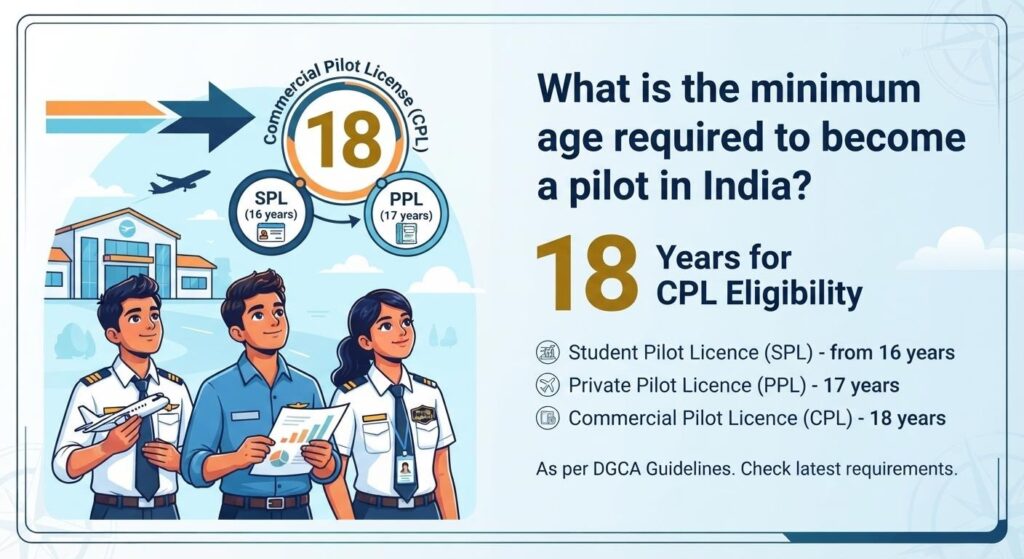
The minimum age requirement for the Commercial Pilot License (CPL) in India is 18 years.
Prior to turning 18, students can prepare for their aviation career by undergoing basic pilot training and preparing to acquire the various licences along the way, before they finally become eligible for the commercial pilot licence.
The age limits for various pilot licences are:
- Student Pilot Licence (SPL) – from 16 years
- Private Pilot Licence (PPL) – 17 years
- Commercial Pilot Licence (CPL) – 18 years
Meeting the minimum age is only the start; here is the best age to start pilot training in practice.
There are different requirements for obtaining a Commercial Pilot Licence and the requirements set by airlines for employment. Airline employment requirements vary based on the particular role, recruitment program, and the operating conditions of the airline.
Thus, it is advisable for students to review requirements set by the DGCA and individual airlines before choosing a training pathway.
Educational Qualifications for Pilot Training
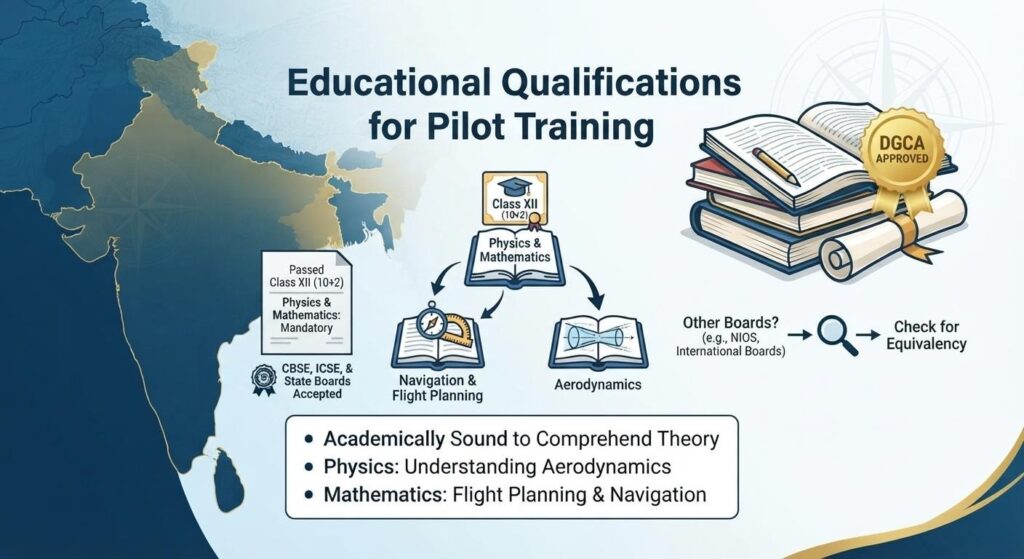
Education is one of the most vital components in meeting the eligibility requirements for commercial pilot training in India. The student needs to be academically sound to comprehend and study concepts of Aviation Theory, Navigation, Meteorology, and other related subjects on systems of the aircraft.
As of the current DGCA regulations, a candidate seeking to acquire CPL must have passed Class XII (10+2) with Physics and Mathematics from a board/university recognized by the government of India, or an equivalent level of education.
Is it necessary to have Physics and Mathematics?
Yes, for commercial pilot licensing, it is required to have studied Physics and Mathematics.
The branch of Mathematics studied by the student helps them with flight planning, navigation and various other calculations. Knowledge of Physics helps a student understand the motion of the aircraft and aerodynamics.
Students with a Commerce or Arts background who did not study Physics and Mathematics may have to complete these subjects through a recognized and accepted educational pathway to become eligible for a commercial pilot license. Alternative routes exist, so it is worth checking your options before ruling yourself out.
Can students from different Educational boards apply?
Yes. Students from other recognized boards of education in India can also apply for pilot training.
Students who have completed their studies through CBSE, ICSE, and other recognised state boards are eligible to apply, subject to fulfilment of other conditions.
Students with international qualifications need to check with the concerned aviation authorities to ascertain if their qualifications are equivalent to the Indian Class 12 qualification.
In the best interest of the candidates, it is recommended to ascertain educational eligibility for the flying training course from the DGCA before enrolling with a flying training organisation to avoid any delays in the CPL exam process.
Medical Requirements for Commercial Pilots
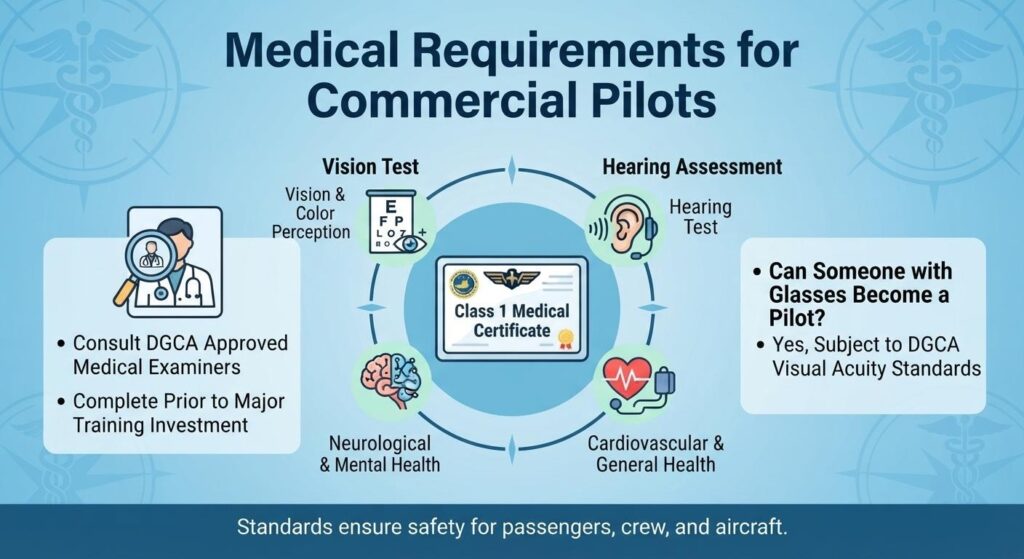
In India, in the aviation sector, medical fitness of a pilot is of prime importance. The reason for this is that safety of the passenger and crew members is the prime responsibility of the pilot. Therefore, the medical standards prescribed by the DGCA need to be fulfilled.
While pursuing a career as a commercial pilot, one has to obtain the DGCA approved Class 1 Medical to obtain a Commercial Pilot Licence (CPL).
Class 1 Medical assessment is primarily to evaluate if the applicant is physically and mentally fit to perform the duties of a pilot and is not likely to endanger the safety of the passengers, crew members and the aircraft.
What does Class 1 Medical Assessment Include?
The Class 1 Medical assessment may include any of the following examinations:
- Vision Test: Tests your ability to see distinct lines on a chart.
- Colour Vision Test: Tests your ability to distinguish colors correctly. This is important to see signals and instrument lights in the cockpit.
- Hearing Assessment: Tests ability to hear and communicate.
- Cardiovascular Examination: Test to see if there are any issues with the heart and associated conditions.
- General Physical Examination: Checks your general physical conditioning and health.
- Neurological Assessment: Tests your ability to conduct safe flight operations. This may uncover conditions that could affect operations.
Depending on a candidate’s medical history and/or exam, more tests may be required.
Can Someone with Glasses Become a Pilot?
Yes. Wearing glasses does not eliminate the possibility of a career in commercial aviation.
There are medical standards set by the DGCA that include lower limits for visual acuity. If a candidate meets the lower limits, then he/she may be eligible.
There are certain medical eye conditions and color deficiencies that may also affect eligibility, and it helps to know the wider medical conditions that can affect pilot eligibility. The best course of action for the applicant is to seek an aviation medical evaluation.
When Should You Complete Your Medical Examination?
It makes sense to do the initial medical assessment prior to making a major financial commitment to flight training.
There are additional reasons to confirm medical eligibility early on because it is not advisable to make a major financial commitment to a flying training programme without first confirming one’s medical eligibility. This can lead to complications at a later date.
Candidates are required to consult DGCA approved medical examiners and undergo the prescribed assessments.
English Language and Communication Skills
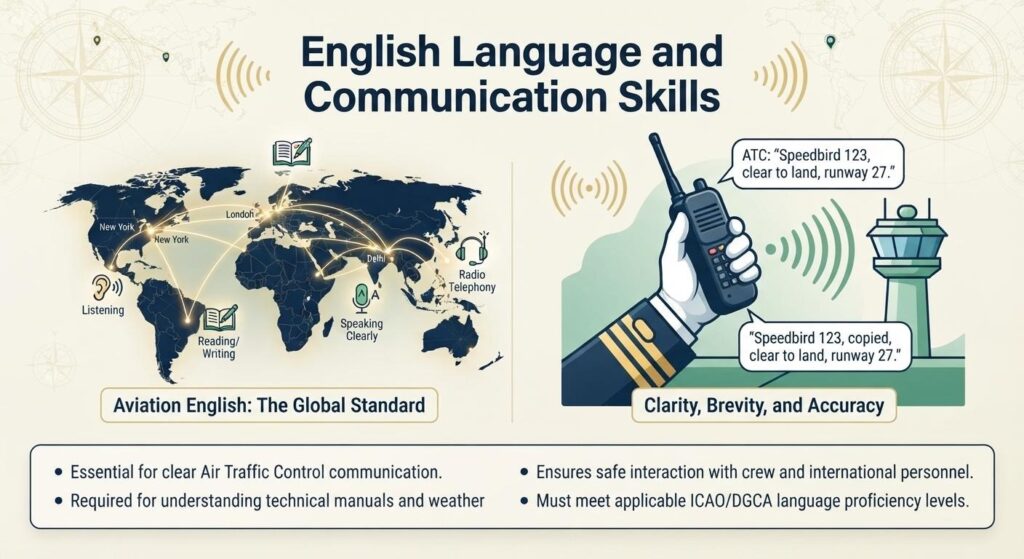
The ability to communicate effectively in English is essential for all pilots. This is because English is the prevalent language used in aviation communication. So, pilots need to be able to communicate clearly with air traffic controllers, other crew members, and other aviation personnel.
While meeting the abovementioned academic requirements is a prerequisite, it is important that candidates have good oral and written communication skills in English. Pilots also have to be able to read, interpret, and extract information from technical manuals, documents, flight papers and weather reports; and be able to communicate clearly and accurately with other personnel.
Improving listening, reading, writing and speaking skills in English before starting flight training can facilitate the training process.
Candidates must meet the applicable level of aviation English language proficiency when exercising the privileges of their licence.
Other Requirements for Obtaining a CPL in India
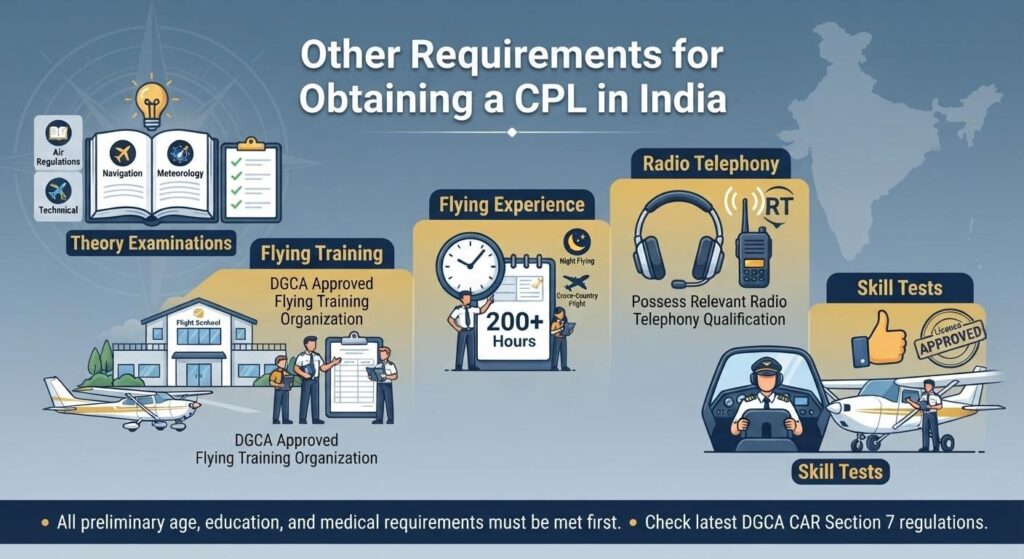
Age, educational, and medical requirements are only some of the preliminary requirements to obtain a CPL. For the complete CPL requirements, see our detailed guide.
These typically include:
- Theory Examinations: Candidates are required to clear the prescribed theory examinations on Air Regulations, Air Navigation, Aviation Meteorology and Technical General.
- Flying Training: Practical training is to be done at a DGCA approved Flying Training Organization.
- Flying Experience: A candidate is required to fulfill the prescribed flying experience.
- Radio Telephony: A candidate is required to possess a relevant Radio Telephony qualification and fulfill the communication requirements.
- Skill Tests: Candidates need to successfully fulfill the flying skills tests conducted by an authorized examiner.
Tips for Students Planning to Become Pilots
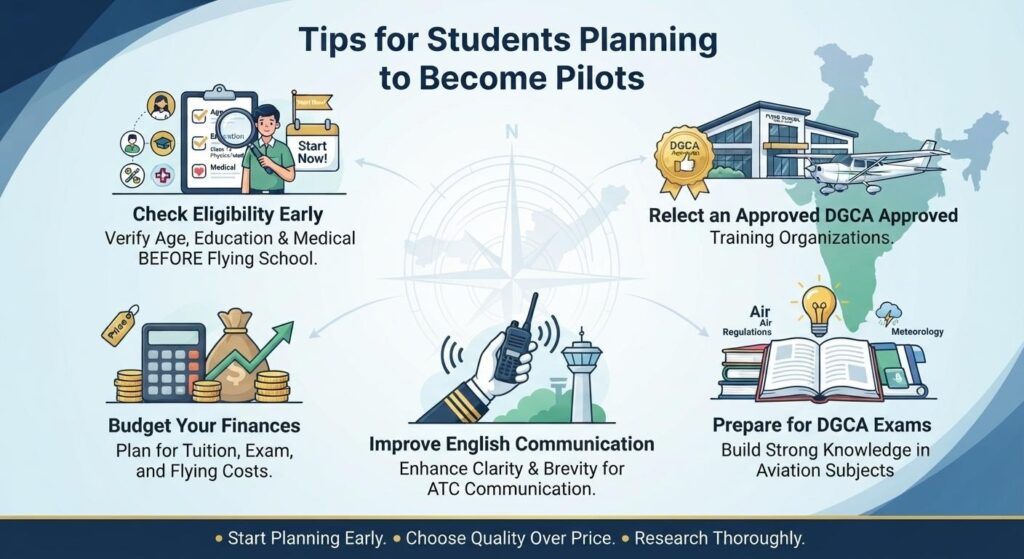
If a student wishes to pursue a career as a commercial pilot, he/she must start planning from an early stage, as it takes a considerable amount of time and efforts to obtain the training, and there are limited pilot training facilities in India.
Some tips for aspiring pilots are:
- Check Eligibility Early: All prospective candidates are suggested to check their age and educational qualification and medical fitness, prior to seeking admission to a flying school.
- Select an Approved Flying School: Information on DGCA approved flying training organizations should be collected, and their training facilities, fleet of aircraft, flight instructors and course structures should be compared. This guide on how to choose the right FTO can help.
- Prepare for DGCA Exams: Aspiring pilots should have a good knowledge of subjects covered in the DGCA examinations and develop the study habit.
- Improve English Communication: In view of the communication being an important aspect of flying, skills in English language should be improved.
- Budget Your Finances: There are many costs associated with training to become a commercial pilot, including tuition, exam fees, flying costs and others. Make sure you research all costs, starting with pilot course fees and duration, and budget accordingly before committing to training.
Avoid choosing a flying school solely based on the best deals. Check their training standards and student support in addition to their approvals.
Conclusion
Age, Education and Medical requirements for Pilots in India: To be a commercial pilot in India, one needs to be a minimum of 18 years to be eligible for a CPL. One also needs to have passed Class 12 with Physics and Mathematics. One also needs to have their medical fitness certificate.
However, just meeting the basic requirements won’t help. One needs to pass DGCA exams, do an approved flying training, gain the required flying experience and pass skill tests.
An approved flying training organisation can guide and train students to be commercial pilots. They can help students take their first step towards a career in the commercial aviation industry.
Note: Bharatiya Vayuyan Niyam, 2026, is set to replace the Aircraft Rules, 1937, from 1st January 2027. Students should check the latest DGCA requirements before applying as licensing regulations may change.