
How Commerce Students Can Become Pilots in India (Without Physics)
pgvisav@gmail.com
December 27, 2025
•11 min read
A common myth circulates in Indian households: “If you want to be a pilot, you must take Science in 12th grade.”
We are here to tell you that they are wrong. A commerce student can become a pilot in India.
Historically, the profession of a Commercial Pilot was viewed through a exclusionary lens. It was perceived as the exclusive domain of “Science Stream” students, especially those who had mastered the rigors of Physics, Chemistry, and Mathematics in their higher secondary education.
However, the actual guidelines from Directorate General of Civil Aviation (DGCA) does not match what many people assume. The academic pathways to the cockpit are far more flexible than many Indian parent or career counselor realises.
In this guide, we will explain how a Commerce student can become a pilot in India. We will also show how Vision Flying Training Institute (VFTI), the best flying institute in India, helps you prepare for your DGCA exams and earn your Commercial Pilot License (CPL).
Regulatory Framework of the Directorate General of Civil Aviation for the Commercial Pilot Licence in India
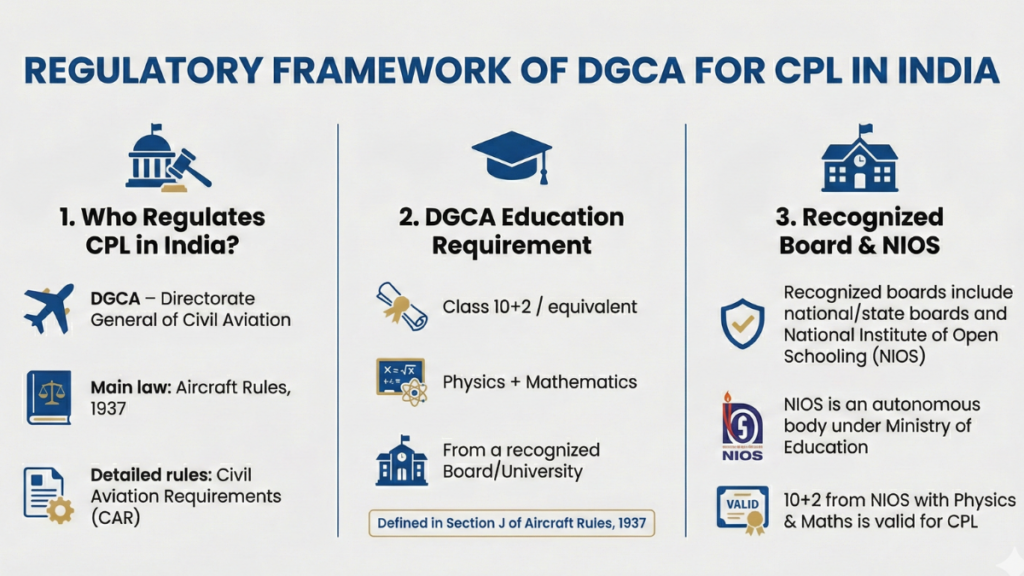
Before understanding how a Commerce student can become a pilot, one must first go through the legal texts that govern Indian civil aviation. The main governing document is the Aircraft Rules, 1937. This is supported by the Civil Aviation Requirements (CAR).
The Specificity of Educational Requirements:
recognisedThe requirements for the issuance of a Commercial Pilot License (CPL) are detailed in Section J of the Aircraft Rules, 1937. An applicant must have passed Class 10+2 or an equivalent examination with Physics and Mathematics, from a recognized Board/University.
The Legitimacy of National Institute of Open Schooling (NIOS):
The second critical component is the term “recognised Board.” The National Institute of Open Schooling (NIOS) is an autonomous institution under the Ministry of Education, Government of India. It was established precisely to provide flexibility in education.
Table 1: Comparative Validity of Boards for DGCA Licensing
| Feature | CBSE / ICSE / State Boards | National Institute of Open Schooling (NIOS) |
| Legal Status | Recognized by Ministry of Education | Recognized by Ministry of Education |
| DGCA Acceptance | Fully Accepted | Fully Accepted |
| Subject Flexibility | Rigid Streams (Science/Commerce/Arts) | Pick Individual Subjects |
| Exam Schedule | Fixed (March/April) | On-Demand (Year-round) |
| Primary Use Case | Foundational Education | Bridging & Up-skilling |
The marks sheet from NIOS containing Physics and Mathematics is not distinguishable in law from the marks sheet of CBSE for the issuance of a pilot license. It is a designed feature of the Indian educational framework to allow career shifts without repeating entire academic years.
DGCA Eligibility Requirements to Become a Pilot in India
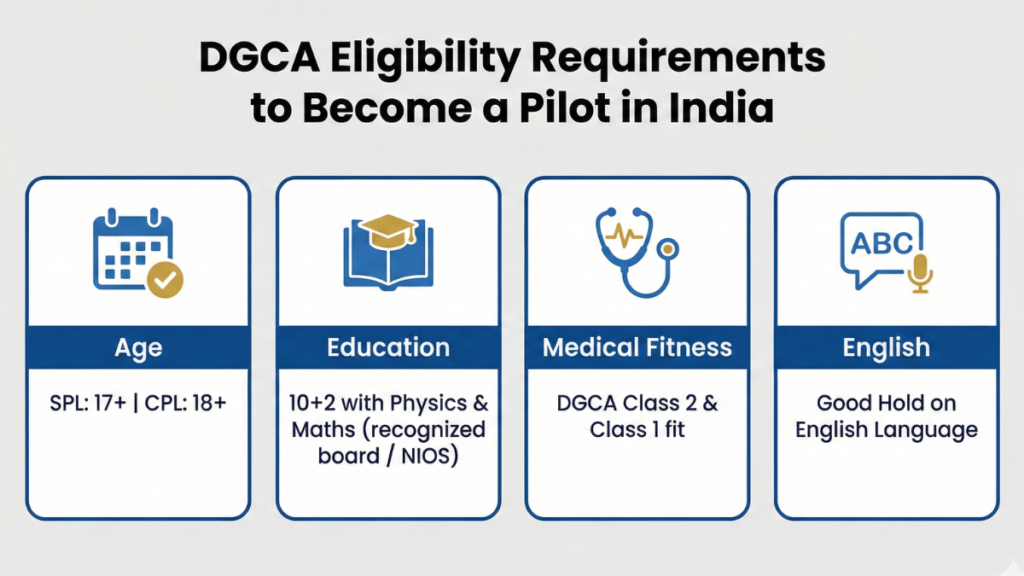
You need to fulfill some requirements specified by the DGCA in order to become a Commercial Pilot in India.
The eligibility criteria for a Commercial Pilot License (CPL) are:
Age: Must be at least 17 years old to start flight training for a Student Pilot License (SPL), and 18 years old to get a CPL issued.
Educational Qualification: Need to have 10+2 (Class XII) with Physics and Mathematics, or an equivalent qualification recognized by any board.
This is the key requirement where commerce students need to pay attention. If you have completed 12th in commerce (or arts) without Physics/Math, you can still fulfill this requirement by passing those subjects through an approved board like NIOS or a state open school.
Medical Fitness: Must be declared fit by DGCA-approved doctors (Class 2 and Class 1 Medicals).
English Proficiency: Since all pilot training exams, cockpit communications, and Air Traffic Control instructions are in English, you need a good command of English.
The eligibility criteria for a Private Pilot License (PPL), which is a license for personal/recreational flying are different and actually less strict on the academic side. In fact, to do a PPL in India you only need to be 10th pass (Class X) and 17 years old, with a DGCA Class 2 medical.
This means a PPL could be pursued even without Physics/Math at 12th. However, a PPL only allows you to fly private aircraft for non-commercial purposes. You cannot get a paid flying job with just a PPL. So, if your goal is an airline or commercial flying career, you will eventually need to meet the CPL requirements.
Step-by-Step Path for a Commerce Student to Become a Pilot
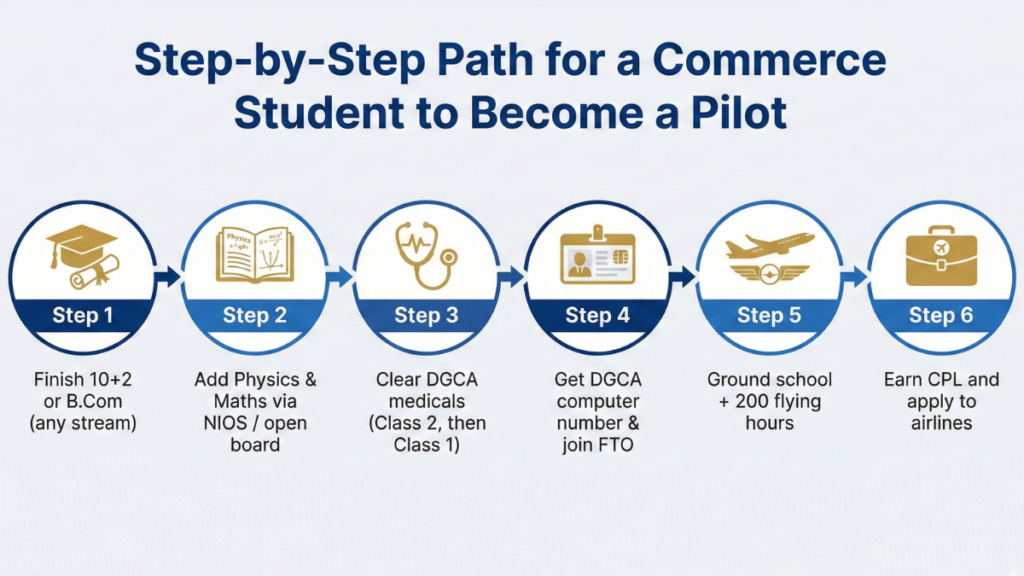
Now let’s put it all together. Here is a step-by-step roadmap for a commerce student (12th pass or even a graduate) to become a licensed pilot:
Step 1: Finish High School in any stream. Whether you have just cleared your 12th in Commerce or already have a B.Com degree, you are eligible. The DGCA simply requires a 10+2 passing certificate to get the ball rolling.
Step 2: Bridge the Gap with NIOS. Since you did not take Physics and Math, you will sit for these two subjects via the National Institute of Open Schooling (NIOS). It’s a recognized, flexible way to meet DGCA requirements without repeating high school.
Step 3: Clear Your Medicals Early. Before investing in training, be sure you are fit to fly. Start with a Class 2 Medical (initial checkup), followed by a Class 1 Medical. At Vision Flying Training Institute (VFTI), we always suggest doing this early so you can fly with peace of mind.
Step 4: Secure Your Computer Number & Join an Flying Training Organization (FTO). Your “Computer Number” is your official DGCA ID. Once you have that and your medicals, you can enroll in a Flying Training Organization (FTO). We help you navigate the paperwork so you can focus on the flying training course.
Step 5: Master the Ground School & Flight Hours. You will balance theory (Navigation, Meteorology, and Regulations) with 200 hours of actual flying. Do not worry about the “Science” aspect, our instructors at VFTI translate complex concepts into practical pilot knowledge.
Step 6: Earn Your CPL and Take Off. Once you pass your DGCA exams and complete your flying hours, you will receive your Commercial Pilot License (CPL).
From here, you are ready to apply to major airlines or charter companies and start your career.
Vision Flying Training Institute (VFTI) is an “infrastructure-first” institute. We have helped many commerce students rewrite their journey from balancing ledgers to flying aircraft thousands of feet above the ground. When you have the passion, the discipline, and the dream to wear the white uniform, your school stream will never hold you back.
The Cost of Becoming a Pilot in India
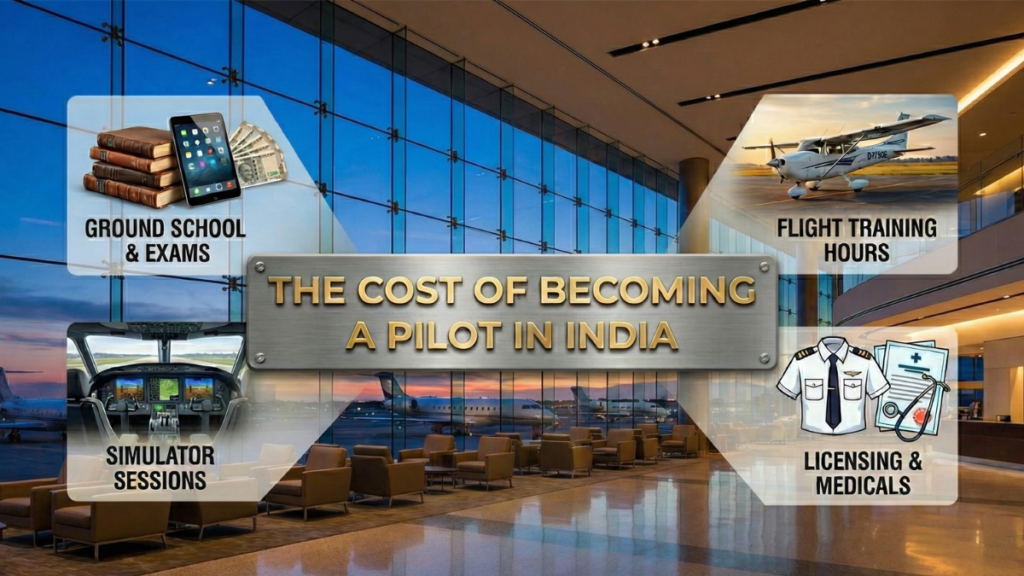
Pilot training is an investment. While the cost is significant, the starting pilot salary for a First Officer in Indian airlines (like Indigo, Air India, or SpiceJet) ranges from ₹2 Lakhs to ₹5 Lakhs per month, making it one of the most financially rewarding careers in the country.
The following table provides a comprehensive breakdown of the various cost components.
Table 2: The “Commerce-to-Pilot” Cost Structure
| Cost Component | Approximate Cost (INR) |
| NIOS Registration & Exams | ₹5,000 – ₹15,000 |
| DGCA Class 2 Medical | ₹5,000 – ₹8,000 |
| DGCA Computer Number & Exams | ₹15,000 – ₹20,000 |
| CPL Ground School (VFTI) | ₹1,50,000 – ₹2,50,000 |
| Flying Training (200 Hrs at VFTI) | ₹35,00,000 – ₹45,00,000 |
| Accommodation & Living (Amreli) | ₹2,00,000 – ₹3,00,000 |
| DGCA Class 1 Medical | ₹5,000 – ₹10,000 |
| TOTAL ESTIMATED COST | ₹40 Lakh – ₹55 Lakh |
What Makes Vision Flying Training Institute the Best for Pilot Training?
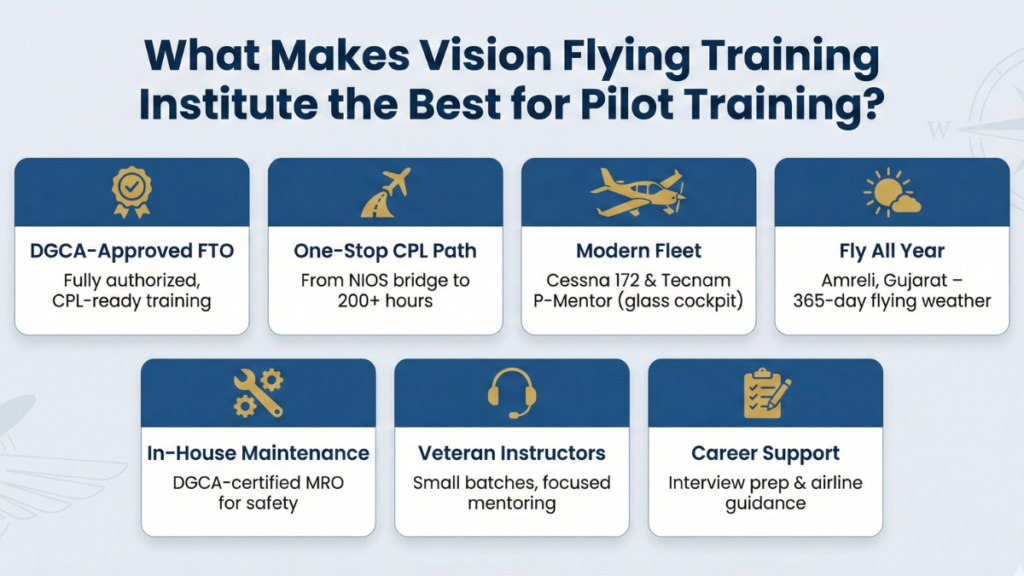
Your choice of training institute for becoming a pilot is important, as it will shape your learning experience and career opportunities.
The best option for aspiring pilots, especially those from commerce or non-science backgrounds is Vision Flying Training Institute (VFTI) . Here’s why:
- DGCA-Approved and Highly Rated: We are a fully authorized Flying Training Organization (FTO). Every hour you log and every exam you pass here is 100% recognized by the DGCA and international airlines.
- A “One-Stop” CPL Program We handle everything, from helping you clear NIOS for Physics and Math to finishing your 200 flying hours. You focus on the sky; we handle the paperwork.
- Modern Fleet & Glass Cockpits Forget outdated planes. You will train on the Cessna 172 Skyhawk and the next-gen Tecnam P-Mentor, featuring the same “Glass Cockpit” technology used in modern Airbus and Boeing jets.
- Fly 365 Days a Year Based in Amreli, Gujarat, we enjoy near-perfect flying weather year-round. While other schools are grounded by monsoons or winter fog, our students finish their 200 hours months ahead of schedule.
- Safety First (In-House Maintenance) We don’t outsource our safety. VFTI has its own DGCA-certified maintenance facility (MRO) on-site, ensuring every aircraft is in peak condition before you ever turn the key.
- Industry-Veteran Mentors Our instructors are not just teachers; they are seasoned captains. We maintain small batch sizes to make sure Commerce students get the personalized attention needed to master technical aviation subjects.
- Placement & Career Support Our job is not done when you get your license. We provide interview prep, airline entrance coaching, and career counseling to help you transition from our tarmac to an airline cockpit.
The transition from a Commerce background to a professional pilot is a path well-traveled at VFTI. We have the tools, the weather, and the expertise to help you earn your wings efficiently and safely.
Frequently Asked Questions
Q1. Can I become a pilot after BCom without having Physics in 12th?
Yes, but you must first clear Physics and Mathematics from NIOS or another recognized open board. Once you have these subject certifications, your BCom degree combined with 10+2 (now including Physics and Maths) meets all DGCA requirements.
Q2. Is the NIOS marksheet valid for airline jobs?
Yes. All major airlines, including Indigo, Air India, and Vistara, recognize NIOS marksheets as long as they are verified and meet the DGCA requirements.
Q3. How long does it take for a Commerce student to become a pilot?
The timeline is roughly 18 to 24 months. This includes 4-6 months for ground school and exams, and 12-14 months for flying training (CPL).
Q4. Can I fly if I wear glasses?
Yes. As long as your vision is corrected to 6/6 with glasses and you have no underlying ocular diseases, you can pass the Class 1 Medical.
Q5. Is the DGCA exam difficult for Commerce students?
It requires hard work, but it is not impossible. With the right coaching at VFTI, the “Maths and Physics” involved are purely functional. You won’t be doing theoretical calculus; you will be calculating fuel burn, wind correction angles, and pressure altitudes.
Conclusion
The physics can be learned. The passion must be innate.
Being a Commerce student is not a barrier; it is simply a different starting point. The sky does not ask what subjects you took in 12th grade, it only cares about your ability to handle an aircraft and your dedication to safety.
Visit VFTI to learn more about their CPL training programs, or check the NIOS website for registration windows. Connect with VFTI’s admission counselors to understand how they can guide you through this journey.
Don’t let another year fly by. Contact us today for a free counselling session.