
![Pilot Course Fees & Duration in India [2027 Guide]](https://blog.vfti.co.in/wp-content/uploads/2026/02/c3-scaled.png)
Pilot Course Fees & Duration in India [2027 Guide]
pgvisav@gmail.com
February 16, 2026
•16 min read
There’s so much data online about pilot course fees, and incorrect information may mislead people from pursuing their ambition, assuming it’s out of budget. When any student searches for “pilot course fees & duration”, many websites just throw random numbers.
While in actual some Indian students spend around ₹ 70–₹ 80 lakh, while others spend about ₹ 35–₹ 45 lakh for DGCA CPL training in India.
The difference depends on the flying institute, per-hour flying rates, training speed, aircraft availability, and how fast you clear DGCA exams.
This guide breaks down pilot training costs in and outside India to help you budget smart and choose the top flying institute, like Vision Flying Training Institute, a school that gets you flying rather than making you scared of the fees.
What does a “pilot course” usually mean in India
There are mainly two types of pilot licenses: a private pilot license and a commercial pilot license.
In India, when people refer to a “pilot course,” they usually mean the Commercial Pilot Licence (CPL). This licence is essential for securing airline jobs, including for students searching “How to Become a Commercial Female Pilot After 12th.”
Checkout our guide on how to apply for pilot training in India which walks you through the process before you dive into the numbers.
However, CPL is not a single fee or a fixed timeline. It involves multiple steps:
- DGCA eligibility and medical exams
- DGCA ground school and exams
- Flying training, which must meet the minimum hours set by DGCA
- Skill Tests and Licence paperwork
- Multi-Engine and Instrument Rating, often included in “airline-ready” training
- Type Rating for aircraft like the Airbus A320 or Boeing 737
Pilot Course Duration in India
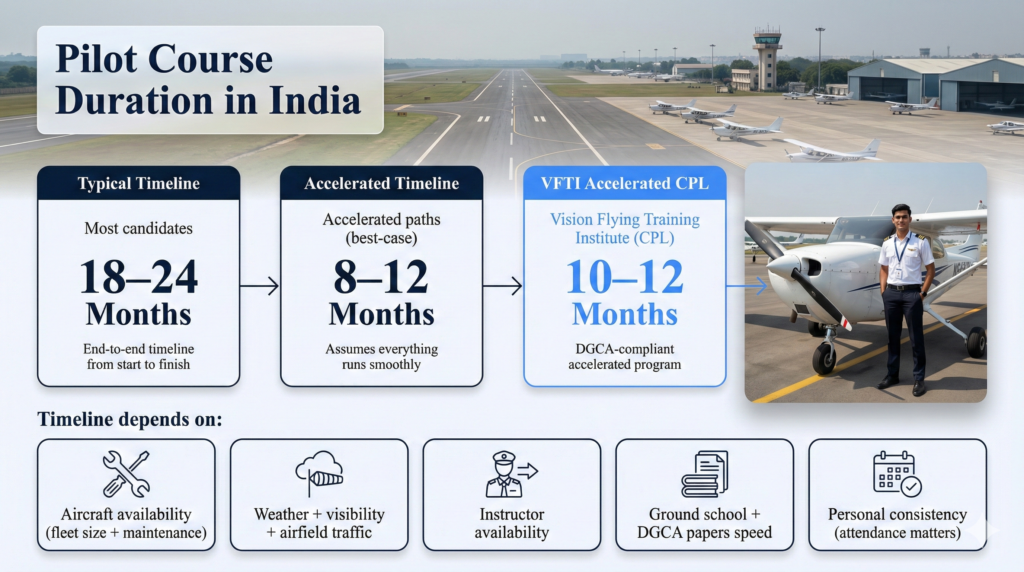
Many flight institutes mention a single fixed duration, but in reality, timelines often vary.
Your timeline depends on:
- Aircraft availability, including fleet size and maintenance schedule
- Weather days, visibility, and airfield traffic
- Instructor availability
- How quickly you finish Ground school and complete DGCA papers, as many delays begin here
- Your personal consistency, since your attendance matters more than motivational quotes
Most candidates take about 18 to 24 months from start to finish. Some accelerated paths advertise 8 to 12 months, but that usually assumes everything goes smoothly.
Vision Flying Training Institute’s Commercial Pilot License (CPL) program is designed to offer high-quality, DGCA-compliant pilot training within a 10 to 12-month accelerated timeline.
A Realistic Pilot Training Duration & Timeline for Becoming a Pilot
This structure matches how pilot training is typically organised across India.
| Phase | Pilot Training Process | Typical Duration |
| Step 1 | Medical + DGCA computer number + onboarding | 2-6 weeks |
| Step 2 | Ground school + DGCA exam prep | 3-6 months |
| Step 3 | Flight training hours building | 8-18 months |
| Step 4 | Skill test + licence processing | 4-10 weeks |
| Step 5 (Optional) | Type rating + airline readiness | 1-3 months |
Pilot Course Duration by Path in India
| Path | What You Get | Typical Duration |
| Traditional CPL route | DGCA CPL (plus your chosen add-ons) | 10 to 12 months (common planning range) |
| CPL + Type Rating later | CPL first, then type rating when ready | 15 to 30 months, depending on the gap |
| Cadet Pilot Program | Structured airline training and type rating | Often ~18 to 24 months (varies by program) |
Pilot course duration without Physics and Mathematics
DGCA’s published rules still require Physics and Mathematics (10+2) for a Commercial Pilot Licence (CPL) and for a Student Pilot Licence (SPL). You usually cannot start flight training in India until you complete these subjects.
Commerce students can become pilots in India only after passing these subjects.
Therefore, the pilot course duration without Physics and Mathematics effectively becomes: the time to add Physics or Mathematics plus the usual CPL duration.
You can fill this eligibility gap through NIOS (National Institute of Open Schooling):
NIOS Public Exams take place twice a year: April-May and October-November.
NIOS On-Demand Examination System (ODES/ODE) allows learners to take exams based on their readiness, not just fixed annual dates. Results are usually published in the last week of each month for exams conducted in the previous month.
How soon you complete pilot training depends on how fast you become eligible and then complete the 10–12 month CPL program.
What Factors Decide the Total Pilot Training Fees?
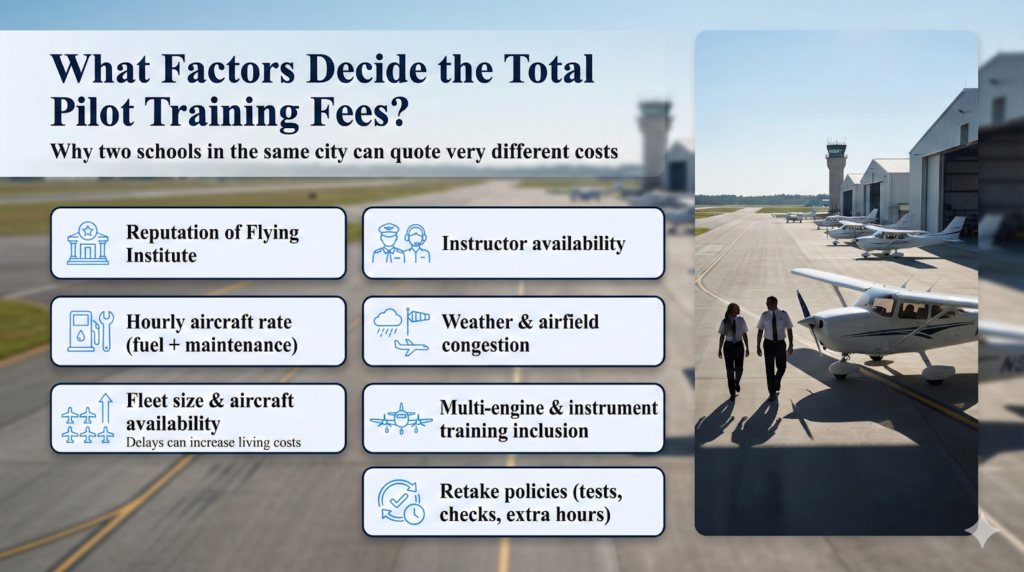
Even in the same city, two schools can report very different numbers due to:
- Reputation of Flying Institute
- Hourly aircraft rate and fuel/maintenance costs
- Fleet size and aircraft availability (delays lead to higher living costs)
- Instructor availability
- Weather and airfield congestion
- Inclusion of multi-engine and instrument training
- Retake policies (tests, checks, extra hours)
Here’s the cost structure for the pilot training course you should budget for:
| Cost Head | What it covers | Notes |
| Flying hours (single-engine) | The bulk of your 200-hour requirement | Biggest cost driver |
| Multi-engine flying | Often 10–15 hours, depending on school/package | Helps with airline readiness |
| Simulator sessions | Instrument practice; some hours can count toward requirements | DGCA allows limited simulator credit for instrument time |
| Ground school | DGCA theory subjects + internal tests | Quality matters a lot for DGCA papers |
| DGCA exam fees | DGCA Pariksha exam fee per paper | Commonly published as ₹2500 per paper (plus other DGCA-related processing costs) |
| Medical (Class 1/2), admin, uniform, materials | Required formalities + logistics | Often underestimated by students |
| Stay + food | Monthly expense during training | A major cost leak. So duration is not just time, it’s literally money. |
Pilot Course Facilities in India vs International Flight Schools
Choosing where to do pilot training is important because it affects cost, how quickly you train, and the cockpit technology you learn on. Two schools might both offer “CPL training,” but the equipment you use, such as aircraft, avionics, simulators, and planning systems, can make a big difference in your experience.
When flight schools mention “good facilities,” they are generally referring to:
- Fleet and dispatch reliability (how many aircraft are actually flying each day)
- Simulators (which are especially useful for instrument training)
- Ground school setup (briefing rooms, computer-based training, mock tests, instructor support)
- Maintenance support (downtime leads to delays and higher living costs)
- Airport + airspace environment (traffic, ATC restrictions, slot issues)
- Training environment (weather, airspace congestion, runway access)
India has also expanded training capacity. There are now 40 DGCA-approved flight training organizations with 385 trainer aircraft as of January 22, 2026.
Even though the pilot training facilities at International Flight Schools are more advanced than those in India. Before you choose a pilot training school, whether in India or abroad, consider how to make your decision.
Here is a side-by-side comparison:
| Facility factor | India (DGCA-approved FTOs) | International (typical FAA Part 141 / EASA ATO style) |
| Training aircraft | Many schools use proven single-engine trainers; multi-engine exposure depends on the institute | Larger academies often have more structured fleet planning; multi-engine access may be easier in bigger setups |
| Cockpit technology (Avionics) | A mix of analogue and glass cockpit, depending on the school/fleet | Glass cockpit training is common in structured programs; modern avionics are often standard |
| Simulators | Usually Limited full-motion simulators, Flight and Navigation Procedures Trainer (FNPT) devices | Clear device classification and heavy full-motion simulator integration are common |
| Ground school tools | Classroom and instructor-led learning; quality depends onthe institute | Strong use of structured syllabi, CBT tools, and standardised stage checks is common |
| Training speed (realistic completion) | More dependent on aircraft availability and scheduling discipline | Often faster in large academies due to stronger infrastructure and tighter systems |
| Student support systems | Hostel/transport/support varies widely; always confirm what’s included vs self-managed. | Many bigger academies package support systems (housing coordination, transport guidance), but costs can be higher |
In India, the top pilot training facilities operate with international systems, a modern fleet, proper simulator use, careful training planning, and strong maintenance discipline.
Vision Flying Training Institute, one of the best institutions for pilot training, offers:
- Modern training fleet and simulator ecosystem: Tecnam P2008 JC, Tecnam P-Mentor, Cessna 172 Skyhawk, and a Tecnam Multi-Engine Simulator as part of their fleet.
- Glass cockpit training on the Cessna 172: Their C172 features the Garmin G1000 glass cockpit. This helps students become familiar with the screen-based navigation style used in modern flying.
- Training airbase in Gujarat: VFTI mentions its airbase at Amreli Airport, Gujarat, which supports dedicated training operations away from the crowded metro areas.
- “365 Days Weather” positioning: VFTI highlights its year-round flying weather as a key benefit for consistent hour-building.
- CAR-approved in-house maintenance: VFTI states it has an in-house MRO facility and notes CAR-145 approval along with CAMO/MRO services. This is vital for reducing downtime and maintaining high aircraft serviceability.
Pilot course fees in India after 12th
After completing 12th grade with Physics and Maths, many aspiring pilot students’ main goal is often a DGCA Commercial Pilot Licence (CPL).
Most Indian students should plan to spend ₹40 lakh to ₹60 lakh for CPL training in India, which includes ground training, flying, and basic courses.
Costs can be lower at some government or state flying clubs. However, they may increase if you require extra flying hours, encounter weather or aircraft delays, or choose premium options.
Typical Pilot Course Fees for Different Pilot Licences
Here’s a quick overview of the typical fees and time needed for each pilot license (SPL, PPL, CPL, and more). This will help you plan your budget and timeline without getting confused by random estimates.
| Course / Step | Typical fee range (India) |
| Student Pilot Licence (SPL) for Aeroplane | ₹0.5-1 lakhs |
| Student Pilot Licence (SPL) for Helicopter | ₹0.5-1.5 lakhs |
| Private Pilot Licence (PPL) for Aeroplane | ₹8-12 lakhs |
| Private Pilot Licence (PPL) for Helicopter | ₹15-30 lakh |
| Commercial Pilot Licence (CPL) for Aeroplane | ₹45-55 lakhs |
| Commercial Pilot Licence (CPL) for Helicopter | ₹35-55 lakh |
| Airline Transport Pilot Licence for Aeroplane | 4-8 lakh (exams only) |
| Airline Transport Pilot Licence for Helicopter | 4-9 lakh (exams only) |
Commercial Pilot License cost breakdown
A Commercial Pilot Licence (CPL) is a professional pilot training program that can lead to airline jobs and a pilot’s salary in India. This cost breakdown gives a reliable benchmark of what CPL training typically costs in India.
| Component | What you pay for | Typical Range |
| Flying school CPL training | Aircraft, instructor, and operations | ₹35-₹55 lakhs |
| Ground school | DGCA subjects, tests, and study support | ₹1.5-4 lakhs |
| DGCA exams and licensing/admin | DGCA attempts and paperwork | ₹50,000-₹1.5 lakh |
| Medicals (Class 1/2) | Tests and renewals if needed | ₹10,000-₹50,000 |
| Instrument exposure within CPL | 10 hours of instrument time required | Usually bundled |
| Multi-Engine add-on | Required by many airlines (preferred) | ₹3-8 lakhs |
| Type Rating (A320/B737 etc.) | Usually post-CPL | ₹12-25+ lakh |
| Equipment & misc | Headset, uniform, charts, logbook | Often ₹1-₹3 lakhs, depending on brand/requirements |
Pilot Course Fees in Government Flying Institutes
When people mention “government pilot course fees,” they usually refer to flying training programs that are run by the government or are linked to it.
Government Flying Institutes do not offer cheaper pilot training. These flying schools, like private ones, also charge between ₹ 45 and ₹ 50 lakhs for pilot courses.
Published examples of “government/state-linked” fee structures
Instead of vague ‘starting from’ figures, the table below shows real, published government/state-linked pilot course fee structures.
| Institute / Flying Club | Published fee | What it shows |
| Madhya Pradesh Flying Club (MPFC) | ≈ ₹42,15,500 (estimate) | Includes 185 hrs @ ₹18,000/hr, 15 hrs @ ₹45,000/hr, simulators, and approx. “other expenses.” |
| Haryana Institute of Civil Aviation (HICA) | CPL estimate shown around ₹51L+ with hourly rates like ₹9,000/hr (C152) and ₹10,000/hr (C172) | Good example of how per-hour pricing shapes totals |
| Indira Gandhi Rashtriya Uran Akademi | ₹55,00,000 (Ab-initio to CPL with IR & multi-engine endorsement) | One of India’s most referenced government-linked benchmarks |
Pilot Course Fees in Government vs Private Flying Institutes
Government and state-linked institutes often publish clear rate cards for per-hour aircraft charges or fixed packages, which is great for transparency. However, seats and timelines can be competitive.
On the other hand, private DGCA-approved schools can be faster or more flexible. Pricing varies a lot based on fleet availability and what is bundled. As a result, the same “CPL fee” can look similar on paper but still end up being different in your final bill if the inclusions are not clearly listed.
| Cost area | Government/state examples | Private DGCA-approved Schools |
| Flying hourly rate (single-engine examples) | Can be ~₹9,000–₹10,000/hr in published structures (aircraft dependent) | Varies widely; usually higher when demand is high, and fleets are limited |
| Course package examples | IGRUA published a package for ab-initio to CPL with IR + multi-engine: ₹55,00,000 | Many market ranges cluster around ₹45–₹55 lakh for CPL planning |
| Best for | Students who want published/structured fee frameworks and govt-backed processes | Students optimizing for faster timelines, location preferences, or specific operational advantages |
| Watch-outs | Seat availability and selection timelines | Hidden extras, if not clearly listed in the fee sheet |
Pilot Course Abroad (International Flying Organizations)
A lot of Indian students look into training abroad for a few reasons:
- Faster flying hour accumulation in certain places.
- Different weather patterns.
- Better training facilities.
However, you also need to think about license conversion, DGCA papers, and documentation.
Now we will compare pilot course fee ranges across India and four major overseas options.
Comparison of Pilot Course Fees in India, USA, Europe, Australia, and Canada
Here’s a country-by-country look at pilot training fees across top aviation hubs.
| Region | Licence/Regulator | Core Minimum Flight Time | Cost Reference |
| India | Directorate General of Civil Aviation (DGCA) CPL | DGCA CPL requirements are 200 hours of flying training | IGRUA course fee example ₹55,00,000 |
| USA | Federal Aviation Administration (FAA) CPL | 250 hours required for Commercial Pilot (Aeroplane) | Fast-track pricing published by ATP Flight School: $123,995 (zero-to-commercial and instructor certificates) |
| Europe | European Union Aviation Safety Agency (EASA) CPL track | EASA integrated CPL training course includes at least 150 hours of flying training | FTEJerez price sheet lists €126,500 for an airline first officer program package |
| Australia | Civil Aviation Safety Authority (CASA) CPL | CASA guidance shows 200 hours for non-integrated CPL; integrated pathways can be lower | RMIT lists 2026 flight training fees as AU$87,260 |
| Canada | Transport Canada CPL | Standard 421 shows 200 hours flight time requirement (with PIC requirements) | Costs vary widely by province, aircraft rates, and training pace |
Is Pilot Training Worth the Cost in 2026?
This is a big-ticket decision for most aspiring pilots in India. However, in 2026, India’s airlines have ordered large aircraft in the last two years, which normally indicates a demand for more pilots, instructors, and airline-ready crew in the long run.
On the demand side, there are a few factors that point towards a positive demand scenario for pilots in India:
Long-term demand forecasts: Boeing’s 2025 report predicts India & South Asian demand for 141,000 new aviation professionals by 2044. The prediction is based on fleet and traffic growth.
Near-term hiring pressure: IndiGo was planning to hire 1,000+ pilots following disruptions related to crew shortages and rest-related issues.
So, is it “worth it”?
Yes!
Aviation in India is growing, and airlines are planning to increase their capacity, so, yes, the profession can absolutely justify the investment.
Ways to Reduce Pilot Course Fees in India Through Scholarships and Financial Aid
Pilot training can also be costly. Although full “CPL scholarships” are scarce, you can minimize the costs with a combination of scholarships, interest subsidies, and education loan assistance.
- Women in Aviation International (WAI) Scholarships: WAI offers significant aviation scholarships. The WAI2027 cycle will open in July 2026.
- State Government Schemes: Many states have schemes through SC/ST/OBC welfare schemes. Check your state’s official website.
- MSJE Post-Matric (OBC) CPL Provision: The Ministry of Social Justice & Empowerment states that there is a CPL provision of ₹5,000 per flying hour up to a maximum of 200 hours under the OBC post-matric scholarship scheme. The scheme is implemented through states/UTs.
- Top Class Scholarship (SC): The top class scholarship scheme includes Commercial Pilot Training and Type Rating. The institutes can also be empanelled with the ministry. The application process is through the National Scholarship Portal (NSP). The institutes have to apply for empanelment.
- Bank Loans: Many banks/NBFCS have education loan schemes for pilot training. The loan application requires an admission letter to a good/reputed DGCA-approved flying school.
Pilot Training Courses at Vision Flying Training Institute (VFTI)
VFTI’s course lineup is built around the 3 most searched (and most practical) pilot tracks in India: CPL, PPL, and license/foreign conversion flying.
| Course | Best for | What you get |
| Commercial Pilot Licence (CPL) | Students aiming for airline/career flying | DGCA-aligned training with minimum 200 hours, ground school, key add-ons like instrument, night & multi-engine exposure |
| Private Pilot Licence (PPL) | Flying for a hobby/early aviation entry | Minimum 40 hours flying, PPL ground classes, simulator (IR training if needed |
| Conversion Flying / CPL Customisation | Foreign license conversion, renewals, and add-on requirements | Options like CPL conversion/renewal, continuous flying, and multi-engine endorsement |
Why is Vision Flying Training Institute (VFTI) among the best choices for Pilot Course Fees & CPL Training in India?
Better training is not just about joining a flying school. It’s about choosing a setup that focuses on availability, safety, and standardization.
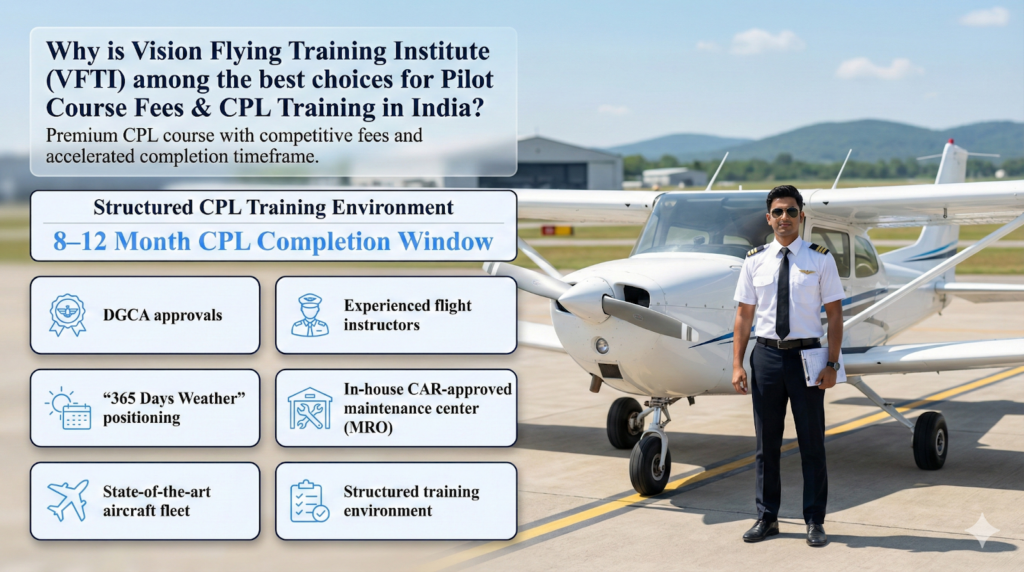
Vision Flying Training Institute centres on a structured training environment and states an 8 to 12 month completion window for the CPL track.
VFTI’s pilot training course includes:
- DGCA approvals
- Experienced flight instructors
- “365 Days Weather” positioning
- In-house CAR-approved maintenance center (MRO)
- State-of-the-art aircraft fleet
The in-house maintenance aspect is important because aircraft availability is one of the most common “hidden” reasons why students can take much longer to finish their training. VFTI specifically calls out their CAR-145 in-house MRO as a way to minimize downtime.
Join a Top Pilot Training Institute for Pilot Licence Training at Competitive Pilot Course Fees
Pilot training gets easier and way more predictable with admission at the best Flying Training Organizations. Vision Flying Training Institute (VFTI) is DGCA-approved and offers the core pathways most Indian pilot aspirants need. It is backed by a training setup designed to keep flying consistent.
Contact VFTI
Phone: +91-9319193602, +91-9319193605
Email: enquiry@vfti.in
Admission Office / Ground Classes: 3rd Floor, D-405, Saini Plaza, Sector-7, Ramphal Chowk, Block D, Palam Extension, Dwarka, New Delhi-110075
Airbase: Amreli Airport, Amreli, Gujarat – 365601
Frequently Asked Questions
How long does it take to become a pilot in India?
The duration of CPL in India usually ranges between 18 and 24 months. This is due to the fact that the availability of flights, weather, as well as the pace of the student, influence the duration. VFTI’s CPL timeline is 10–12 months.
What is the total cost of pilot training?
The cost of completing a practical CPL in India is usually within the ₹40-₹55 lakh range. The cost of completing a DGCA CPL is dependent on factors like single-engine hours, multi-engine hours, simulator time, and ground classes.
Can I be a pilot in 2 years?
Yes, 2 years is totally doable for CPL in India when training stays consistent, and you do not get stuck in long gaps between flying slots.