
DGCA Commercial Pilot License (CPL) Requirements in India
pgvisav@gmail.com
April 27, 2026
•11 min read
Becoming a commercial pilot in India follows a clear and well-defined process set by the Directorate General of Civil Aviation (DGCA). A DGCA Commercial Pilot Licence (CPL) is issued only after a candidate meets the required academic, medical, and flying standards.
Anyone planning to get a CPL in India must:
- Be at least 18 years old
- Have passed Class 12 (10+2) with Physics and Mathematics
- Hold a valid DGCA Class 1 Medical Certificate
- Have International Civil Aviation Organisation (ICAO) English Language Proficiency at Level 4 or above
- Complete a minimum of 200 hours of flight training
- Pass all five DGCA theory exams, along with RTR(A), with at least 70% in each paper
- Clear the CPL Skill Test conducted by a DGCA-approved examiner
Every aspiring pilot has to meet the required eligibility criteria, complete intensive flight training, clear the theory papers, and pass the practical skill test before the DGCA grants the licence.
This guide by Vision Flying Training Institute (VFTI), one of the top 10 DGCA-approved Flying Training Organisation based in Amreli, Gujarat, explains each DGCA CPL requirement in a simple and easy-to-understand way.
What is a DGCA Commercial Pilot License (CPL)?
A Commercial Pilot Licence (CPL) is the professional licence a pilot needs to start earning a pilot’s salary from flying. In India, it is issued by the DGCA.
A valid CPL is required before a pilot can legally fly passengers or cargo for an airline, charter company, or any other commercial aviation operator. It is the starting point for a professional flying career, whether the goal is to become an airline first officer, a charter pilot, or a corporate jet pilot.
Most airline careers need more than just a basic CPL. Students usually continue with Instrument Rating and Multi-Engine training, depending on the aircraft they plan to fly.
| Feature | Details |
| Issuing Authority | DGCA – Directorate General of Civil Aviation, India |
| License Type | Commercial Pilot License (CPL) – Aeroplanes |
| Regulatory Reference | Aircraft Rules 1937, Schedule II, Section J |
| Minimum Age for Issuance | 18 years |
| Validity | 5 years (subject to medical renewal and currency) |
| Purpose | Allows the holder to fly aircraft commercially (for hire and reward) |
| Next License Level | Airline Transport Pilot License (ATPL) after 1,500 flight hours |
What are the DGCA CPL Eligibility Requirements?
Before you can enroll in flight training or sit for DGCA entrance exams, you must meet all the eligibility criteria prescribed under the Aircraft Rules, 1937, and DGCA Civil Aviation Requirements (CARs). Let us break them down one by one.
- Age Requirement for CPL
You can begin your flight training as a student pilot from the age of 17, but the DGCA will not issue the actual Commercial Pilot License until you are at least 18 years old.
| Milestone | Minimum Age |
| Start Flight Training (Student Pilot License SPL) | 17 Years |
| Obtain Commercial Pilot License (CPL) | 18 Years |
| Maximum Age Limit (as per DGCA) | 65 Years |
- Educational Qualification
The DGCA requires all CPL applicants to have completed their Class 12 (10+2) examination from a recognised board. Here is what the educational requirement looks like:
- Physics and Mathematics are mandatory subjects in Class 12
- Candidates from CBSE, ICSE, or State Boards are all eligible
- Students who did not study PCM in Class 12 can complete physics and mathematics through NIOS (National Institute of Open Schooling), which is officially accepted by DGCA. This way, commerce students can become pilots in India.
- Arts or commerce students may pursue CPL after completing physics and mathematics via open schooling.
- DGCA Class 1 Medical Certificate
The pilot medical test is arguably the most important eligibility step and should ideally be done before you invest in flight training. The DGCA mandates that every CPL holder must possess a valid Class 1 Medical Certificate issued by a DGCA-approved medical examination centre.
What is the Difference Between Class 1 and Class 2 Medical?
| Parameter | Class 2 Medical | Class 1 Medical |
| Required For | Student Pilot License (SPL) / PPL | Commercial Pilot License (CPL) |
| When to Get It | Before starting flight training | Before CPL application |
| Examination Level | Standard health checks | Comprehensive & rigorous |
| Validity | 2 years (for pilots under 40) | 1-2 years (age-dependent) |
| Approximate Cost | ₹3,000 – ₹6,000 | ₹8,000 – ₹15,000 |
- English Language Proficiency
Aviation worldwide operates in English. The DGCA requires all CPL applicants to demonstrate ICAO English Language Proficiency at Level 4 or above. This is typically assessed during the RTR(A) practical examination and at the time of license application.
Level 4 means you can communicate clearly, understand aviation phraseology, and handle unexpected situations using English.
- DGCA computer number
Your computer number is your identity in the DGCA examination system. Without it, you cannot move smoothly through the exam and licensing process. Apply for a DGCA computer number early and keep your school documents ready. It is one of the first major administrative steps in the CPL journey.
Step-by-Step Process to get a DGCA CPL in India
The process of getting a commercial pilot license in India follows a proper step-by-step path. Each stage matters, and missing one or doing it too early can lead to unnecessary delays, extra effort, and added cost.
Here is a clear roadmap that makes the entire process much easier to understand and follow.
| Step | Milestone | What It Involves |
| 1 | DGCA Class 2 Medical | Get medically cleared for student flying. Obtain your Class 2 Medical Certificate from a DGCA-approved medical examination center. |
| 2 | Get DGCA Computer Number | Register on the DGCA Pariksha portal (pariksha.dgca.gov.in) to receive your unique Computer Number. This is mandatory for all DGCA exams. |
| 3 | Enroll in a DGCA-approved flying training organisation. | Join a DGCA-approved flying training organisation (like VFTI). Begin ground school and receive your Student Pilot License (SPL). |
| 4 | Complete Ground School | Attend structured ground classes covering all 5 DGCA CPL subjects: Air Navigation, Meteorology, Air Regulations, Technical General, and Technical Specific. |
| 5 | Clear DGCA Theory Exams | Appear for and pass all 5 DGCA theory papers through the Pariksha portal. Minimum 70% required in each subject. Exams are conducted 4 times a year. |
| 6 | Complete 200 Hours of Flight Training | Log a minimum of 200 flight hours at an approved FTO, including solo, cross-country, instrument, and night flying. |
| 7 | Obtain RTR(A) Certificate | Clear the Radio Telephony Restricted (Aeronautical), RTR(A), exam conducted by WPC (Wireless Planning and Coordination Wing), Government of India. |
| 8 | DGCA Class 1 Medical | Upgrade from a Class 2 to a Class 1 medical certificate before submitting your CPL application. |
| 9 | CPL Skill Test (Check Ride) | Appear for a practical flying test conducted by a DGCA-approved examiner. You will be assessed on general flying by day, general flying by night, and an instrument rating (IR) test. |
| 10 | Apply for CPL via eGCA Portal | Submit your application on the eGCA portal with all required documents, including logbook entries, exam results, a medical certificate, and skill test records. DGCA reviews and issues your CPL. |
How to become a commercial pilot in India after 12th
You do not need a degree in aviation or engineering to get a CPL. A Class 12 pass certificate with physics and mathematics is enough to begin the process. You must follow the step-by-step process given above to obtain a DGCA CPL in India.
Documents Required for DGCA CPL Application
When applying for your CPL through the eGCA portal, you must submit the following documents. Incomplete documentation is one of the most common reasons for delays.
| Document | Details |
| Valid DGCA Class 1 Medical Certificate | Issued by a DGCA-approved medical examination center |
| Class 12 (10+2) Marksheet & Certificate | With Physics and Mathematics as mandatory subjects |
| DGCA Theory Exam Results | Passing certificates for all 5 subjects from the Pariksha portal |
| RTR(A) Certificate | Issued by WPC (Ministry of Communications) |
| Certified Flying Logbook | Signed by your CFI, showing 200+ hours with breakdown |
| Ground Training Course Completion Certificate | From your DGCA-approved flying training organization |
| CPL Skill Test Record / Check Ride Results | Signed by a DGCA-approved examiner for day, night, and IR tests |
| Student Pilot License (SPL) / PPL (if applicable) | Copy of previously issued DGCA license/s |
| Passport / Government-issued Photo ID | Valid proof of identity and Indian citizenship |
| Passport-size Photographs | Recent, clear, colour photographs as per DGCA specifications |
DGCA Theory Examination Subjects for CPL
Clear the DGCA exams to become eligible for a CPL. These exams are computer-based multiple-choice tests conducted through the Pariksha portal at approved exam centres across India.
The DGCA exam syllabus for the pilot course covers five main subjects: Air Navigation, Aviation Meteorology, Air Regulations, Technical General, and Technical Specific. Along with these papers, students also need to clear RTR(A) – Radio Telephony, which is a practical communication test related to aviation communication.
DGCA CPL Training at the Best Pilot Training Institute in India
Choosing the right flying school is one of the most consequential decisions you will make in your aviation journey. The quality of your training, the equipment you fly, and the guidance you receive will directly shape your readiness for a commercial aviation career.
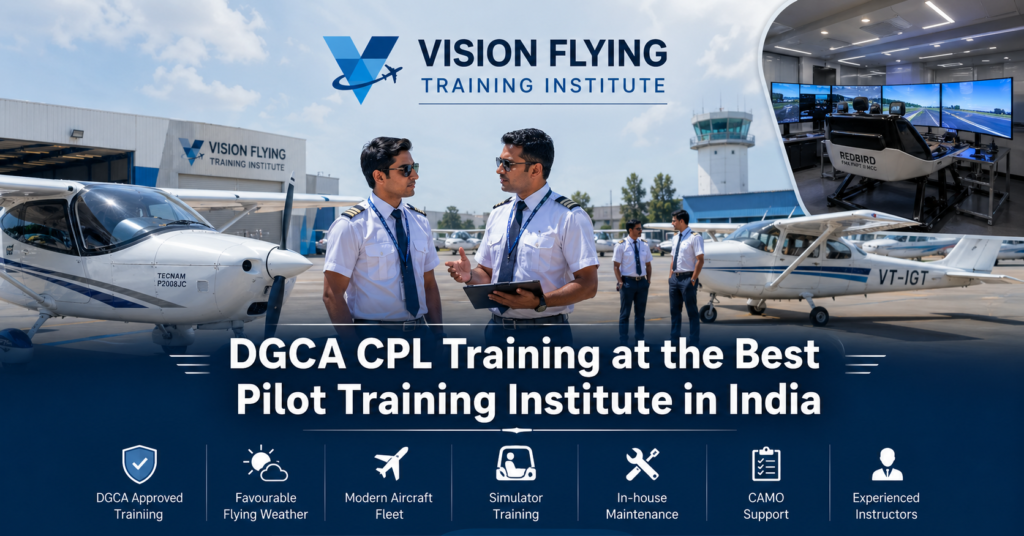
Here is why Vision Flying Training Institute (VFTI) stands out among DGCA-approved flying schools in India:
- DGCA-approved training: VFTI is a DGCA-approved flying training organization, so students train within an officially recognised system that meets Indian aviation standards.
- Favourable flying weather: Amreli, Gujarat offers strong flying conditions for most of the year. More flyable days usually mean fewer interruptions, quicker hour building, and better training continuity.
- Modern training aircraft: Students train on aircraft such as the Tecnam P2008JC, Cessna 172 Skyhawk, and Tecnam P-Mentor, providing them with experience on modern, well-maintained training platforms.
- Multi-engine simulator access: VFTI also offers access to a Tecnam Multi-Engine Simulator, which helps students build confidence in instrument and multi-engine training in a more controlled learning environment.
- In-house maintenance support: An in-house DGCA CAR 145-approved Maintenance, Repair and Overhaul facility helps reduce aircraft downtime and supports smoother training schedules.
- Dedicated CAMO support: A dedicated Continuing Airworthiness Management Organisation (CAMO) helps ensure that the aircraft remain compliant with DGCA requirements and ready for operation.
- Experienced instructors: Training at VFTI is guided by instructors with practical aviation experience, which adds real-world value to day-to-day learning.
- Strong institutional backing: VFTI is backed by the Vision Group of Institutions, which brings over two decades of educational experience and adds academic strength to the training environment.
Frequently Asked Questions
Q1: What is the minimum age to get a CPL in India?
You must be at least 18 years old when the DGCA issues your CPL. However, you can begin flight training as a student pilot from the age of 17. There is no maximum age restriction for training, but the CPL is valid only up to the age of 65.
Q2: Can I do CPL without physics and math in class 12?
Yes, you can. Students from non-science backgrounds can complete physics and mathematics through NIOS (National Institute of Open Schooling), which is officially recognised by the DGCA. However, do this before applying for the CPL, as the qualification must be verified at the time of license application.
Q3: What if I fail the DGCA Class 1 Medical?
If you are found unfit in the DGCA Class 1 Medical, there are two possible scenarios. A temporary unfit condition (such as high blood pressure or elevated blood sugar) can be treated and re-evaluated. A permanent unfit condition (such as colour blindness or certain heart conditions) may mean you cannot obtain a CPL. This is exactly why getting the medical done before investing in training is strongly recommended.
Q4: Is DGCA CPL recognised internationally?
The DGCA CPL is issued in compliance with ICAO Annex 1 standards and is generally recognised internationally. However, if you want to fly professionally in another country, you will typically need to convert your DGCA CPL to that country’s national license (e.g., EASA in Europe, FAA in the USA, CAAS in Singapore). The conversion process varies by country.
Conclusion
Getting a DGCA Commercial Pilot License in India is a structured and achievable goal for those who approach it with clarity, commitment, and the right institutional support.
Each step in the CPL process matters, and every requirement is there for a reason. The goal is not just to help you get a licence, but to make sure you are truly prepared for the responsibility of flying a commercial aircraft.
Aviation in India is growing quickly, and the need for well-trained commercial pilots is rising with it. This creates a real opportunity for students who are serious about building a career in flying.
Our focus at Vision Flying Training Institute (VFTI) is on helping students move through this process with the right training and support. Contact us today!