
DGCA Entrance Exam 2026: Eligibility, Syllabus and Fees
pgvisav@gmail.com
April 22, 2026
•9 min read
There is no single national “DGCA entrance exam” like JEE or NEET. In a pilot training course, students usually use that phrase to mean the DGCA flight crew exam on the PARIKSHA portal.
The DGCA theory exams are one of the first major milestones on the path to becoming a commercial pilot in India. Without clearing the DGCA exams, you cannot hold a valid pilot license in India.
Let us understand this in greater detail.
Overview of DGCA Entrance Exam
| Parameter | Details |
| Conducted By | DGCA (Directorate General of Civil Aviation), Govt. of India |
| Exam Mode | Online Computer-Based Test (CBT) |
| Official Portal | pariksha.dgca.gov.in |
| Subjects (CPL) | Air Regulations, Meteorology, Navigation, Technical General, Technical Specific |
| Additional | RTR (Aero) – conducted by WPC Wing |
| Duration per Paper | 2-3 hours |
| Question Type | MCQs – no negative marking |
| Passing Score | 70% per subject |
| Exam Fee | ~₹2,500 per subject |
| Exam Sessions | Multiple sessions per year (approx. 6) |
| Min. Age (CPL) | 18 years |
| Education Required | 10+2 with Physics and Maths |
| Medical Required | Class 1 (CPL/ATPL), Class 2 (SPL/PPL) |
| Computer Number | Mandatory – free at pariksha.dgca.gov.in |
What is the DGCA entrance exam?
The DGCA entrance exam is a set of computer-based theory examinations conducted by the Directorate General of Civil Aviation (DGCA), which operates under the Ministry of Civil Aviation, Government of India.
DGCA does not run a single pilot entrance test. Instead, DGCA runs subject-wise examinations connected to pilot licensing, and you apply for them through the Pariksha portal.
These exams are part of the requirements for obtaining a pilot license, specifically the Student Pilot License (SPL), Private Pilot License (PPL), Commercial Pilot License (CPL), and Airline Transport Pilot License (ATPL).
Types of Pilot Licenses and Their DGCA Entrance Exam Requirements
The DGCA exam requirements depend on the type of pilot license you want to pursue. That is why it is important first to understand the different license categories and what each one demands.
| License | Min. Age | Theory Exam Required | Medical Needed |
| Student Pilot License (SPL) | 16 years | Basic written test | Class 2 |
| Private Pilot License (PPL) | 17 years | PPL theory subjects | Class 2 |
| Commercial Pilot License (CPL) | 18 years | 5 CPL subjects + RTR | Class 1 |
| Airline Transport Pilot License (ATPL) | 21 years | Additional ATPL subjects | Class 1 |
The Commercial Pilot License (CPL) is the most commonly pursued license for a professional flying career in India.
Eligibility for the DGCA CPL exam
Before you register for the DGCA exam, you must meet a specific set of eligibility criteria. Here is a complete breakdown.
- Educational Qualification
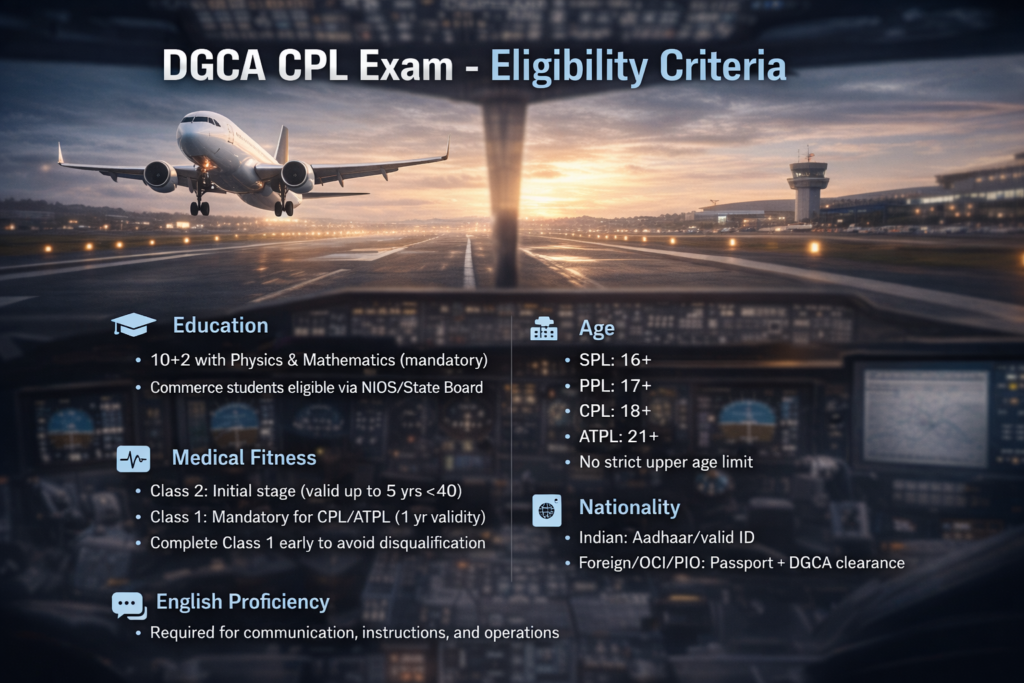
You must have passed Class 12 (10+2) with Physics and Mathematics as compulsory subjects from a recognised board (CBSE, ICSE, or State Board). English is also important since all aviation communication is in English.
Commerce students can become pilots in India. They must qualify in mathematics and physics by passing equivalent examinations through NIOS (National Institute of Open Schooling) or a recognised state board.
- Age Requirement
| License Being Pursued | Minimum Age |
| Student Pilot License (SPL) | 16 years |
| Private Pilot License (PPL) | 17 years |
| Commercial Pilot License (CPL) | 18 years |
| Airline Transport Pilot License (ATPL) | 21 years |
There is no strict upper age limit for DGCA theory exams. However, starting a commercial aviation career in your mid-to-late 30s without prior flying experience can be challenging. The earlier you start, the better.
- Medical Fitness
DGCA pilot medical test is one of the most critical eligibility requirements and one that many candidates overlook until it is too late.
| Medical Certificate | Required For | Validity |
| DGCA Class 2 | SPL, PPL, initial stage of CPL training | Up to 5 years (below age 40) |
| DGCA Class 1 | CPL, ATPL – mandatory before flying commercially | 1 year (6 months if above 60 or airline pilot) |
It is best to complete your Class 1 medical at the very beginning of your pilot training journey, ideally before joining a flying school. Some students invest lakhs of rupees in training, only to discover later that a medical condition disqualifies them.
- Nationality
Indian citizens need an Aadhaar card or valid government-issued photo ID. Foreign nationals, Overseas Citizen of India (OCI), and Person of Indian Origin (PIO) candidates must provide a passport and obtain DGCA security clearance.
- English Proficiency
Aviation communication is global, and English is the standard language used throughout the industry. DGCA requires all candidates to be proficient in both spoken and written English. This includes the ability to understand aviation terminology, instructions, and day-to-day operational communication.
How to apply for DGCA theory exams on the Pariksha portal
Here is the step-by-step process to apply for the DGCA examination through the PARIKSHA portal:
- Login to pariksha.dgca.gov.in using your DGCA Computer Number and password.
- Go to ‘Apply for Examination’ under the Flight Crew menu.
- Select the session and subjects you want to appear for.
- Choose your preferred exam centre from available options.
- Review your application details carefully.
- Click ‘Pay Fees’ and you will be redirected to Bharatkosh for payment via Net Banking, Debit or Credit Card.
- Download and save your Admit Card once it is issued.
Appear for only 2–3 subjects per attempt rather than all five at once. Spreading out subjects gives you more preparation time and increases your chances of clearing in fewer attempts.
DGCA CPL Exam Subjects and Syllabus
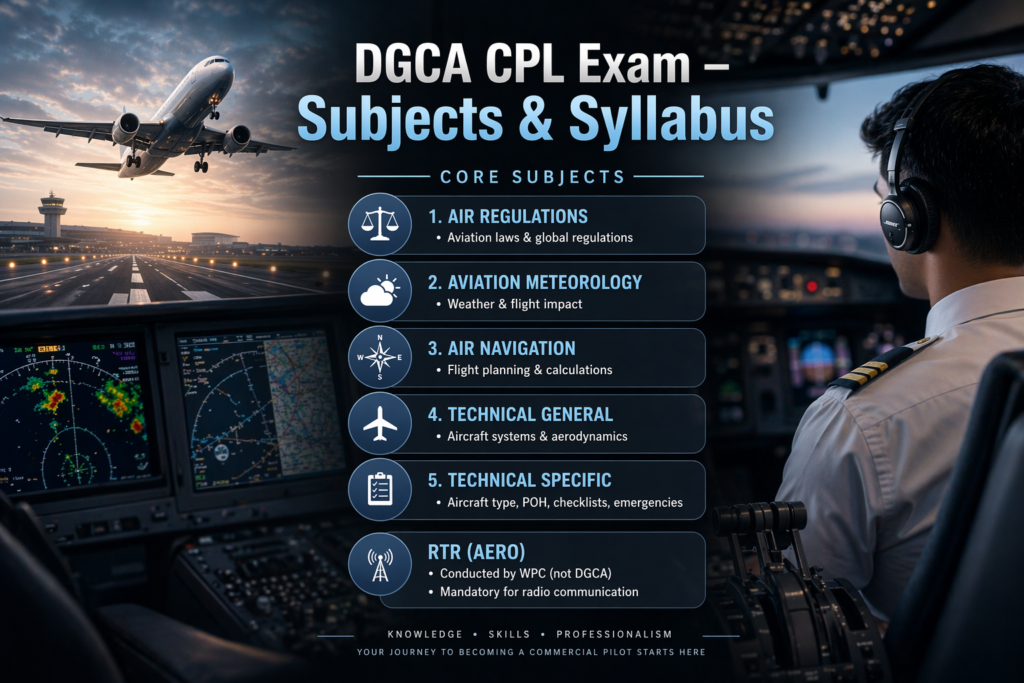
The DGCA CPL exam covers five core ground subjects along with a separate Radio Telephony (RTR) certification. Here is a subject-wise breakdown.
Subject 1 – Air Regulations: It covers the legal and regulatory framework of aviation in India and internationally.
Subject 2 – Aviation Meteorology: It deals with weather science and its impact on flight operations.
Subject 3 – Air Navigation: One of the most calculation-heavy subjects. It tests your ability to navigate aircraft accurately.
Subject 4 – Technical General (Aircraft Systems & Aerodynamics): This tests your knowledge of how aircraft are built, how they fly, and how their systems work.
Subject 5 – Technical Specific: It goes deeper into the specific aircraft type you are rated for during CPL training, covering Pilot Operating Handbooks (POH), limitations, checklists, and emergency procedures.
RTR (Aero) – Radio Telephony Restricted: The RTR (Aero) exam is conducted by the WPC Wing (Wireless Planning & Coordination Wing) under the Ministry of Communications and not by DGCA directly. However, it is mandatory for all pilots in India to legally operate aircraft radios.
| RTR Component | Details |
| Part 1 – Written/Oral | RT procedures, standard phraseology, Q-codes |
| Part 2 – Practical | Mock RT communication with simulated ATC, emergency calls |
| Passing Score | 50% (lower than the 70% required for DGCA subjects) |
You can read our detailed blog, DGCA Syllabus & Subjects for Pilot Training in India, for a complete overview of the DGCA theory exam syllabus and subjects.
DGCA Exam Pattern
The DGCA theory exams follow a clear and structured pattern. Before starting your preparation, take a look at the exam format, marking system, and subject-wise passing requirements given below.
| Parameter | Details |
| Mode | Computer-Based Test (CBT), online at DGCA-approved exam centres |
| Question Type | Multiple Choice Questions (MCQs) |
| Duration | 2 to 3 hours per subject |
| Total Marks | 100 marks per subject |
| Passing Score | 70% – minimum 70 marks out of 100 in each subject |
| Negative Marking | None |
| Attempt Limit | Unlimited attempts |
| Passed Paper Validity | 5 years from the date of first pass |
Each subject must be cleared individually with a minimum score of 70%. There is no aggregate scoring, which means that if you score 68 in one paper, you will need to reappear for that subject alone.
DGCA Exam Fee Structure
The DGCA theory exam fee is approximately ₹2,500 per subject for regular exams. Based on the six subjects listed above, the total exam fee is around ₹15,000 for one complete attempt.
The cost of the DGCA exam can go higher if you include re-attempts or Online On Demand Examinations, for which DGCA lists a fee of ₹5,000 per paper. This ultimately affects the total pilot course fees and duration.
Fees are paid online through Bharatkosh, the government payment gateway. Always check the official Pariksha portal for the latest fee updates.
When are DGCA exams held?
DGCA conducts Flight Crew theory examinations in multiple sessions throughout the year. As per the official 2026 PARIKSHA calendar, the main Regular Flight Crew exams are scheduled in March, June, September, and December.
Separate OLODE (On Line On Demand Examination) and FIR/AFIR (Flight Instructor Rating / Assistant Flight Instructor Rating) sessions are also notified during the year.
Since the dates are tentative and may change, candidates should always check the PARIKSHA notice board for the latest updates.
Subject-Wise Strategy and Preparation for the DGCA Exam
Preparing for the DGCA exam requires consistency, smart planning, and regular revision. Along with your flying schedule, make sure you set aside 2 to 3 hours every day for ground studies. A structured approach can make preparation much easier and improve your chances of clearing the subjects confidently.
- Begin with Air Regulations and Meteorology as these subjects build the foundation for your overall DGCA preparation.
- Practise Air Navigation every day using previous years’ question papers, because both speed and accuracy are important in the exam.
- Take mock computer-based tests (CBTs) to get comfortable with the actual exam format and time pressure.
- Revise regularly, as DGCA exams test not only your understanding but also how well you retain information.
- Keep track of DGCA updates, especially in Air Regulations, because new CARs and rule changes can make old study material outdated.
Difficulty Level by Subject
| Subject | Difficulty | Why |
| Air Navigation | High | Calculation-heavy, time-sensitive |
| Aviation Meteorology | Medium–High | Conceptual and application-based |
| Air Regulations | Medium | Memory-heavy; regularly updated with new CARs |
| Technical General | Medium | Broad; covers multiple aircraft systems |
| Technical Specific | Low–Medium | Based on your training aircraft manuals |
Conclusion
A career in aviation begins with the right information, the right preparation, and the right training environment. Once you understand the DGCA exam process and plan your journey properly, the path to becoming a pilot in India feels far more clear and achievable.
Choose one of the top 10 flying institutes, such as Vision Flying Training Institute (VFTI). It can make a real difference in how smoothly you progress, both in ground training and in the air. With DGCA-approved training, experienced instructors, modern aircraft, and strong student support, VFTI gives aspiring pilots a solid foundation to begin their aviation journey with confidence.