

Best Age to Become a Pilot in India – VFTI
pgvisav@gmail.com
October 31, 2026
•10 min read
Students aiming for an airline career can begin professional pilot training at around 18 to their early twenties, provided they meet the educational and medical requirements and have the necessary funding. This is planning advice and not an official age bracket.
In India, the minimum age requirement is 16 for a Student Pilot Licence (SPL), 17 for a Private Pilot Licence (PPL) and 18 for a Commercial Pilot Licence (CPL).
But what if you are 25, 30 or 40? Have you missed your chance?
The answer depends on what you want to do. Learning to fly, obtaining a commercial pilot licence and getting your first airline job have different requirements. Understanding those differences will help you decide whether to start now, prepare first or reconsider your intended route.
What is the Minimum Age to Become a Pilot in India?
The minimum age depends on the licence you are applying for.
| Licence | Minimum age at application | What the milestone means |
| Student Pilot’s Licence (SPL) | 16 years | Student flying under the applicable training and supervision requirements |
| Private Pilot’s Licence (PPL), aeroplanes | 17 years | Private flying within the licence’s privileges, rather than employment as a commercial pilot |
| Commercial Pilot’s Licence (CPL), aeroplanes | 18 years | Professional flying privileges, subject to the relevant qualifications and operating requirements |
These ages come from Schedule II of the Aircraft Rules, 1937. Meeting the minimum age requirement does not replace the education, medical, examination, experience or skill requirements.
Can You Start Preparing for Pilot Training Before 18?
Yes. You can strengthen your physics, mathematics and English skills, learn about the pilot training process and research flying schools while you are still in school.
Eligible students can also begin the student-pilot stage before 18. However, flight schools may have their own admission criteria and training schedules. The legal minimum age for an SPL does not mean every academy accepts students from the age of 16.
If you plan to pursue a commercial pilot career, prioritise completing Class 12 with the required subjects. Starting early is beneficial only when it aligns with your educational requirements and overall pilot training plan.
What is the Best Age to Start Pilot Training?
The period after Class 12 through the early twenties offers a practical window to begin pilot training. You can transition from academic study to aviation training while allowing time for examinations, flying hours, licensing and recruitment.

Starting earlier also gives you more flexibility if any stage takes longer than expected. However, age alone does not determine whether a training plan is workable.
Before enrolling, you should be able to answer three questions:
- Have I checked my academic and medical eligibility?
- Can I fund the planned training and manage additional expenses or delays?
- Do I understand the requirements of the career route I want?
An adequately prepared 23-year-old may have a more realistic plan than an 18-year-old who can pay the admission deposit but cannot finance the remaining training.
The ideal age to start pilot training is the earliest age at which you can pursue a realistic and financially sustainable plan.
Should You Become a Pilot After 12th or After Graduation?
You do not need a university degree to meet the academic requirements for a Commercial Pilot Licence (CPL). The requirement is a recognised 10+2 qualification or equivalent with Physics and Mathematics. DGCA’s flight crew examination guidance also specifies these subjects for applicants outside the Private Pilot Licence (PPL) category.
Starting pilot training after Class 12 can make sense if you are confident about pursuing a career in aviation and ready for the financial and academic commitment.
Completing graduation first may be a better option if you want an additional career qualification, need more time to arrange funding or are still deciding whether aviation is the right path for you. However, this route takes additional time, so check the age requirements for your intended airline or cadet pilot programme before deciding.
A university degree does not replace the physics and mathematics requirements for pilot training. Equally, completing graduation before starting flight training does not automatically mean you are too old to pursue a pilot career.
What is the Maximum Age to Become a Pilot in India?
There is no single upper age limit that applies to every stage of becoming a pilot in India.

Maximum Age for Pilot Training and Licensing
The minimum age requirement for a Commercial Pilot Licence (CPL) is 18. However, this provision does not specify a general upper age limit for starting training. The DGCA also states that there is no maximum age for registering as a flight crew candidate on its examination portal.
However, this does not mean every flight school, sponsored training programme or airline must accept applicants of any age. Admission criteria, medical fitness and the intended flying activity still matter.
Age Limits for Airline Pilot Recruitment in India
Airlines set age requirements for individual recruitment routes. A cadet pilot programme, a trainee-pilot opportunity for CPL holders and a vacancy for experienced pilots may each have different eligibility criteria.
For example, the Air India Trainee Pilot Programme listed a maximum age of 30, with an upper limit of 40 for employees and ex-defence applicants. These limits are specific to the programme and its eligibility categories.
Do not turn one airline’s requirement into a national rule.
Maximum Age for Commercial Airline Pilots in India
Rule 28A restricts pilots aged 65 and above from acting as pilot-in-command or co-pilot in commercial air transport operations. Additional conditions apply from age 60.
This is an operational age limit. It is not a guarantee that airlines will recruit new pilots until age 65 or that every pilot will remain employed until that age.
Can You Become a Pilot at 25, 30 or 40?
Becoming a Pilot at 25 Years of Age
At 25, you are not beyond the general minimum-age framework for obtaining a Commercial Pilot Licence (CPL). Your immediate priorities should be eligibility, medical assessment, training quality and funding.
If your goal is an airline career, compare the eligibility criteria for suitable recruitment routes before enrolling. Factor in the time required to complete training, obtain your licence and meet the requirements for the positions you intend to pursue.
Becoming a Pilot at 30 Years of Age
At 30, distinguish between eligibility for pilot training and eligibility for airline recruitment. Some recruitment routes may be unavailable because of their published age limits, while others may still be worth investigating.
Look for opportunities that match your qualifications and experience as a newly qualified pilot. An advertisement accepting experienced captains up to a certain age does not mean the airline accepts beginners of the same age.
Becoming a Pilot at 40 Years of Age or Older
Learning to fly may still be possible, subject to medical fitness, admission and licensing requirements. However, starting from scratch with the expectation of securing an airline job requires particularly careful financial and career planning.
Do not assume that charter flying or flight instruction will automatically provide an alternative. These roles have their own qualification, experience and recruitment requirements.
If personal flying is your main aim, discuss the PPL route instead of choosing commercial training by default.
Calculate Your Age When You Can Apply for Airline Pilot Jobs, Not Just When You Enrol
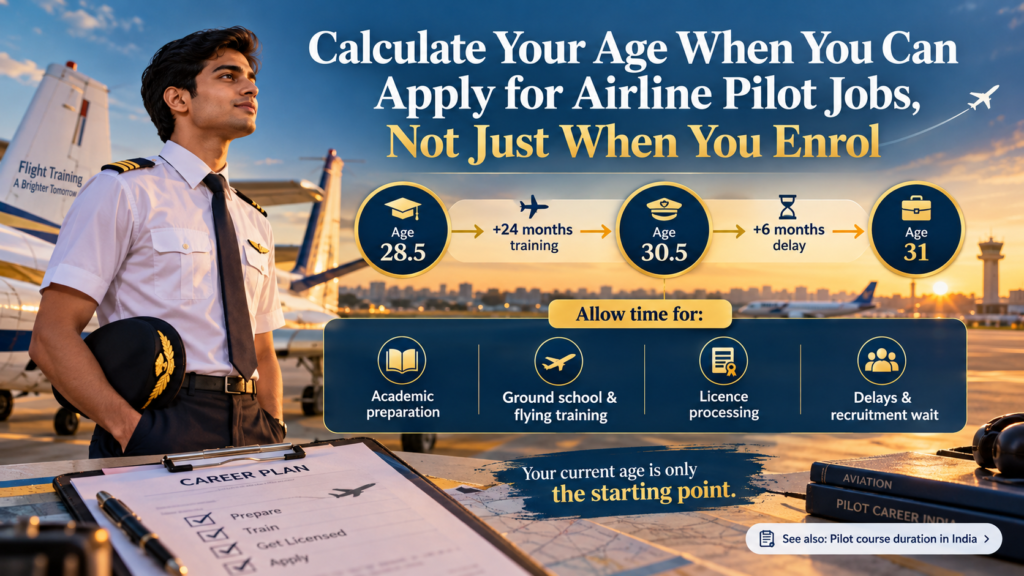
Your current age is only the starting point. If your goal is to join an airline that recruits qualified pilots, calculate how old you are likely to be when you meet all the application requirements.
Allow time for:
- Any remaining academic preparation.
- Ground school, examinations and flying training.
- Licence processing and any additional qualifications required.
- Potential delays and the wait for a suitable recruitment opening.
Take a look at our post on pilot course duration in India.
Consider a hypothetical applicant aged 28 years and six months. If their chosen training route takes another 24 months to reach application readiness, they will be 30 years and six months old. A further six-month delay takes them to 31.
These figures illustrate how to plan around age-related eligibility requirements; they do not represent a guaranteed training timeline.
What Should You Check Before Committing to Training?
A useful age assessment should end with a decision, rather than reassurance alone.
- Define your goal. Decide whether you want recreational flying, an airline career or another professional role.
- Check the relevant route. Review the current entry requirements for your intended training or recruitment route, considering your expected qualifications and experience.
- Address medical eligibility early. Follow the appropriate DGCA medical process and take individual concerns to an authorised medical examiner.
- Build a realistic training timeline. Ask flight schools about their recent student completion times and the common reasons for delays.
- Plan beyond the licence issue. Budget for living expenses, additional qualifications and the possibility of waiting for a suitable job opportunity.
Avoid calculating your future income simply by subtracting your age from 65. Such a calculation assumes uninterrupted medical fitness, employment and career progression, which nobody can promise.
Plan Your Pilot Training with VFTI
Vision Flying Training Institute offers CPL, PPL and DGCA ground-school programmes, giving aspiring pilots options to explore based on their career goals.
Before deciding when to begin, bring together your age, academic qualifications, medical status and available budget. Contact VFTI’s admissions team to discuss your eligibility and a suitable pilot training pathway.
Call: +91 9319193602 or +91 9319193605
Email: enquiry@vfti.in.
Frequently Asked Questions
- Is 21 or 22 Too Late to Become a Pilot?
No. Neither age is beyond the CPL minimum or a general licensing entry ceiling. Assess your readiness and intended recruitment route rather than comparing yourself with students who started after Class 12.
- Can You Become an Airline Pilot Immediately After Turning 18?
Turning 18 satisfies the CPL age minimum. You still need the licence requirements, relevant qualifications and successful airline selection and training. Meeting the age requirement alone does not make you ready to join an airline.
- Are the Minimum Licence Ages Different for Women?
No. The minimum ages for SPL, PPL and CPL do not differ by gender. Applicants must meet the requirements applicable to their licence and chosen programme.