
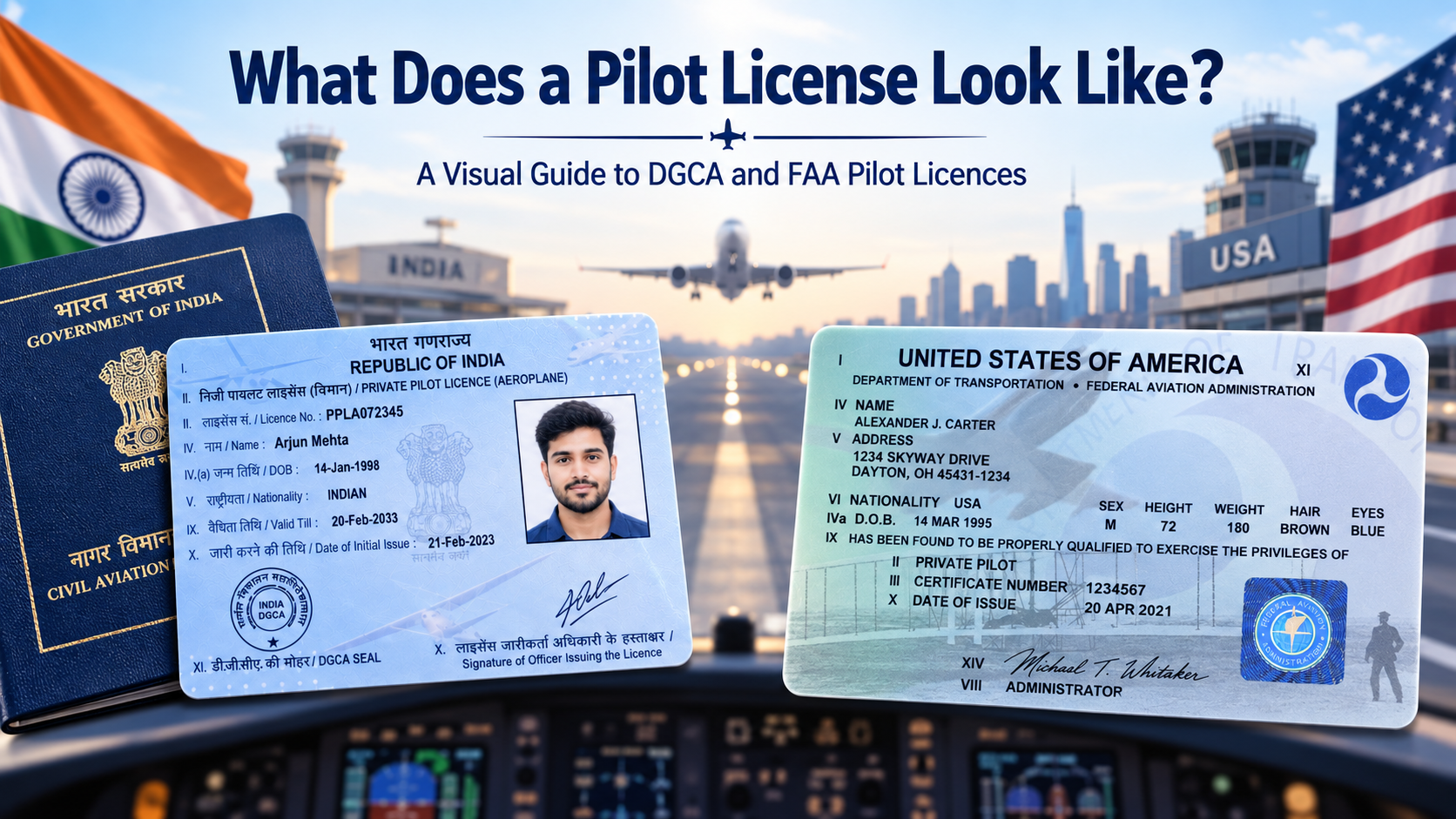
What Does a Pilot Licence Look Like? Visual Guide (2027)
pgvisav@gmail.com
September 11, 2026
•8 min read
A pilot licence usually looks like a wallet-sized, credit-card-style aviation credential that identifies the pilot and shows key licensing information such as the pilot’s name, licence or certificate number, licence category, ratings, and issuing authority. Depending on the country and licence format, it may also display a photograph, nationality, date of birth, validity details, and official security features.
The design varies by aviation authority. In India, pilot licences are issued by the Directorate General of Civil Aviation (DGCA), while in the United States, the Federal Aviation Administration (FAA) issues pilot certificates.
Traditionally, pilot licences were issued as physical cards containing the pilot’s personal details. However, aviation licensing is now moving towards digital systems, with India introducing the Electronic Personnel Licence (EPL) for flight crew.
What Does a DGCA Pilot Licence Look Like in India?
A DGCA pilot licence is an official identity and qualification document issued by the Directorate General of Civil Aviation (DGCA), India.
The physical DGCA Commercial Pilot Licence (Aeroplane) card contains important information that identifies the pilot and confirms their flying privileges.
The DGCA Commercial Pilot Licence issued in India is bilingual, featuring both Hindi and English text. Hindi is included because it is an official Indian government document, while English is used to maintain international aviation compatibility under ICAO standards.
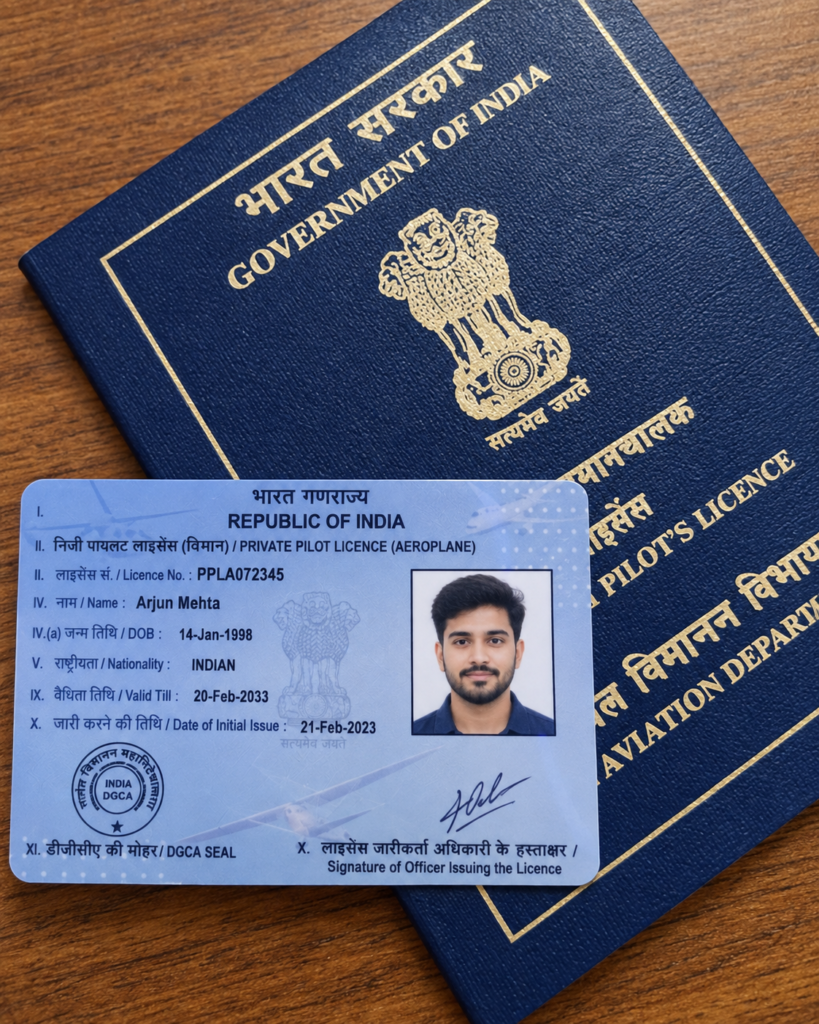
The front side of a DGCA CPL licence generally includes:
| Section | Information Displayed |
| Country Name | Republic of India |
| Issuing Authority | Directorate General of Civil Aviation |
| Licence Category | Commercial Pilot’s Licence (Aeroplane) |
| Licence Number | Unique licence identification number |
| Name | Name of the licence holder |
| Nationality | Pilot’s nationality |
| Date of Birth | Pilot identification information |
| Date of Issue | Date when licence was issued |
| Photograph | Identification photograph |
| DGCA Seal | Official authority seal |
| Signature | Signature of issuing authority |
Understanding the Front Side of a DGCA CPL Licence
The top section of the DGCA licence displays:
Republic of India: This confirms that the licence is issued under India’s civil aviation regulatory system.
Commercial Pilot’s Licence (Aeroplane): This identifies the type of licence. A Commercial Pilot Licence (CPL) allows a qualified pilot to work professionally in aviation after completing required training, examinations, and additional airline requirements.
Licence Number: Every pilot receives a unique licence number issued by DGCA. This number helps authorities and aviation organisations verify the pilot’s credentials.
Pilot Photograph: The licence contains the pilot’s photograph for identification purposes.
Personal Details: The licence includes:
- Name
- Nationality
- Date of Birth
- Date of Issue
These details ensure that the licence belongs to the authorised pilot.
What Information Appears on the Back Side of a DGCA Pilot Licence?
The reverse side of a DGCA pilot licence contains operational information related to the pilot’s qualifications.
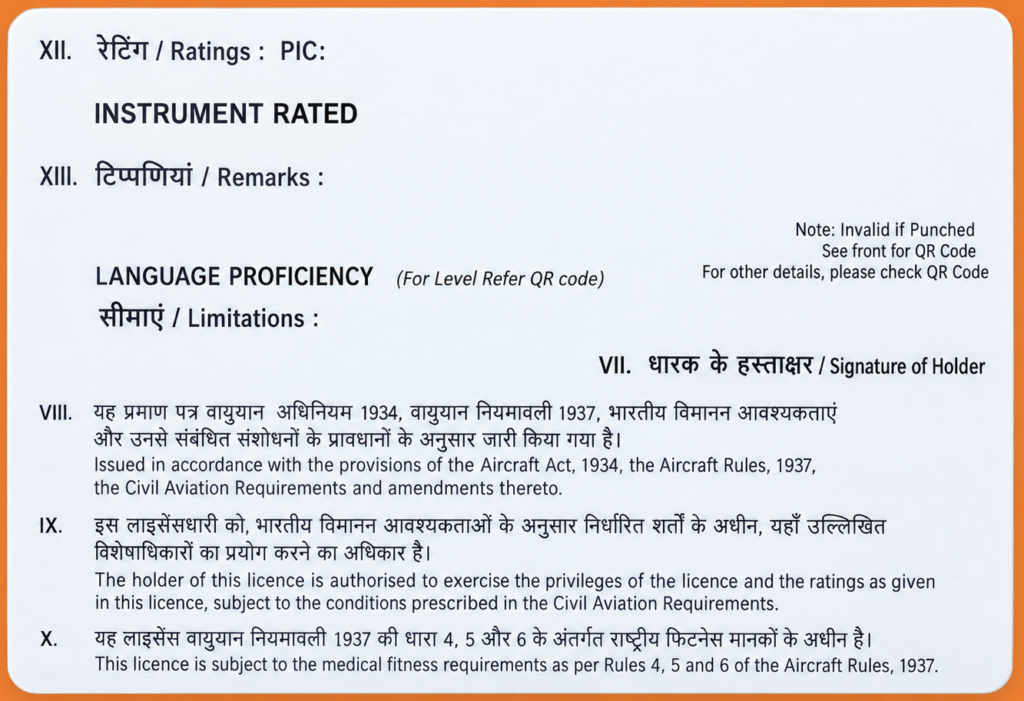
It includes details such as:
| Field | Meaning |
| Ratings | Aircraft and operational qualifications held by the pilot |
| PIC Information | Pilot-in-command privileges |
| Instrument Rating | Qualification to operate aircraft under instrument flight conditions |
| Remarks | Additional limitations or endorsements |
| Language Proficiency | Aviation communication qualification |
| Holder Signature | Signature of licence holder |
The ratings section is especially important because it shows what aircraft categories and privileges the pilot has earned.
What Does an FAA Pilot Licence Look Like?
In the United States, the FAA does not use the term “pilot licence”. Instead, it is officially called an Airman Certificate.
The FAA pilot certificate is a wallet-sized card containing information about the pilot and their flying privileges.
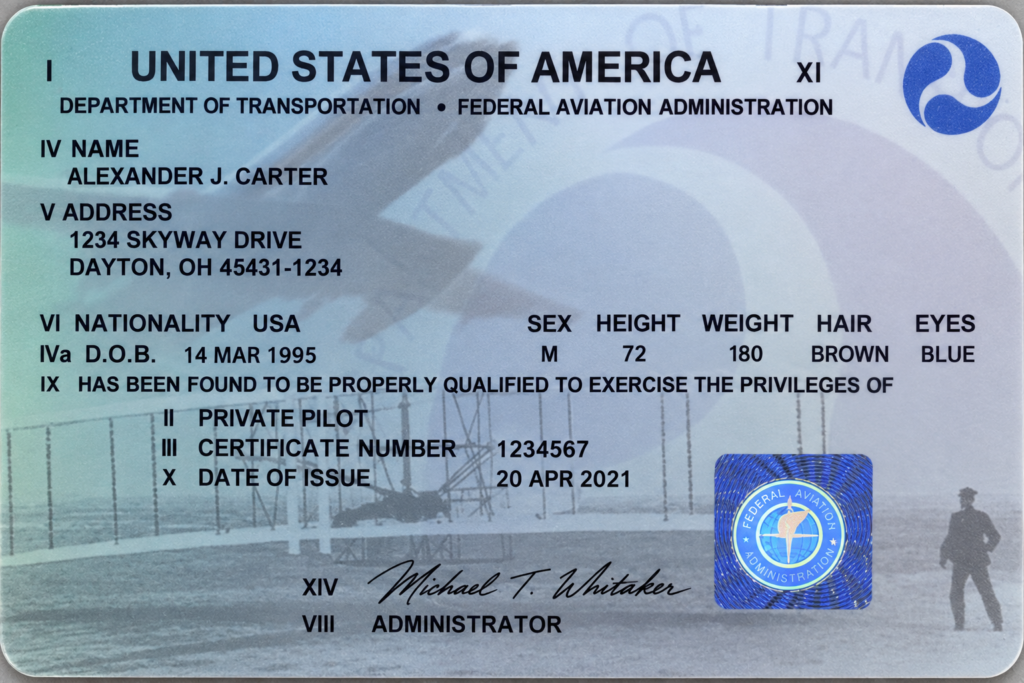
The FAA certificate shown above includes:
| Section | Information |
| Country | United States of America |
| Authority | Department of Transportation – Federal Aviation Administration |
| Pilot Name | Certificate holder name |
| Address | Registered address |
| Nationality | Country of citizenship |
| Date of Birth | Pilot identification detail |
| Certificate Type | Private Pilot, Commercial Pilot, etc. |
| Certificate Number | Unique FAA identification number |
| Date of Issue | Certificate issue date |
| Administrator Signature | FAA authorised signature |
Why Did DGCA Introduce Electronic Personnel Licence (EPL)?
The aviation industry is becoming increasingly digital, and pilot licensing is also moving away from traditional physical documents.
In September 2024, DGCA announced plans to introduce the Electronic Personnel Licence (EPL) for flight crew licences in alignment with ICAO standards.
The official launch of the EPL took place on 20 February 2025, when the Union Minister for Civil Aviation, Sh. Ram Mohan Naidu, introduced the digital pilot licence system. With this launch, India became the second country in the world to implement an ICAO-aligned electronic licensing system for aviation personnel.
The EPL system is designed to provide pilots with faster access to their licence information while allowing airlines, regulatory authorities, and other aviation organisations to verify credentials more efficiently.
What is an Electronic Personnel Licence (EPL)?
An Electronic Personnel Licence is a digital version of a traditional pilot licence.
Instead of carrying a physical card, pilots can securely access their licence through the eGCA Mobile Application.
The EPL allows:
- Digital storage of pilot licence information
- Faster verification
- Better security against forgery
- Easier access to licence details
- Faster updates and renewals
Which Pilot Licences Are Covered Under DGCA EPL?
The rollout of EPL started in phases.
Initially, DGCA introduced EPL for:
- Commercial Pilot Licence (CPL)
- Flight Radio Telephone Operator’s Licence (FRTOL)
Later, EPL services were expanded to include additional licensing services.
The system was further expanded for Airline Transport Pilot Licence (ATPL) services in January 2026.
Physical Pilot Licence vs Electronic Pilot Licence
The transition from traditional physical pilot licences to digital licensing represents a significant advancement in aviation documentation. While physical licences served pilots for many years, the Electronic Personnel Licence (EPL) introduces a faster, more secure, and convenient way to access and verify pilot credentials. The key differences between the two systems are:
| Feature | Physical Licence | Electronic Personnel Licence |
| Format | Plastic card | Digital licence |
| Storage | Carried physically | Stored digitally |
| Verification | Manual checking | Digital verification |
| Updates | Requires physical processing | Faster digital updates |
| Security | Card-based security features | Digital security features |
Do Pilots Still Receive a Physical Licence?
With the introduction of EPL, DGCA is gradually reducing dependence on physical pilot licence cards.
However, the licensing transition happens in phases, and existing physical licences continue according to DGCA procedures.
What Does a Pilot Licence Prove?
A pilot licence is not just an identification card. It represents:
- Completion of pilot training course
- Successful DGCA exams
- Flying experience
- Medical fitness
- Compliance with aviation regulations
Earning a CPL licence is one of the biggest milestones in a pilot’s journey before entering professional aviation.
Is a Pilot Licence Similar to a Driving Licence?
A pilot licence and a driving licence serve a similar basic purpose: both are official documents that confirm a person has met the required standards to operate a vehicle. A driving licence allows a person to operate a road vehicle, while a pilot licence authorises a person to fly an aircraft under specific conditions.
However, a pilot licence is far more detailed and specialised than a driving licence because flying an aircraft requires advanced technical knowledge, extensive pilot training, medical fitness, and continuous skill evaluation.
While a driving licence mainly confirms that a person has passed a driving test and meets basic road safety requirements, a pilot licence contains detailed information about the pilot’s aviation qualifications and flying privileges.
Conclusion
Understanding a pilot licence is the first step towards understanding the aviation career pathway.
At Vision Flying Training Institute (VFTI), aspiring pilots receive structured training designed to help them meet DGCA requirements and develop the knowledge and skills required for professional flying.
From ground classes to flight training, VFTI supports students throughout their journey towards earning their pilot licence and building a successful aviation career.
Start your journey towards becoming a professional pilot with VFTI today.
Frequently Asked Questions About Pilot Licences
- What does a pilot licence look like?
A pilot licence looks like an official aviation identification document containing the pilot’s name, photograph, licence number, ratings, issuing authority, and flying privileges.
- Is CPL the same as a pilot licence?
Yes. A CPL (Commercial Pilot Licence) is one type of pilot licence that allows qualified pilots to work in commercial aviation after meeting required conditions.
- Which licence is required to become an airline pilot in India?
Aspiring airline pilots in India generally complete CPL training and later meet airline requirements before joining commercial operations.
- Is an FAA pilot certificate valid in India?
FAA certificates are not automatically valid for commercial flying in India. Pilots must complete the DGCA conversion process to obtain Indian licensing privileges.
- How long does it take to get a pilot licence in India?
The duration depends on factors such as training availability, weather conditions, aircraft availability, examinations, and student progress. CPL training generally takes around 18–24 months for many students.