
What is an Aircraft MRO? A Beginner’s Guide for Pilots in India
pgvisav@gmail.com
May 10, 2026
•14 min read
Behind every safe flight is a much larger system of trained engineers, hangars, tools, records, approvals, and strict safety checks.
This system is called Aircraft MRO, which stands for Maintenance, Repair, and Overhaul.
MRO may sound like a technical subject meant only for aircraft engineers, but every pilot in India should understand its importance. It is closely connected to your journey in the cockpit. Every flying hour you complete during Commercial Pilot License (CPL) training, every takeoff, landing, and training sortie depends on how well the aircraft is maintained.
By the end of this guide, you will know exactly why a CAR-145-approved in-house MRO matters and why Vision Flying Training Institute (VFTI) in Amreli, Gujarat, with its own DGCA-approved MRO and CAMO department, is built for serious CPL aspirants.
What Does MRO Mean in Aviation?
Aircraft MRO stands for Maintenance, Repair, and Overhaul. It is the complete set of services that keeps an aircraft safe, legal, and ready to fly throughout its working life.
In simple words, an MRO does for aircraft what a service center does for your car, but with far stricter rules, deeper checks, and zero room for error.
A pilot can be the best in the world, yet without a properly maintained aircraft, no flight is safe. That is why aviation regulators across the world, including India’s Directorate General of Civil Aviation (DGCA), treat MRO as a non-negotiable part of flying.
Without MROs, no airline, no flying training organisation (FTO), and no charter operator can legally put an aircraft in the sky.
What Does Aircraft MRO Stand For?
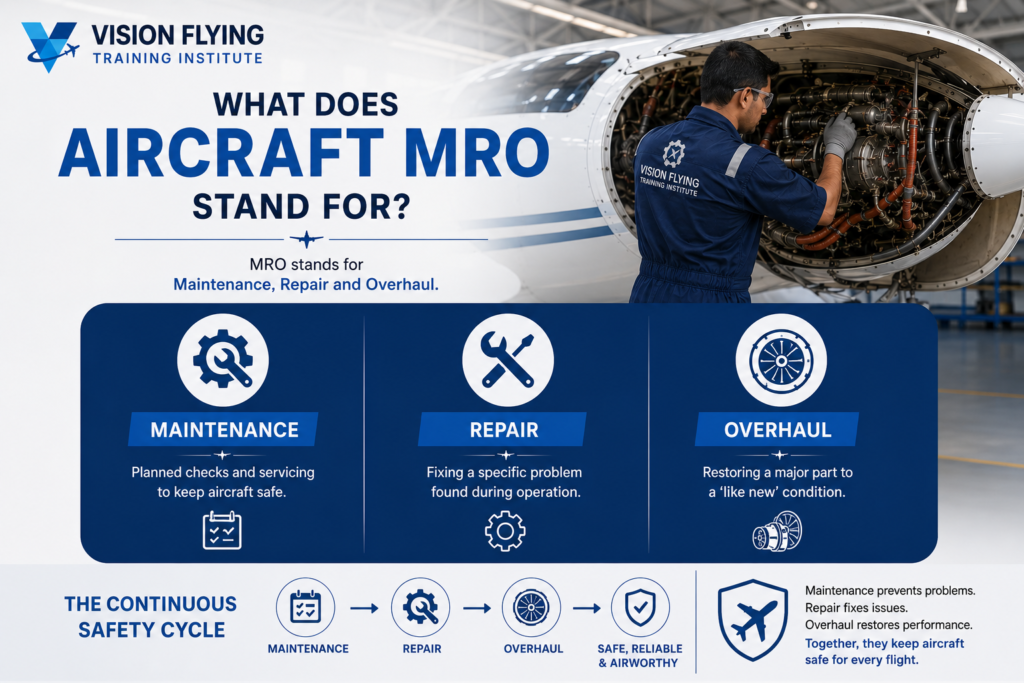
Most beginners use the words “maintenance,” “repair,” and “overhaul” as if they mean the same thing. They do not. Each one has a clear meaning under aviation rules.
| Term | What It Means |
| Maintenance | Planned, regular checks and servicing to keep an aircraft fit. It is mostly preventive. |
| Repair | Fixing a specific problem found during inspection or operation. It is reactive. |
| Overhaul | Taking a major part fully apart, inspecting it, refurbishing it, and putting it back to a “like new” condition. |
Together, these three activities form a non-stop cycle. This cycle is the reason a single airliner can keep flying for 25 to 30 years.
Why Aircraft MRO Matters for Aspiring Pilots in India
Many pilot aspirants only think about flight hours, simulator sessions, and DGCA entrance exams. MRO seems like “the engineer’s department.” That mindset is risky for two reasons.
- Every aircraft you sit in during training has been signed off by a licensed Aircraft Maintenance Engineer (AME). If MRO standards are weak at your flying school, your daily safety is weak too. Strong MRO equals safer training.
- If a pilot training school has only a few aircraft and no proper in-house MRO, even small snags can ground a plane for days or weeks. Your pilot course duration can slip from 18 months to 30 months for no fault of yours.
This is exactly why choosing a top flying training institute with its own DGCA CAR 145-approved MRO makes a real difference.
Types of Aircraft Maintenance Checks (A, B, C, and D Checks)
When people in aviation talk about “aircraft maintenance checks,” they usually mean a structured set of inspections known as A, B, C, and D checks.
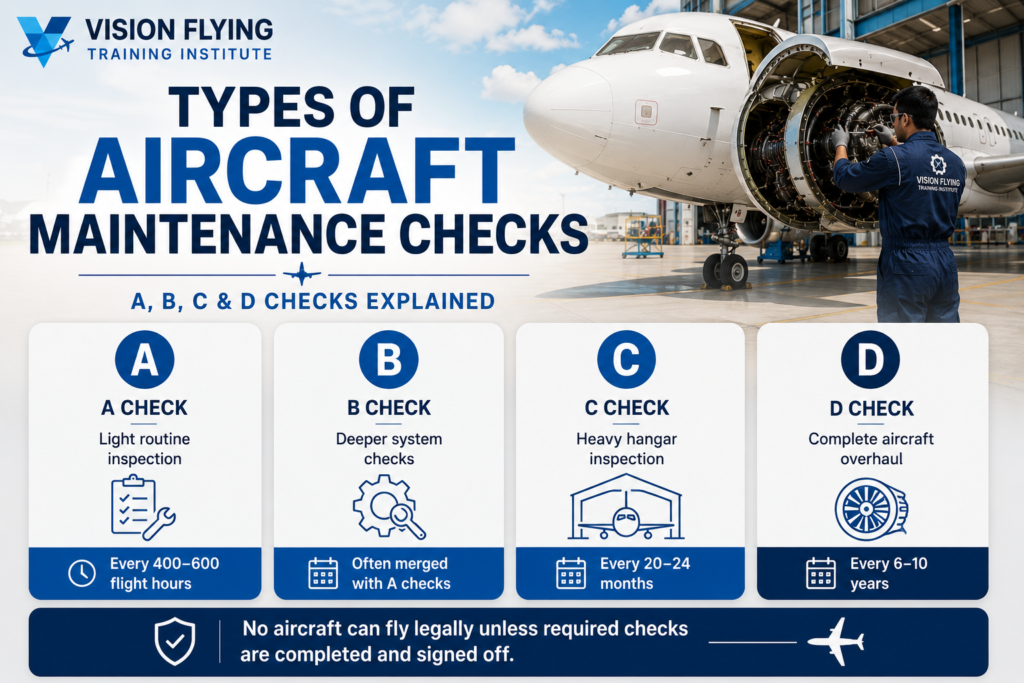
A and B checks are considered “lighter” and fall under line maintenance. C and D checks are much deeper and fall under base or heavy maintenance.
| Check | When It Happens | How Long | What Gets Done |
| Line / Daily | Between flights or every 24-60 hours of flying | Minutes to a few hours | Visual inspection, tyres, brakes, oil, hydraulic levels, and basic systems. |
| A Check | Every 400-600 flight hours or 200-300 flights | Around 10–24 hours, often overnight | Detailed checks of the cabin, engines, filters, lubrication, and emergency equipment. |
| B Check | Earlier every 6-8 months (now mostly merged into A checks) | 1-3 days | Deeper systems checks. Most modern airlines fold B-check items into A checks. |
| C Check | Every 20-24 months or after a set number of hours | 1-4 weeks | Heavy inspection of structures, systems, and components. The aircraft is grounded in a hangar. |
| D Check | Every 6-10 years | Up to 2 months; 30,000-50,000 man-hours | The aircraft is almost completely disassembled, inspected for corrosion and metal fatigue, and then rebuilt. |
As a student pilot, you do not need to memorise every type of check, but you should understand that no flight is legal unless the required inspections have been completed and properly signed off.
Key Sectors of Aircraft MRO Services
The MRO world is usually split into four main sectors. Each one needs its own specialists, tools, and approvals.
| MRO Sector | What It Covers |
| Airframe MRO | The body of the aircraft: fuselage, wings, tail, landing gear, skin, and paint. |
| Engine MRO | Aircraft engines and APUs (Auxiliary Power Units). |
| Component MRO | Individual parts like avionics, hydraulic pumps, landing gear actuators, brakes, and on-board electronics. |
| Line Maintenance | Light, daily checks at the airport between flights. |
Types of MRO Facilities
The aviation industry has developed several distinct types of facilities, each with its own scope, equipment, and certifications.
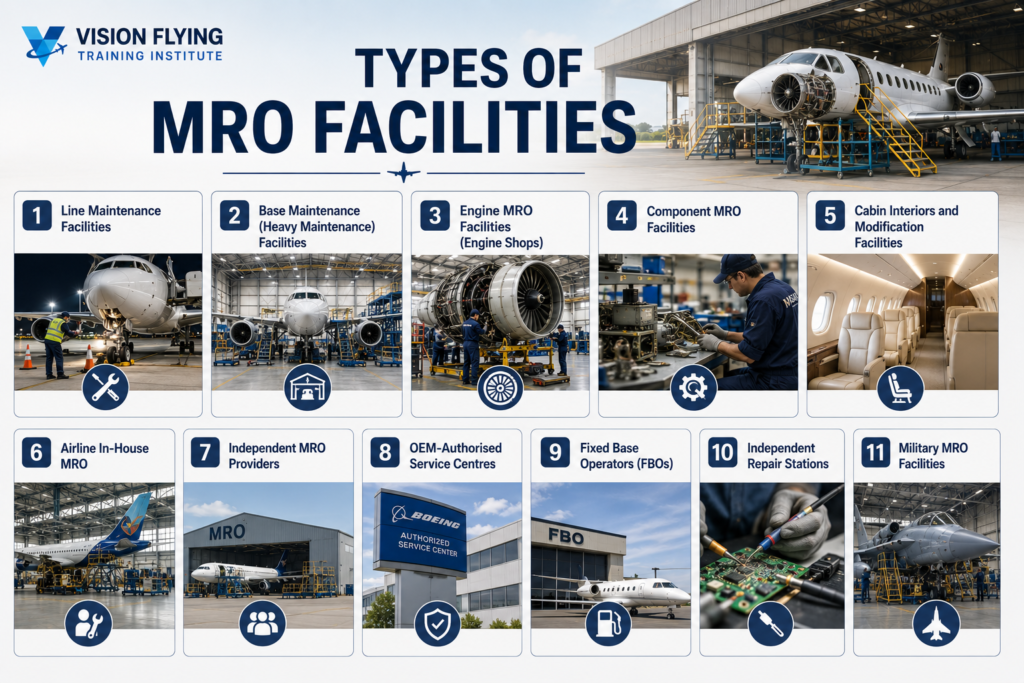
- Line Maintenance Facilities
Line maintenance is the everyday, on-the-ground side of MRO. It covers the routine checks and minor work done on an aircraft between flights or during overnight stops, to prepare the aircraft for its next departure.
- Base Maintenance (Heavy Maintenance) Facilities
Base maintenance is the deep, hangar-bound work that line stations cannot do. It takes place at dedicated maintenance facilities or hangars equipped with specialised tools, equipment, and workstations that allow technicians to perform complex tasks on aircraft. Most of this work is built around the well-known scheduled A, B, C, and D checks.
- Engine MRO Facilities (Engine Shops)
Engine shops are a world of their own. They focus only on the powerplants, taking engines apart, inspecting every part, repairing or replacing what needs it, putting them back together, and running them on a test cell before they go back on wing.
- Component MRO Facilities
Component MRO is the catch-all category for everything that is not the airframe or the engine. It covers maintenance of aircraft parts such as avionics, instruments, batteries, and tires.
- Cabin Interiors and Modification Facilities
This is the passenger-facing side of MRO and a fast-growing segment. Cabin interior MRO can itself be broken into several categories, including Body MRO, which covers structural aspects of the cabin. The same kind of facility usually handles seat refurbishment, IFE (in flight entertainment) installation, galley reconfiguration, and full cabin layout changes during major overhauls.
- Airline In-House MRO
Plenty of large airlines run their own MRO operations. Some service only their own fleet, others sell capacity to third parties. These facilities are usually built at the airline’s main hubs.
- Independent MRO Providers
A big chunk of global aircraft maintenance is not done by airlines or manufacturers at all. It is done by independent MRO providers that serve multiple airlines and operators.
- OEM-Authorised Service Centres
The original equipment manufacturers also run service operations, either directly or through authorised partners. MRO providers are broadly classified into two categories: original equipment manufacturers and independent service providers. Boeing and Airbus maintain service networks of this kind.
- Fixed Base Operators (FBOs)
FBOs are typically based at smaller regional airports and serve general aviation rather than the airlines. Their MRO work tends to focus on inspections, light maintenance, component servicing, and aircraft storage.
- Independent Repair Stations
Independent repair stations are smaller than full-service MROs. They specialise in specific disciplines such as landing gear, interiors, or component overhaul.
- Military MRO Facilities
Military MRO is a category by itself. These facilities support a wide range of aircraft, from transport platforms to tactical jets and rotary wing assets. In India, HAL and BEML are the obvious names in this space.
The MRO ecosystem is really a layered network. Knowing which type of facility does what is the first real step to understanding how the global aviation industry actually stays in the air.
What is CAMO and How is It Different from an MRO?
If you spend any time on aviation websites, you will keep seeing two acronyms together: MRO and CAMO. They are connected, but they are not the same thing.
- MRO (Maintenance, Repair and Overhaul) is the organisation that does the actual hands-on maintenance work on the aircraft.
- CAMO (Continuing Airworthiness Management Organisation) is the organisation that plans, tracks, and signs off that the aircraft is always airworthy.
A CAMO is responsible for:
- Tracking every flight hour and every cycle of an aircraft.
- Ensuring all Airworthiness Directives (ADs) and Service Bulletins are complied with.
- Maintaining the technical log books and all maintenance records.
- Planning and scheduling each maintenance task.
- Coordinating with the MRO so that the aircraft gets the right work at the right time.
Indian flying training schools gain a major operational advantage when they have both an in-house MRO and an in-house CAMO. It means the aircraft can be flown, monitored, tracked, and maintained under one roof, with better coordination and full DGCA compliance.
VFTI is one of the few flying training institutes in India that operates both a CAR-145-approved MRO and its own CAMO department, fully approved by the DGCA.
DGCA CAR-145: India’s MRO Approval Standard
In India, every MRO that touches a commercially operated aircraft must be approved under CAR-145. The full name is Civil Aviation Requirements, Section 2, Series ‘E’, Part II – Approval of Maintenance Organisations, issued by the DGCA under Rule 133A of the Aircraft Rules, 1937.
An organisation must demonstrate the following to obtain and maintain CAR-145 approval:
- It has the right facilities, hangars, and tooling.
- It has DGCA-licensed Aircraft Maintenance Engineers (AMEs) and trained support staff.
- It follows a strictly approved Maintenance Organisation Exposition (MOE).
- It has a quality system, safety management, and audit process.
- It maintains detailed maintenance records for every task performed.
Top MRO Companies in India
Here are some of the well-known MRO and CAMO players operating in India today.
| Company | Known For |
| AIESL (Air India Engineering Services Ltd) | India’s largest MRO. DGCA, FAA, EASA approved |
| GMR Aero Technic | Body airframe MRO. Multiple international approvals |
| Air Works | One of India’s oldest MROs (since 1951) |
| Indamer / AAR-Indamer | Business and commercial aircraft MRO |
| Hindustan Aeronautics Limited (HAL) | Defence and commercial MRO |
| Max MRO Services | Component and aircraft MRO with DGCA, EASA, and FAA approvals |
| Safran Aircraft Engine Services India | DGCA CAR-145 approved engine MRO |
| Thales (avionics MRO) | Avionics MRO for Indian carriers, opened in March 2025 |
Apart from these big names, India has many specialised MROs and several flying training institutes that operate their own in-house MROs, including VFTI in Amreli, Gujarat.
How an In-House MRO Helps Your Pilot Training
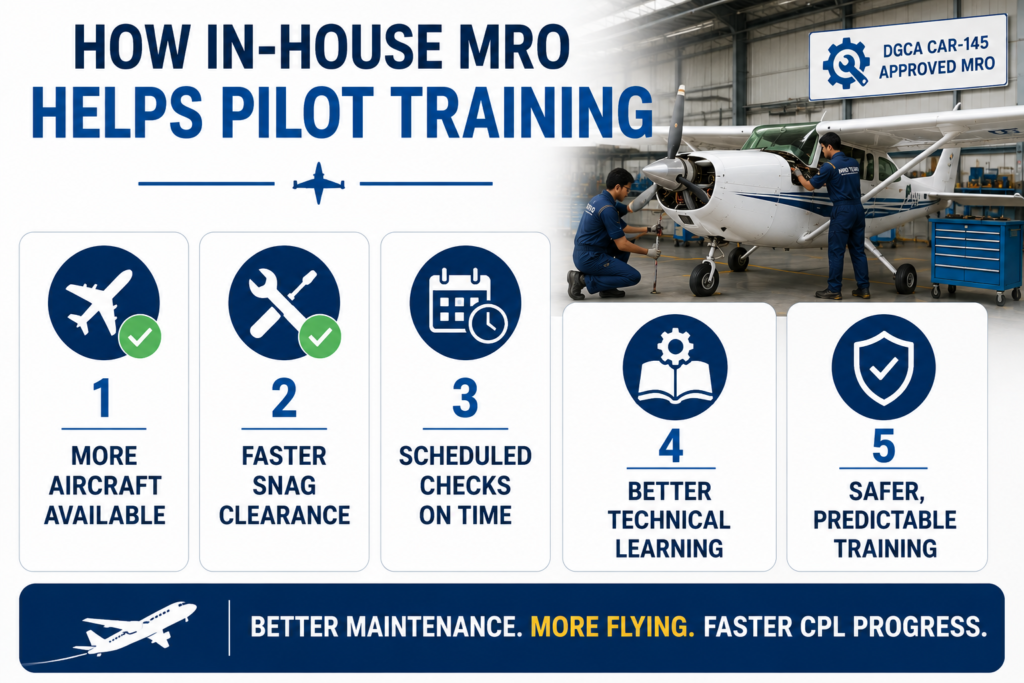
The MRO setup of your flying school directly affects your everyday training.
- Higher aircraft availability: With an in-house DGCA CAR-145 approved MRO, snags can be cleared on the same day, sometimes within a few hours. More serviceable aircraft equals more flying hours for you.
- Faster turnaround during scheduled checks: When 50-hour and 100-hour checks are due, an in-house MRO plans them around the training schedule. Outside MROs work according to their own queue.
- Better technical exposure: You can actually walk into the hangar, see how an engine inspection is done, and understand the technical log of the aircraft you fly.
- Stronger safety culture: When the same management runs both flying and maintenance, safety becomes part of the daily culture.
- Predictable training timelines: This is the single biggest reason Indian pilot students take longer to finish their CPL. With a CAR-145 in-house MRO, your training timeline becomes predictable.
VFTI’s In-House MRO Advantage for CPL Students
Vision Flying Training Institute (VFTI), based in Amreli, Gujarat, with its admission office in Dwarka, New Delhi, is one of the few flying schools in India that offers:
- A modern fleet including Tecnam P2008 JC, Cessna 172 Skyhawk, Tecnam P-Mentor, and a Tecnam Multi Engine Simulator.
- A DGCA CAR-145 approved in-house MRO
- Its own CAMO department for tracking flight hours, airworthiness directives, service bulletins, and technical records.
- DGCA-licensed AMEs and experienced technicians.
When you train at VFTI, you are not depending on an outside vendor for the safety and serviceability of the aircraft you fly.
Career Paths in Indian Aviation Beyond the Cockpit
Students who enter aviation to become pilots after 10+2 with physics and mathematics can explore several career paths connected to aircraft maintenance, safety, and operations.
| Career Path | What You Do |
| Aircraft Maintenance Engineer (AME) | Inspect, maintain, and certify aircraft. DGCA-licensed under CAR-66. |
| MRO Technician | Hands-on repair and inspection work in an MRO facility. |
| CAMO Engineer / Planner | Track airworthiness, plan maintenance, and manage records. |
| Quality / Safety Officer | Audit MRO processes and ensure DGCA compliance. |
Frequently Asked Questions (FAQs)
- What does MRO stand for in aviation?
MRO stands for Maintenance, Repair, and Overhaul. It refers to all the activities that keep an aircraft safe, airworthy, and ready to fly throughout its life.
- Is MRO important for pilots to know?
Yes. Pilots are responsible for accepting the aircraft before each flight. A basic understanding of MRO helps you read technical logs, understand defect reports, and communicate clearly with engineers. It also matters in airline interviews.
- What is the difference between MRO and CAMO?
An MRO physically performs maintenance, repair, and overhaul on the aircraft. A CAMO (Continuing Airworthiness Management Organisation) plans and tracks all maintenance, manages records, and ensures the aircraft stays airworthy at all times.
- What is DGCA CAR-145?
CAR-145 is the regulation issued by India’s DGCA that lays down the rules for approval of aircraft maintenance organisations. Any MRO working on commercial or training aircraft in India must hold a valid CAR-145 approval.
- What are A, B, C, and D checks?
These are scheduled aircraft maintenance checks of increasing depth. A and B checks are lighter, often performed overnight or in a few days. C and D checks are heavier, take weeks, and need a hangar.
- Can I become a pilot if I am interested in MRO too?
Yes. Many CPL holders also take a strong interest in maintenance. Some even later qualify as Type Rating Examiners or move into airline technical and safety roles.
- What aircraft does VFTI maintain at its in-house MRO?
VFTI’s CAR-145 approved MRO supports popular training aircraft including Cessna series, Tecnam aircraft, Diamond DA40 / DA42, and Piper PA-28 series, among others.
Conclusion
Aircraft MRO is the backbone of every safe flight. A flying training institute that takes MRO seriously is a flying school that takes you seriously.
Every Indian pilot aspirant must pick an institute that is:
- DGCA approved for pilot training.
- CAR-145 approved for in-house MRO.
- Backed by its own CAMO department.
- Equipped with a modern training fleet and skilled instructors.
- Located in a place with good flying weather and dedicated airspace.
Vision Flying Training Institute (VFTI) ticks every one of these boxes. With our DGCA-approved CPL, PPL, and Conversion Flying courses, our CAR-145 in-house MRO, our CAMO department, and our 365-day flying weather in Amreli, Gujarat, we are built for one job: to turn serious aspirants into safe, skilled, and career-ready pilots.
If you are ready to start your aviation journey with a flying school that is as committed to maintenance as it is to flying, talk to us today.
→ Explore VFTI Courses: https://vfti.co.in/courses
→ Visit Our MRO Facility: https://vfti.co.in/mro
→ Enquire Now: https://vfti.co.in/contact-us