
How Difficult Are DGCA Exams? Difficulty & Preparation Tips
Parth
November 20, 2026
•10 min read
Becoming a commercial pilot is an exciting career aspiration, and passing the DGCA exams is one of the crucial steps towards meeting the commercial pilot licence requirements. Many aspiring pilots have a single question in mind: how difficult are the DGCA exams, and how should they prepare for them?
The Directorate General of Civil Aviation (DGCA) conducts exams to assess whether pilots in training have the theoretical knowledge needed to fly safely. These tests cover various facets of aviation, such as navigation, aviation regulations, meteorology and aircraft systems.
The exams are not impossibly hard, but they do need planning, regular practice and a clear understanding of aviation concepts. With the right preparation strategy, students can maximise their chances of passing every required paper.
In this article we discuss how tough the DGCA exams really are, which papers are the toughest, and how an aspiring commercial pilot can prepare.
What is the Difficulty Level of the DGCA Exams?
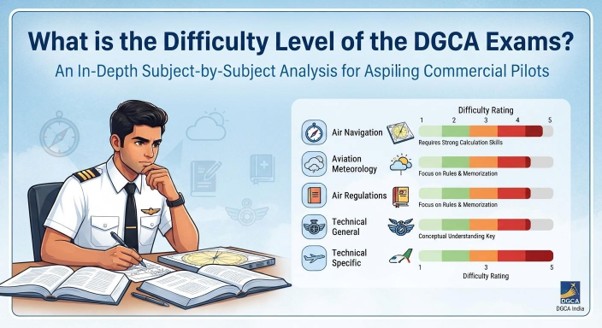
DGCA exams are generally reported to be of moderate to difficult level, especially for students who are new to aviation subjects. The main challenges depend on your background, your comfort with mathematics and physics, and the study routine you follow.
DGCA exams are not like normal school exams. They test aviation knowledge and, more importantly, how well you can apply it. Students should learn how aircraft fly, how weather influences flight and how a pilot uses navigation systems.
In India, candidates for a Commercial Pilot Licence (CPL) have to take five written examinations:
- Air Navigation: Covers flight planning, chart interpretation and navigation techniques.
- Aviation Meteorology: Covers weather, clouds and winds as well as changes in the atmosphere.
- Air Regulations: Covers international, national and local regulations, rules and practices pertaining to flight.
- Technical General: Covers the principles of flight, instruments and engines used in flight.
- Technical Specific: Covers the technical details of specific aircraft types.
You can read the full DGCA syllabus breakdown to see exactly what each subject includes.
Candidates need at least 70% marks in each subject to pass. Each subject is assessed separately, so a high score in one subject cannot make up for a low score in another.
What are the Toughest Exam Papers in the DGCA Exams?
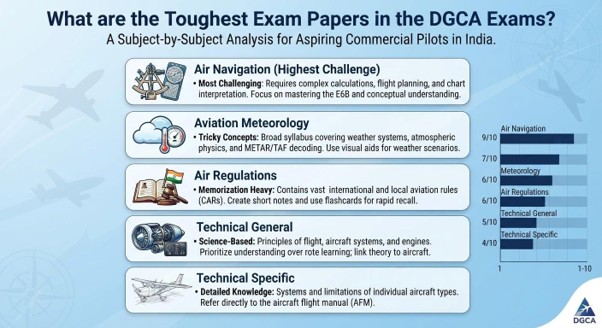
The subjects are not equally difficult. Some demand strong calculation skills, while others test your ability to memorise and understand technical concepts. Here is a general look at how difficult each of the five main CPL subjects is.
Air Navigation
Air Navigation is often considered one of the most challenging DGCA subjects. It involves calculations, charting, directions and navigation tools. Students must understand wind correction angle, ground speed, distance, time and fuel calculations.
Preparation tip: Solve numerical problems daily. Do not learn formulas by rote without knowing what they are used for.
Aviation Meteorology
Meteorology can be tricky because it covers many concepts. Students should learn about weather systems, temperature, humidity, clouds, wind and atmospheric pressure. It is also important to be able to interpret aviation weather briefings and forecasts.
Preparation tip: Use diagrams and real weather conditions to understand different atmospheric scenarios. Revise key definitions and weather concepts regularly.
Air Regulations
Air Regulations primarily covers aviation rules, regulations and law. It includes Indian aviation regulations as well as the international standards and rules a pilot must follow. Many students find it difficult because they have to memorise many rules and technical terms.
Preparation tip: Make short notes for important regulations, revise them often, and relate each rule to how it applies in real flying.
Technical General
Technical General covers aircraft systems, engines, instruments, electrical systems and basic aerodynamics. Students with a science background may have an advantage in some topics, although others can still be technically demanding.
Preparation tip: Learn how the different aircraft systems work. Focus on understanding rather than rote learning textbook paragraphs.
Technical Specific
Technical Specific covers the systems, performance and technical data of a specific aircraft. Detailed knowledge of aircraft components, limitations, operating procedures and technical specifications is essential.
Preparation tip: Use the aircraft flight manual and approved references for the aircraft type, and focus on its construction details and specific data.
Why Do Students Find DGCA Exams Hard?
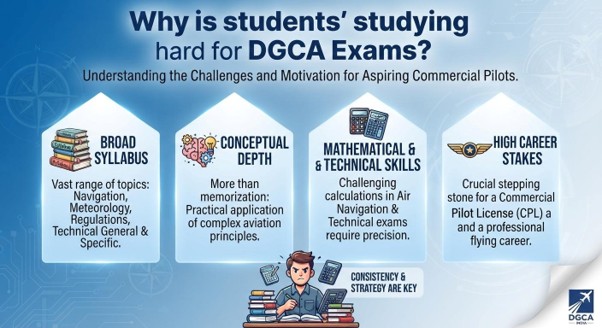
Students struggle with DGCA exams for a variety of reasons:
- Broad syllabus: There are many aviation concepts, terms and calculations. Covering them without a timetable can be difficult.
- Lack of conceptual understanding: Memorising answers is not enough. Students must apply aviation concepts to real-life situations.
- Weak mathematics for Air Navigation: The subject involves many types of calculations. Students uncomfortable with basic maths need extra practice.
- Poor time management: Without a fixed schedule for multiple subjects, students get overloaded.
- Skipping revision: Learning new topics every day often means previously studied topics are forgotten.
Recognising these problems early helps students prepare better.
Best Preparation Tips to Pass DGCA Exams
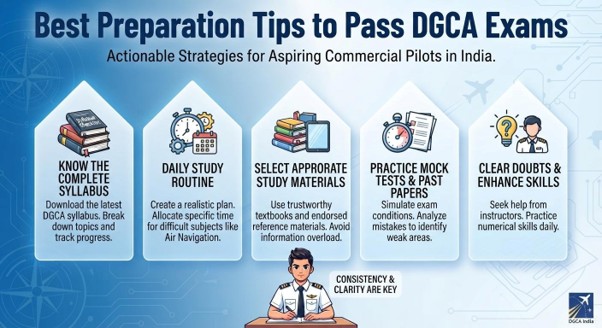
Passing the DGCA exams requires consistency and regular preparation rather than long study hours in a short span. Here are some tips to help you prepare.
Know the Complete Syllabus
Start by downloading the latest DGCA syllabus and exam information from the official website. Break big chapters into smaller topics and make a checklist for each, so you can track progress and not miss anything. For a detailed walkthrough of the whole process, see our step-by-step guide to clearing DGCA exams.
Follow a Daily Study Routine
Make a realistic study plan. Allow longer study periods for topics you find difficult, such as Air Navigation and Technical General. Study every day and do not postpone your preparation to the last minute. A balanced daily routine could look like this:
- 2 hours for Air Navigation and numerical practice
- 1.5 hours for Technical General or Technical Specific
- 1 hour for Meteorology
- 1 hour for Air Regulations
- 30 minutes for revision
Modify the schedule based on your learning speed and exam date.
Select Appropriate Study Materials
Use trustworthy aviation textbooks, endorsed reference books and DGCA syllabus documents. Avoid accumulating too many books. Choose a few reliable sources and master them.
Practise Previous Question Papers and Mock Tests
Solving previous questions helps you understand the nature of the exam and identify weak areas. Take mock tests under time constraints, then go through the answer key and understand why you made each mistake.
Enhance Your Numerical Skills
Air Navigation contains many calculations and cannot be neglected. Practise basic mathematics, conversions and navigation calculations to sharpen your skills and build confidence.
Prepare Short Revision Notes
Short notes on aviation terminology, weather, formulas and regulations are handy during revision.
Clear Your Doubts Early
Talk to experienced instructors or peers about topics you cannot grasp. Attend classes regularly and do not skip subjects you find hard.
How Long Does It Take to Prepare for DGCA Exams?
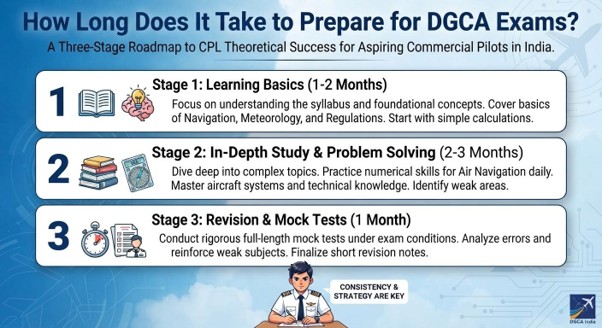
This depends on your educational background, your understanding of aviation subjects and your study hours. Generally, students spend four to six months preparing for the theory exams. Treat this as a rough planning guide. Preparation can be split into three stages.
Stage 1: Learning the basics. Understand the entire syllabus and get an overall picture of each subject. Learn the concepts and practise the basic calculations.
Stage 2: Completing the syllabus and practising. Focus on the more important chapters. Practise questions, identify your weak areas and spend extra time on the harder chapters.
Stage 3: Revision and mock tests. Revise each subject and take full-length mock tests. With the remaining time, concentrate on weak areas rather than new topics.
Can an Average Student Pass DGCA Exams?
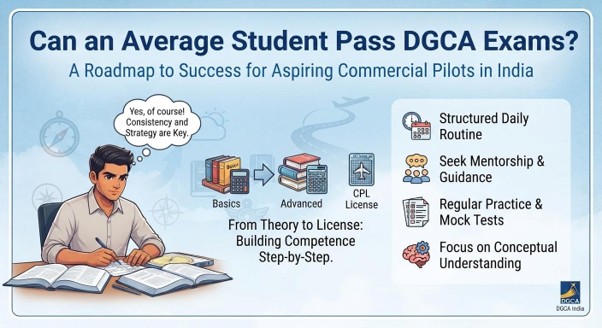
Yes. With the right guidance and enough dedication, an average student can clear the DGCA exams.
Mathematics and science are the two most important foundations for pilot training. For mathematics, the basics of algebra and trigonometry are sufficient. For science, the basics of physics are important. If you come from a commerce background, here is how pilot training without physics works in practice.
Consistency, discipline, clarity of concepts and continuous practice are what it takes to succeed. Students who revise regularly and stick to a study plan usually improve their performance drastically.
Is DGCA Ground School Necessary?
Different instructors provide different study materials, test formats and teaching aids. Choosing the right institute is of utmost importance, so read our guide on how to choose the best DGCA ground classes and compare your options carefully. If you prefer structured classroom or online batches, you can also explore our DGCA ground classes. Remember that frequent practice, patience and effort matter just as much for success.
Frequently Asked Questions
Are DGCA exams difficult to pass? DGCA exams are technical and need detailed understanding. However, every topic is clearly defined, and with enough practice the exams can be cleared.
What is the passing percentage for DGCA exams? For the CPL theory examinations, candidates generally need at least 70% marks in each subject to pass.
Which DGCA subject is the hardest? Air Navigation is arguably the most difficult, as it involves calculations, flight planning and navigation.
How many months are required to prepare for DGCA exams? Many students set aside four to six months for intensive preparation. Ultimately it depends on your understanding of the subject, your study habits and how quickly you learn.
Can I prepare for DGCA exams without coaching? Yes. Self-preparation is possible with reliable textbooks and practice tests. Ground school can give you an extra edge.
Conclusion
Understanding the syllabus is the first step in preparing for the exams. Keep a consistent schedule, practise as many numericals as you can, and make revision a habit.
No two subjects need the same kind of preparation. Constant numerical practice is important for Air Navigation, while understanding the key aviation rules is crucial for Air Regulations.
Consistent practice is the key. With the right study aids and a mentor, and a structured CPL training programme, you can steadily move towards your goal of becoming a pilot.