
Flight Instructor Course in India: Eligibility, Fees, Salary
pgvisav@gmail.com
November 1, 2026
•13 min read
A flight instructor course in India prepares qualified pilots to teach others to fly. A newly qualified commercial pilot will usually consider the Assistant Flight Instructor Rating (AFIR) first, followed by the Flight Instructor Rating (FIR) as experience develops. Both qualifications involve more than accumulating flying hours; candidates must also demonstrate instructional knowledge, effective communication and practical teaching competence.
Flight instruction can offer a professional career in its own right. It also develops communication, judgement and aircraft-handling skills. However, completing an instructor training programme, obtaining a DGCA rating and securing employment are separate milestones, each with its own requirements.
What Does a Flight Instructor Do?
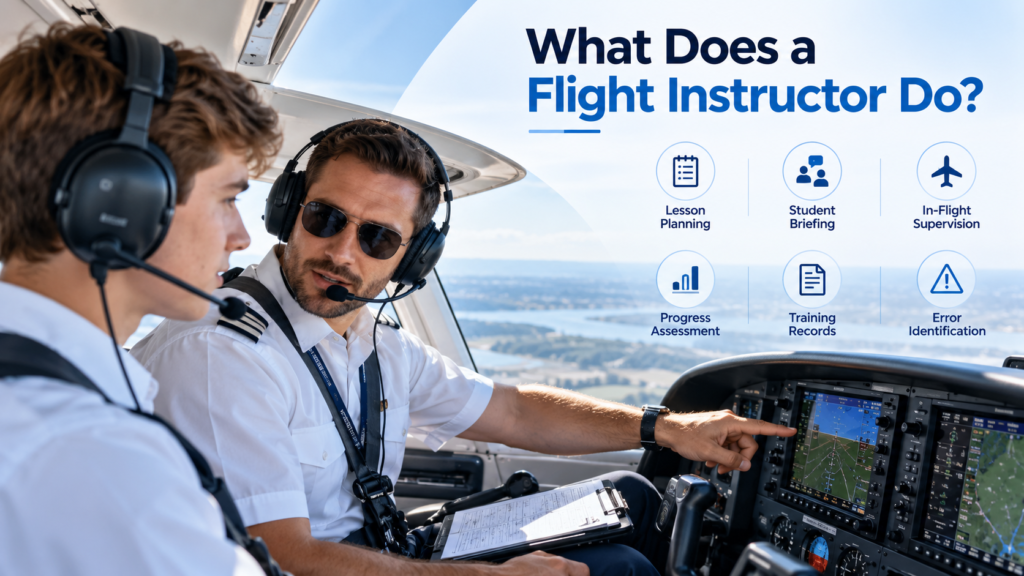
A flight instructor trains student pilots to develop the knowledge, practical flying skills and judgement required for safe aircraft operations. Their work extends beyond demonstrating flying manoeuvres.
A typical training cycle includes preparing a lesson, briefing the student, supervising practice and explaining what needs improvement afterwards. Instructors also monitor student progress, assess performance and maintain training records.
One of the key responsibilities is identifying why a student is struggling. An unstable approach, for example, may result from incorrect aircraft handling, inadequate preparation, or difficulty managing workload. An effective instructor identifies the underlying issue, explains the necessary correction, and helps the student improve through structured practice.
AFIR vs FIR: What is the Difference and Which Rating Should You Choose?
India recognises two distinct flight instructor qualification pathways: the Assistant Flight Instructor Rating (AFIR) and the Flight Instructor Rating (FIR).
Although both qualify pilots for instructional responsibilities within their respective privileges, they differ in eligibility requirements, flying experience, assessment procedures, and instructional authority.
Understanding these differences can help you identify which rating matches your current qualifications and long-term flight instruction goals.
| Point of comparison | Assistant Flight Instructor Rating | Flight Instructor Rating |
| Minimum application age | 18 years | 20 years |
| Typical candidate | A professional pilot beginning flight instruction | A pilot meeting the higher experience requirements |
| Teaching authority | Daytime instruction under a Flight Instructor’s authority and supervision, within prescribed limits | Broader instructional privileges, subject to ratings and DGCA directions |
| First solo authorisation | Not permitted | Permitted within applicable privileges and directions |
| Initial rating validity | 12 months | 12 months |
An AFIR holder operates under specific instructional limitations. AFIR privileges do not include night-flying or aerobatic instruction, and instruction is restricted to appropriately endorsed aircraft with an all-up weight not exceeding 1,500 kg. These limitations appear in DGCA’s AFIR requirements under Schedule II, Section Q.
A ground instructor position is different. Teaching aviation theory or conducting classroom sessions does not automatically authorise someone to provide practical flight instruction in an aircraft.
Flight Instructor Qualification In India
The eligibility requirements for becoming a flight instructor in India depend on the rating you intend to obtain, your existing pilot licence, and your recorded flying experience. The DGCA specifies separate requirements for the Assistant Flight Instructor Rating (AFIR) and Flight Instructor Rating (FIR).
Pilots applying for an Assistant Flight Instructor Rating (AFIR) must satisfy the applicable licensing, experience, training and assessment requirements.
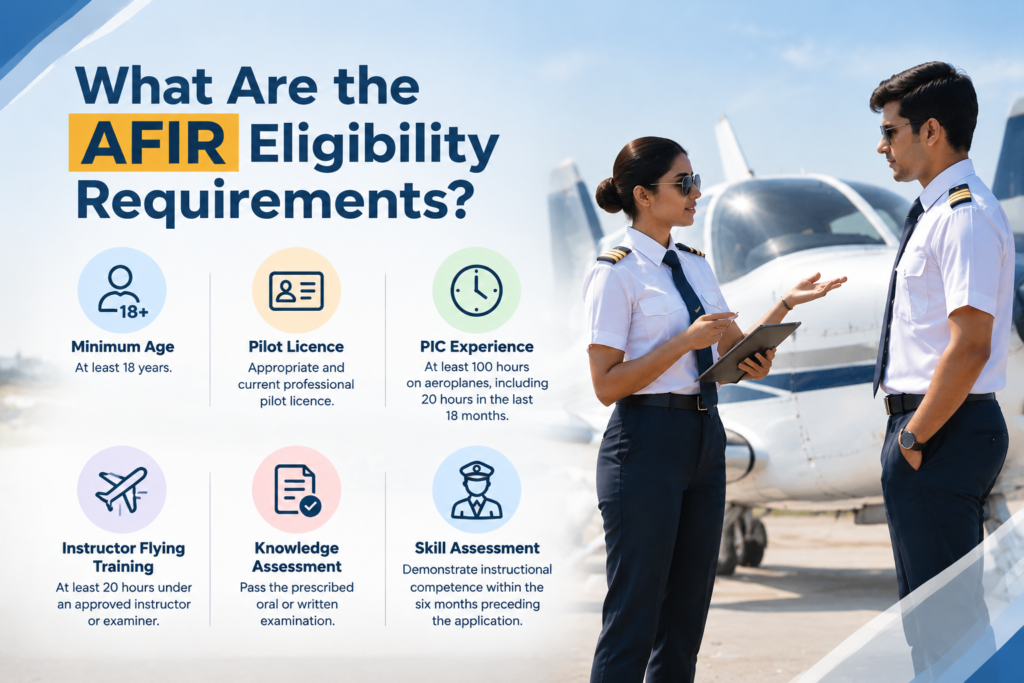
The principal aeroplane qualifications include:
- Minimum age: At least 18 years on the date of application.
- Pilot licence: An appropriate and current professional pilot licence.
- Pilot-in-command (PIC) experience: At least 100 hours on aeroplanes, including a minimum of 20 hours within the preceding 18 months.
- Instructor flying training: At least 20 hours of training under an approved Flight Instructor or Examiner, following the prescribed syllabus.
- Knowledge assessment: Passing the prescribed oral or written examination.
- Skill assessment: Successfully demonstrating instructional competence within the six months preceding the application.
These requirements apply to aeroplane pilots. Helicopter applicants have different flying-experience requirements.
Pay particular attention to pilot-in-command (PIC) hours, which must be distinguished from total flight time. Having 200 hours in your logbook does not automatically establish that you meet the minimum PIC experience requirements for AFIR.
Candidates should also confirm applicable medical fitness, radio-telephony, English-language proficiency and aircraft-rating requirements with the relevant training organisation. Admission and employment may involve additional conditions.
Can You Become a Flight Instructor After Class 12?
A beginner cannot move directly from Class 12 into aircraft instruction. The usual professional route starts with Commercial Pilot Licence (CPL) training.
The CPL pathway requires 10+2 or equivalent with Physics and Mathematics, the applicable medical fitness, examinations, flying experience, and skill tests. VFTI’s guide to applying for pilot training in India explains the earlier admission stages of professional pilot training.
How Can You Progress from AFIR to FIR?
The Flight Instructor Rating (FIR) has separate eligibility and experience requirements under DGCA regulations. Importantly, there is more than one qualifying aeroplane experience route, so FIR eligibility should not be reduced to a universal requirement of 500 flying hours and 200 instructional hours.
Under DGCA Schedule II, Section R, the specified aeroplane experience routes include:
- Instructional-experience route: 200 hours in the prescribed assistant flight instructor capacity, together with 20 hours of night PIC flying involving at least 20 take-offs and 20 landings.
- PIC-experience route: 500 hours as pilot-in-command of an aeroplane.
Meeting either experience route does not automatically grant an FIR. Applicants must also satisfy the applicable minimum age, professional licence, knowledge assessment, approved instructor training and skill test requirements.
Pilots intending to provide instrument flight instruction must additionally hold a current Instrument Rating, as applicable under the relevant DGCA provisions.
Before planning your progression, review the complete requirements under Section R and confirm that your logged experience, training and assessments satisfy the applicable route.
How to Become a Flight Instructor in India
Becoming a flight instructor in India involves meeting the applicable DGCA eligibility requirements, completing approved instructional training, demonstrating teaching competence and obtaining the relevant instructor rating. The following steps outline the process.
Step 1: Check Your Pilot Licence and Flying Experience Logbook
Before enrolling in an instructor training programme, have your existing licence and flying records reviewed by the training organisation.
The assessment should cover:
- Total flying hours and pilot-in-command (PIC) hours.
- Recent flying experience.
- Aircraft endorsements and ratings.
- Licence and medical validity.
- Any outstanding experience or eligibility requirements.
Request a written assessment identifying the requirements you have already met and those you still need to complete. This helps you avoid paying for training before confirming your eligibility.
Step 2: Select the Appropriate AFIR or FIR Training Programme
Identify whether you qualify for the Assistant Flight Instructor Rating (AFIR) or Flight Instructor Rating (FIR). The two pathways have different eligibility requirements, instructional privileges, and assessment procedures.
Before enrolling, confirm:
- Which instructor rating the programme prepares you for.
- Who will conduct the instructional training and assessments.
- Which aircraft will be used for practical training.
- Whether the training arrangements meet the applicable DGCA requirements.
- What examinations and skill assessments are included.
A Flight Training Organisation’s (FTO) approval to conduct Commercial Pilot Licence (CPL) training should not automatically be treated as confirmation that it is authorised or equipped to provide every instructor-training arrangement.
Step 3: Complete Flight Instructor Ground Training
Instructor ground training develops the teaching knowledge and instructional techniques needed to train student pilots effectively.
Common subject areas include:
- Learning and teaching methods: Understanding how students acquire flying knowledge and practical skills.
- Lesson planning: Preparing structured briefings and training exercises.
- Student assessment: Monitoring performance and evaluating progress.
- Error recognition and correction: Identifying mistakes and explaining appropriate corrective actions.
- Training aids: Using classroom materials and instructional techniques effectively.
- Human factors and safety: Understanding human performance, threat and error management, and the risks involved in simulating aircraft failures.
Strong aviation knowledge remains essential, but instructor preparation adds a separate teaching component.
VFTI’s guide to CPL ground training provides useful background on pilot theory preparation and the knowledge foundation required before progressing into instructional training.
Step 4: Complete Patter Flying and Instructor Assessments
“Patter flying” refers to practising flight instruction while demonstrating and explaining flying exercises. Candidates learn to demonstrate manoeuvres, communicate instructions and monitor a student’s performance simultaneously.
Effective patter flying requires more than continuously describing each action. You must communicate clearly, maintain situational awareness and explain the purpose of each exercise while managing the aircraft safely.
Complete the prescribed flying training and skill assessment, and follow the applicable examination process. DGCA’s FIR/AFIR oral-examination notice confirms that candidates require a Computer Number and use Pariksha. Check the current notice board for application windows.
Step 5: Obtain the Instructor Rating and Apply for Suitable Jobs
After successfully completing the applicable training, examinations, and assessments, proceed with the instructor rating application and submit the required supporting documentation.
Remember that completing an instructor course does not automatically grant AFIR or FIR privileges. The relevant rating must be issued after the applicable requirements have been satisfied.
Once qualified, look for instructor vacancies that match your rating, aircraft experience, flying-hour requirements and current licence status.
Prepare for recruitment assessments by practising student briefings, explaining common flying errors and demonstrating how you would guide a learner through challenging exercises. Review each vacancy carefully because flying schools may specify additional experience and currency requirements.
How Long Does It Take to Complete a Flight Instructor Course in India?
The duration of a flight instructor course depends on the rating, training provider, and the candidate’s existing flying experience. It is also important to distinguish the advertised training duration from the total time required to obtain the instructor rating and become eligible for employment.
For example, Asia Pacific Flight Training advertises an AFIR programme lasting approximately eight weeks. This is a provider-specific schedule, not a guaranteed completion period for every candidate or a national DGCA timeline.
Your overall timeline may also be affected by:
- Additional flying required to meet experience criteria.
- Availability of examinations and assessment dates.
- Aircraft maintenance and weather interruptions.
- Completion of instructor skill tests.
- Documentation and rating application processing.
Before enrolling, ask the training organisation for two separate timelines: the expected duration of classroom and practical training, and the estimated time required to complete the assessments and obtain the relevant instructor rating.
What is the Cost of Flight Instructor Training in India?
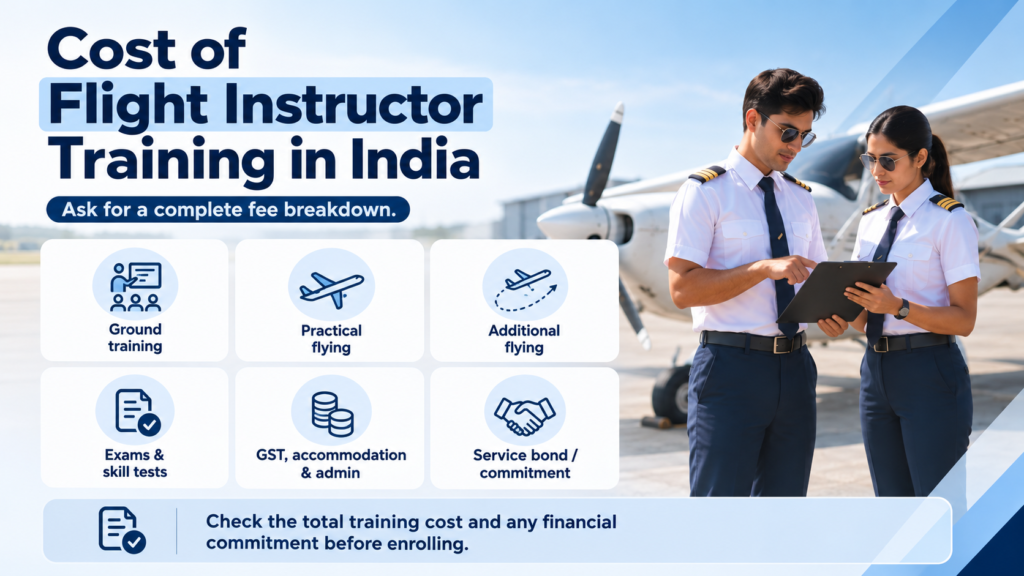
The cost of flight instructor training in India depends on the rating, training provider, aircraft used, and additional flying or assessment requirements. When comparing programmes, request a complete fee breakdown rather than relying only on the advertised price for instructor or patter flying.
Before enrolling, check whether the quotation includes:
- Ground training: Instructor theory classes and teaching preparation.
- Practical flying: Instructor flying and aircraft familiarisation.
- Additional flying: Any recency flying or experience required before assessment.
- Examination and assessment fees: Initial skill tests, examination charges and repeat attempts.
- Additional expenses: GST, accommodation, administrative charges and other applicable costs.
Also, check whether a training-linked employment arrangement includes a service bond or minimum employment commitment.
For example, IGRUA’s July 2026 Trainee Assistant Flying Instructor advertisement, which is now closed, included a declaration relating to a ₹25 lakh service bond and a minimum two-year commitment. This was a specific employment arrangement, not a standard flight instructor course fee.
Before accepting such an offer, carefully review the bond amount, repayment conditions, exit provisions, and employment terms.
The actual cost of becoming a flight instructor should include both the training investment and any contractual financial commitments associated with the opportunity.
Flight Instructor Salary in India
Flight instructor pay depends on the employer, rating, experience, aircraft qualifications, and contract. Fixed salary, flying allowance, and cost to company should be compared separately.
A documented example is IGRUA’s 2025 Assistant Flying Instructor advertisement, which offered ₹1,25,000 per month plus ₹500 per flying hour on a contractual basis.
That recruitment has closed. The figure is evidence of one advertised package.
Before comparing flight instructor salary packages, establish:
| Pay component | Question to ask |
| Fixed remuneration | What amount is payable regardless of monthly flying? |
| Flying allowance | Which hours qualify, and when is payment made? |
| Training period | Is there a stipend, salary, or unpaid period? |
| Benefits and deductions | How do accommodation, insurance, and deductions affect take-home pay? |
| Contract obligations | What notice period, bond, or training-cost recovery applies? |
Compare the expected monthly earnings under both regular and lower-flying conditions. This gives you a more realistic picture of the income you can expect from a flight instructor position.
Can Becoming a Flight Instructor Help You Get an Airline Job?
Working as a flight instructor can help you develop valuable flying experience, technical knowledge, communication skills, and decision-making abilities. However, becoming a flight instructor does not guarantee selection for an airline pilot position.
Airline recruitment requirements vary by employer and vacancy. Some positions specify particular aircraft type ratings, minimum flying hours, aircraft-specific experience, or other qualifications that instructional flying hours alone may not satisfy.
Before applying, compare your experience and qualifications with the advertised eligibility criteria. VFTI’s guide to pilot vacancies and airline application requirements in India explains why different recruitment categories require separate eligibility checks.
Choose flight instruction because you are interested in teaching, mentoring student pilots, and taking responsibility for their training and safety. Accumulating flying hours can be an additional benefit, but it should not be your only reason for pursuing the profession.
Not sure which path suits you? Compare the two in our guide to flight instructor vs airline pilot careers.
Build Your CPL Foundation Before Pursuing Flight Instructor Training
Before applying for AFIR or FIR training, establish that your pilot licence, flying experience and other qualifications meet the applicable DGCA requirements.
VFTI offers Commercial Pilot Licence (CPL) training, DGCA ground classes and foreign CPL conversion support. These programmes address different stages of professional pilot training and can help candidates prepare for their next aviation qualification.
If you are still working towards a professional pilot licence, contact VFTI’s admissions team to discuss your CPL pathway. Share your academic background, medical status and existing flying experience so the team can explain the relevant training requirements, programme structure and fees.
Frequently Asked Questions
- Can a fresh CPL holder become a flight instructor?
A fresh CPL holder can pursue AFIR if the required PIC experience, recency, training, examinations, and skill requirements are met. Holding a CPL alone is insufficient.
- Is a Degree Required to Become a Flight Instructor in India?
No. DGCA Schedule II, Section Q does not specify a university degree as a mandatory AFIR eligibility requirement. However, candidates must hold the appropriate professional pilot licence and satisfy the other applicable conditions. Individual employers may specify additional educational qualifications.
- Does an instructor rating remain valid indefinitely?
No. AFIR and FIR are initially valid for 12 months. Maintaining instructional privileges requires the applicable renewal conditions and current supporting qualifications.