
Flight Instructor vs. Airline Pilot: Which Career is Right?
pgvisav@gmail.com
October 31, 2026
•14 min read
A flight instructor trains aspiring pilots to develop the knowledge, technical skills, and judgement needed to fly safely. An airline pilot, on the other hand, operates passenger or cargo flights as part of a professional flight crew.
Both careers require strong aviation knowledge, disciplined decision-making, and practical flying experience, but their daily responsibilities and career progression differ.
You can also pursue both paths at different stages of your career. Becoming a flight instructor can provide valuable teaching experience and help you build flying hours, while airline flying offers opportunities to operate commercial aircraft and progress within an airline.
The right choice depends on whether you enjoy teaching and mentoring future pilots or prefer operating commercial flights as part of an airline crew.
Flight Instructor vs Airline Pilot: Key Differences
| Career consideration | Flight instructor | Airline pilot |
| Main responsibility | Teach flying skills and assess student progress within authorised privileges | Operate airline flights safely within company procedures |
| Working environment | Flying training organisation, training aircraft and briefing rooms | Airline flight deck, airports and simulator training facilities |
| Entry pathway | Appropriate pilot licence, instructor training, assessments and rating | Appropriate licence and ratings, airline selection and employer-specific training |
| Daily interaction | Students with different abilities and learning needs | Fellow pilots, cabin crew, dispatchers and ground teams |
| Schedule considerations | Student bookings, weather, aircraft availability and school operations | Rosters, reporting times, routes, standby and overnight duties |
| Progression | Greater instructional responsibility, supervisory and training leadership roles | First officer, command and potentially training or management roles |
| Best personal fit | Someone who enjoys explaining, observing and developing others | Someone who enjoys coordinated crew operations and structured procedures |
Neither career is automatically easier than the other. Flight instructors must identify, correct, and manage student errors while maintaining a safe learning environment. Airline pilots, meanwhile, handle complex operational demands, make time-sensitive decisions, and maintain effective coordination with other crew members.
What Do Flight Instructors and Airline Pilots Do?
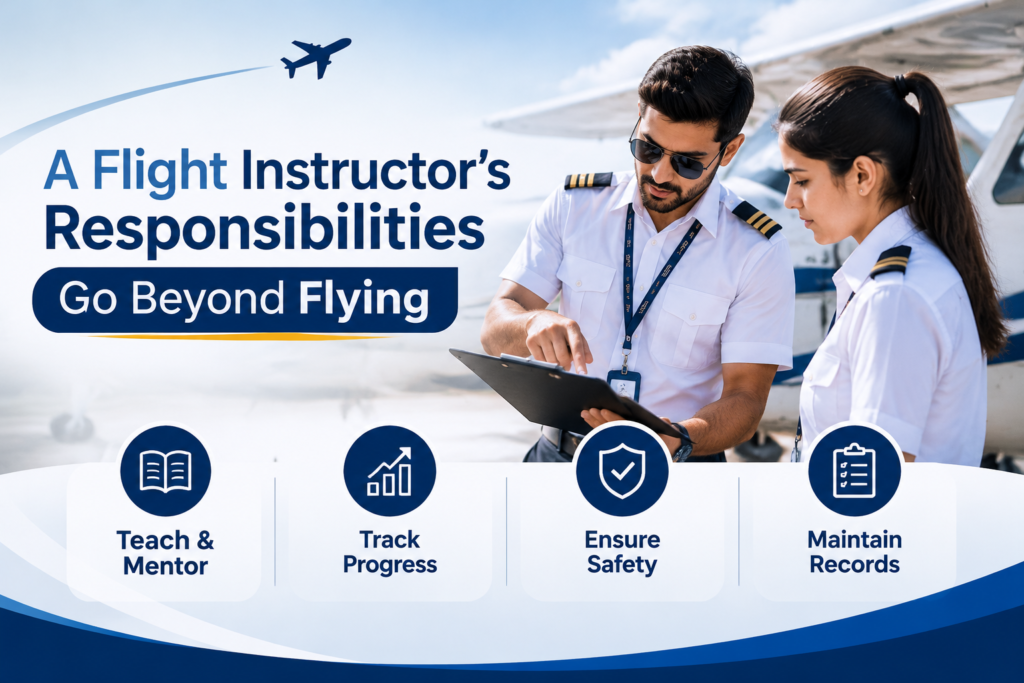
A Flight Instructor’s Responsibilities Go Beyond Flying
A flight lesson usually begins with a specific learning objective. The instructor explains the exercise, demonstrates the required techniques, observes the student’s performance, and provides feedback after the flight.
Student progress is not always consistent. One student may understand an approach briefing but struggle to apply it in the aircraft. Another may demonstrate accurate flying skills but need more guidance with independent decision-making.
Good instruction requires patience, clear communication, and consistent safety standards. Instructors must identify the reasons behind mistakes, explain the necessary corrections, and help students build confidence without compromising safe flying practices.
The role also involves ground briefings, lesson preparation, progress assessments, and maintaining training records. These responsibilities continue even when the instructor is not flying.
An Airline Pilot Works Within a Coordinated Flight Operation
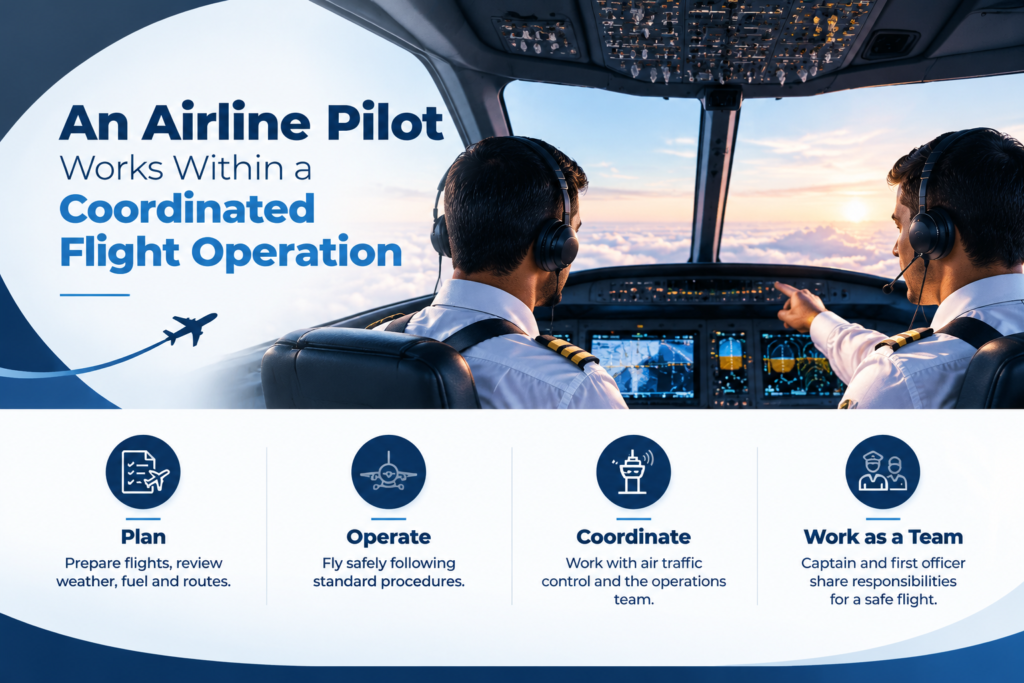
Airline pilots are responsible for preparing and operating commercial flights in accordance with operational procedures and safety requirements. Their duties include flight planning, aircraft inspections, reviewing weather and fuel information, communicating with air traffic control, and following standard operating procedures.
The captain and first officer share flying and monitoring responsibilities according to the operation. While the captain holds overall command responsibility, the first officer actively contributes to operational decisions, communication, and flight safety.
VFTI’s explanation of first officer and captain responsibilities provides further context for these roles.
Although travelling is part of airline flying, the profession involves much more than visiting different destinations. Pilots must operate reliably during delays, challenging weather, changing flight conditions, and other demanding operational situations.
What Qualifications Do You Need to Become a Flight Instructor or Airline Pilot in India?
The qualification requirements for flight instructors and airline pilots in India differ. Although both careers require professional flying knowledge and experience, becoming a flight instructor involves additional instructional qualifications, while airline pilots must meet the licensing, rating and recruitment requirements of their intended operator.
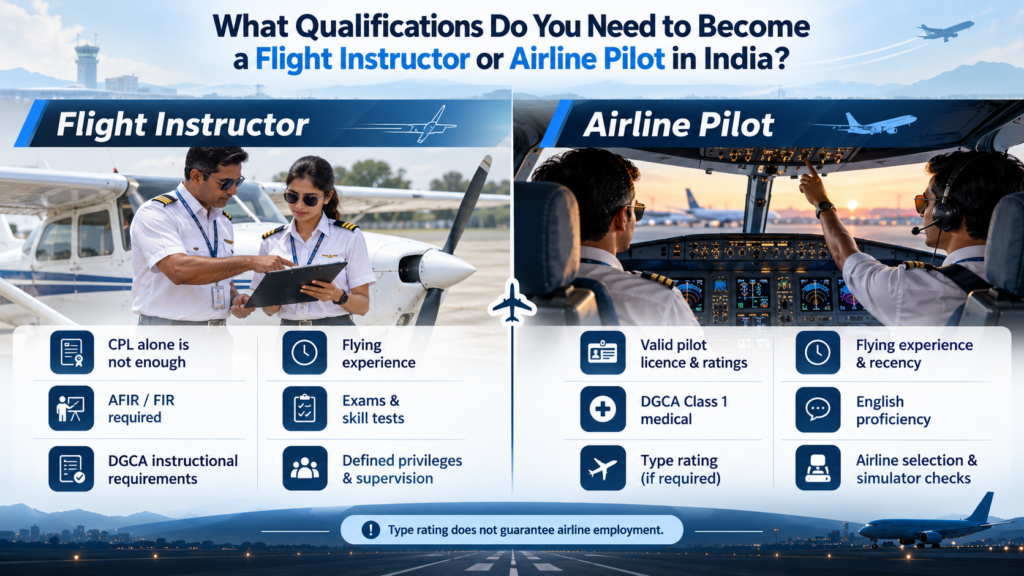
What Qualifications Are Required to Become a Flight Instructor in India?
Holding a Commercial Pilot Licence (CPL) does not automatically authorise you to instruct student pilots. You must obtain the appropriate instructor qualification and meet the applicable DGCA requirements.
India recognises separate Assistant Flight Instructor’s Rating (AFIR) and Flight Instructor’s Rating (FIR) pathways. These involve specific licensing, flying experience, instructional training, examinations and skill assessments.
An assistant flight instructor operates within defined privileges and supervision requirements. For example, the DGCA’s AFIR provisions under Schedule II, Section Q do not authorise an assistant flight instructor to approve a student’s first solo flight.
The FIR provisions under Section R establish separate experience and assessment requirements for flight instructors.
Your existing licence, flying experience and eligibility determine which instructor qualification pathway you can pursue. Review the applicable DGCA requirements before planning additional training.
What Qualifications Are Required to Become an Airline Pilot in India?
Airline pilot recruitment involves different entry categories, each with its own eligibility requirements. A trainee pilot or junior first officer vacancy may have different conditions from an experienced first officer position.
Applicants must meet the applicable requirements relating to:
- Valid pilot licence and required ratings.
- DGCA Class 1 medical fitness.
- Aircraft type rating, where specified.
- Required flying experience and recency.
- English language proficiency.
- Airline-specific selection and assessment criteria.
The recruitment process may include technical examinations, personal interviews, psychometric assessments and simulator checks, depending on the airline and vacancy.
An aircraft type rating qualifies a pilot to operate a particular aircraft type, subject to the applicable licensing and operational requirements. However, completing a type-rating course does not guarantee airline employment. Some airlines expect candidates to hold the relevant rating before applying, while others may provide type-rating training through their recruitment or training programmes.
VFTI’s guide to pilot vacancies and airline applications in India explains how to match your qualifications and experience with the requirements of different airline recruitment categories.
Flight Instructor vs Airline Pilot Salary: What Should You Compare?
A useful salary comparison starts with equivalent career stages. Comparing a newly qualified flight instructor with an experienced airline captain can give a misleading picture of earning potential.
How Much Does a Flight Instructor Earn in India?
Flight instructor salaries depend on qualifications, instructional experience, flying hours, employer, and contractual arrangements. Some organisations offer a fixed monthly salary, while others combine fixed pay with additional flying-hour allowances.
An example is the IGRUA Assistant Flying Instructor recruitment advertisement from 2025, which offered ₹1,25,000 per month plus ₹500 per flying hour. This was a specific contractual vacancy with its own eligibility requirements. It is not a national salary average or guaranteed starting package.
VFTI’s guide to Commercial Pilot Licence salary and career opportunities in India provides further information about instructor earnings and other career options available after obtaining a CPL.
How Much Does an Airline Pilot Earn in India?
Airline pilot earnings vary according to the airline, rank, aircraft fleet, flying experience, and employment contract. A trainee pilot, junior first officer, experienced first officer, and captain can have substantially different compensation packages.
The following are indicative monthly salary ranges:
| Airline Position | Approximate Monthly Salary |
| Junior First Officer | ₹1.5 lakh–₹3 lakh |
| Experienced First Officer | ₹2.5 lakh–₹4.5 lakh |
| Senior First Officer | ₹3.5 lakh–₹4.5 lakh |
| Captain (Narrow-body aircraft) | ₹5 lakh–₹8 lakh |
| Senior Captain | ₹8 lakh–₹15 lakh or more |
These figures are indicative rather than guaranteed salaries. Actual compensation depends on the airline, aircraft fleet, flying hours, seniority, allowances and employment contract.
A salary advertised for an experienced airline captain should not be treated as an expected starting salary for a newly qualified CPL holder. Training arrangements, type-rating requirements and the time taken to secure an airline position also affect the overall financial picture.
You can read VFTI’s detailed guides on pilot salary in India and First Officer vs Captain salary, responsibilities and career growth for a closer comparison of airline pilot earnings.
What Should You Compare Before Choosing Either Career?
When evaluating a flight instructor or airline pilot opportunity, request a written compensation breakdown and compare:
- What fixed amount is payable each month?
- Which allowances depend on flying hours or duties?
- What is paid during training and probation?
- Are accommodation, insurance or travel benefits included?
- What deductions, service commitments or repayment clauses apply?
Your decision should account for the financial commitment before employment as well as the salary you can expect after joining. A higher advertised package does not necessarily mean greater financial security if a significant portion depends on flying hours or additional conditions.
Flight Instructor vs Airline Pilot: Which Career Offers a Better Lifestyle?
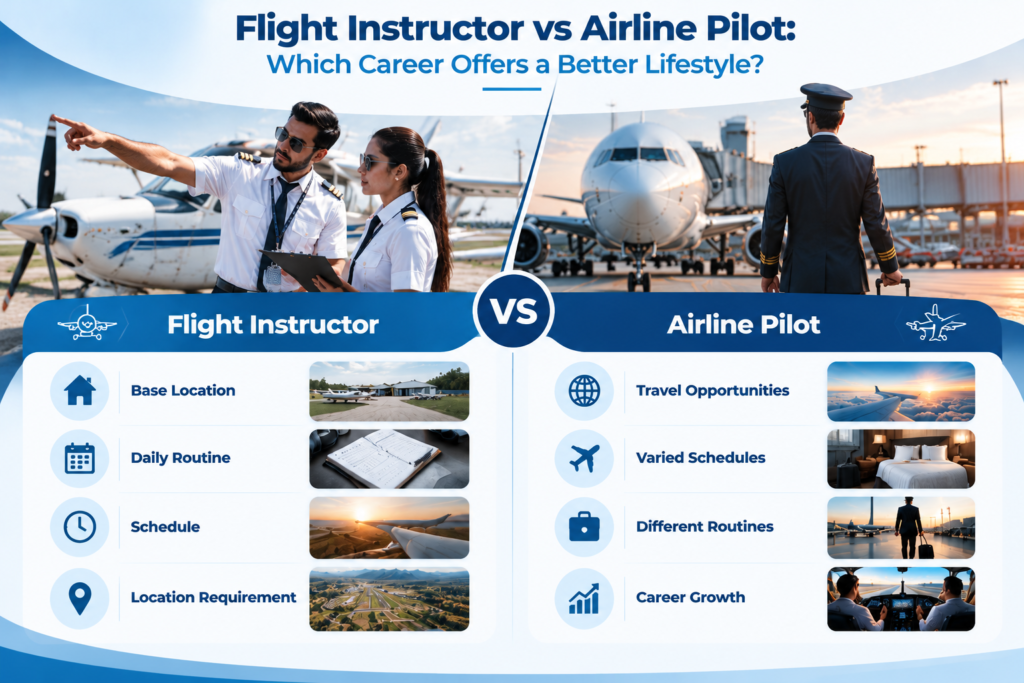
Lifestyle is an important factor when choosing between a flight instructor and an airline pilot career. Both involve irregular schedules and operational responsibilities, but the working environment, travel commitments, and daily routines can differ considerably.
What is the Work-Life Balance of a Flight Instructor?
Working as a flight instructor may offer a more consistent base location, as you generally report to the same flying school for training assignments. This can suit pilots who prefer staying in one location and building a regular professional routine.
However, a flying school job does not necessarily follow standard office hours. Early morning flights, weekend duties, and schedule changes caused by weather conditions or aircraft maintenance can affect your routine. The location of the flying school may also require relocation.
Before accepting an instructor position, clarify the working days, flying schedule, leave arrangements, and accommodation options.
What is the Lifestyle of an Airline Pilot Like?
An airline pilot’s lifestyle depends heavily on the assigned roster, aircraft fleet, route network, and operating base. Duties can involve early reporting, late finishes, standby periods, overnight stays, and travel between destinations.
Domestic and international airline operations can also create different routines. A domestic pilot may operate several sectors within a day, while an international pilot may spend longer periods away from the assigned base.
Consider commuting requirements, base allocation, roster patterns and time away from home alongside the opportunities for travel and career progression.
Ultimately, neither career guarantees a better work-life balance.
The better choice depends on your preferred working environment, family responsibilities, location preferences and ability to manage an unpredictable schedule.
Can You Become an Airline Pilot After Working as a Flight Instructor?
Yes. A flight instructor can transition to an airline pilot career, provided they meet the airline’s current eligibility requirements and successfully complete its recruitment and training process.
Working as an instructor can strengthen several skills relevant to airline operations, including aircraft handling, technical knowledge, communication, situational awareness, and decision-making. However, flight instruction experience is not automatically equivalent to experience operating a commercial airline aircraft.
For example, Air India’s published A320 First Officer eligibility criteria include a minimum of 500 hours on the A320 family. Flying hours accumulated while instructing on light training aircraft would not satisfy this specific aircraft-experience requirement.
Other airline vacancies may have different experience categories and entry conditions. Check whether the airline accepts total flying hours, instructional experience, or requires experience on a particular aircraft type before applying.
VFTI’s article on skills pilots need during airline recruitment provides further guidance on the professional skills and preparation involved.
Which Path Makes More Financial Sense After CPL?
Choosing between a flight instructor and airline pilot career after obtaining a Commercial Pilot Licence (CPL) requires looking beyond the advertised salary. Consider the additional training costs, time before employment, realistic earning potential, and financial commitments associated with each pathway.
A flight instructor route may involve additional instructor-rating training, examinations, assessments, accommodation and ongoing licence and medical expenses. The airline pathway may involve aircraft-specific type-rating training, recruitment preparation and other costs, depending on the airline’s selection and training arrangements.
Prepare a financial plan covering four important areas:
- Qualification costs: Instructor ratings, aircraft type ratings, training fees and required assessments.
- Living expenses: Accommodation, travel, food and everyday expenses before regular employment income begins.
- Licence maintenance: Medical examinations, proficiency checks and any flying required to maintain eligibility.
- Contractual commitments: Training bonds, notice periods, repayment clauses and other employment obligations.
Also, ask prospective employers how compensation is structured and what happens when flying activity is lower than expected. Packages with substantial variable components require particular attention when planning monthly expenses.
Do not choose flight instruction solely because it appears to be a cheaper way to accumulate flying hours. Teaching requires commitment, preparation, and responsibility towards student safety. Equally, do not assume that self-funding an airline type rating guarantees recruitment.
The more financially suitable pathway is the one you can realistically afford, qualify for and sustain while working towards your long-term career goals.
How to Decide Whether a Flight Instructor or Airline Pilot Career Suits You
Choosing between flight instruction and airline flying requires an honest assessment of your interests, professional goals and preferred working environment. Both careers offer different responsibilities and opportunities, so consider the nature of the work rather than focusing only on salary or career progression.
Consider flight instruction if you enjoy developing people
Flight instruction may suit you if you enjoy explaining technical concepts, guiding others through challenging tasks, and watching students develop their flying skills.
The role requires patience, effective communication, and the ability to identify and correct mistakes while maintaining safety standards.
Ask yourself: Would I still enjoy teaching and mentoring student pilots if an airline opportunity took longer than expected?
If you find satisfaction in developing other pilots, flight instruction may offer a rewarding professional pathway.
Consider airline flying if crew operations appeal to you
An airline pilot career may suit you if you enjoy operating commercial aircraft, following structured procedures and sharing responsibility within a professional flight crew.
The role requires adaptability, disciplined decision-making and the ability to work with changing rosters, operational demands and employer-specific procedures.
Ask yourself: Am I comfortable with regular assessments, possible relocation, changing schedules, and the responsibilities of commercial airline operations?
Your answers can help clarify which professional environment aligns with your expectations.
Neither career makes someone a better pilot by default. The right choice depends on whether you find greater professional satisfaction in teaching future pilots or operating commercial flights as part of an airline crew.
Make an Informed Decision Before Investing in Pilot Training
Your first investment in aviation training should support a career goal, even if you are still deciding between flight instruction and airline flying.
VFTI offers Commercial Pilot Licence (CPL) training and DGCA ground classes. If you are considering the CPL pathway, speak with VFTI’s admissions team about your eligibility, the training structure, and a current written fee breakdown.
Bring your career goals, questions, and budget to the discussion. Request written details of the training schedule, course inclusions, and additional costs so you can assess the commitment before making an admission decision.
Frequently Asked Questions
- Is becoming a flight instructor compulsory before joining an airline?
No. Instructor experience is not a universal airline entry requirement. Eligibility depends on the recruitment category and the airline’s published conditions.
- Can an airline pilot become an instructor later?
Airline pilots may progress into airline training roles after meeting the applicable experience, training, and approval requirements. Teaching at a flying school is a separate pathway with its own rating requirements.
- Do You Need to Choose Between a Flight Instructor and Airline Pilot Career Before Starting CPL Training?
No. You do not need to finalise your career choice before beginning Commercial Pilot Licence (CPL) training. You can develop your preference as you gain flying experience and understand the responsibilities involved in each career.
Strong aviation knowledge, disciplined preparation and safe flying practices provide a foundation for both pathways. VFTI’s guide to what to expect from CPL ground training explains an important part of this preparation.