

Flying Officer Salary in India: In-Hand Pay, Benefits & Perks
pgvisav@gmail.com
November 6, 2026
•15 min read
The Indian Air Force follows a rank-based pay structure under the Defence Pay Matrix. The Indian Air Force’s official pay structure lists the Flying Officer’s monthly basic pay range as ₹56,100 to ₹1,77,500 under Level 10.
A newly commissioned Flying Officer’s salary in India includes the following components:
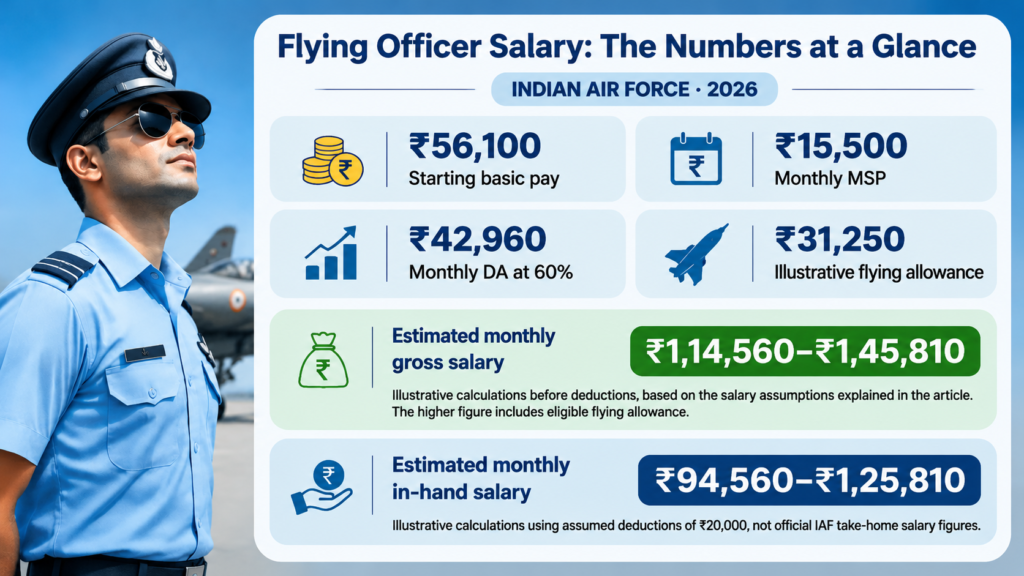
- Basic Pay: ₹56,100 per month.
- Military Service Pay (MSP): ₹15,500 per month.
- Basic Pay + MSP: ₹71,600 per month.
- Dearness Allowance (DA): 60% of basic pay plus MSP, amounting to ₹42,960 per month.
- Flying Allowance: Approximately ₹31,250 per month for eligible Flying Branch officers, subject to applicable Ministry of Defence provisions.
- Estimated Monthly Gross Salary: Approximately ₹1,14,560 without flying allowance and ₹1,45,810 with eligible flying allowance.
These are illustrative gross salary calculations before deductions. The actual amount credited to an officer’s bank account will vary according to applicable taxes, insurance contributions, accommodation-related recoveries, and other deductions.
What is a Flying Officer in the Indian Air Force?
A Flying Officer is the entry-level commissioned officer rank in the Indian Air Force (IAF). Officers holding this rank can serve in the Flying Branch or Ground Duty branches, depending on their specialisation and assigned responsibilities.
A Flying Officer is not necessarily a pilot. The rank identifies the officer’s position in the military hierarchy; the branch identifies their professional duties.
Three aviation terms are worth distinguishing:
- Flying Officer: A commissioned rank in the Indian Air Force.
- Flying Branch Officer: An IAF officer specialising in military flying operations.
- First Officer: A civilian airline pilot who serves as the co-pilot alongside the Captain.
Military and civilian pilot careers also differ in their training pathways, selection procedures, and service requirements. VFTI’s guide to flight school vs. Air Force pilot training compares these two career routes.
These roles also follow different salary structures. An IAF Flying Officer is paid under the Defence Pay Matrix, whereas a civilian airline First Officer receives compensation according to the airline’s employment terms.
The financial commitments also differ between these career paths, as civilian pilot training involves expenses such as flight hours, ground classes and additional qualifications. The cost of pilot training in India and its associated expenses provides further context when comparing these two routes.
Flying Officer Salary Structure in 2026
A newly commissioned Flying Officer enters Level 10 of the Defence Pay Matrix. The IAF’s official pay information confirms the starting basic pay and Military Service Pay (MSP).
| Salary component | Amount or treatment |
| Starting monthly basic pay | ₹56,100 |
| Level 10 basic-pay range | ₹56,100–₹1,77,500 |
| Monthly Military Service Pay (MSP) | ₹15,500 |
| Starting basic pay plus MSP | ₹71,600 |
| Dearness Allowance (DA) | Added at the applicable rate |
| Other allowances | Depends on eligibility, branch, duties and posting |
| In-hand salary | Gross earnings minus applicable deductions |
The upper figure of ₹1,77,500 is the maximum basic pay cell in Level 10. It is not a fresher’s salary or an in-hand amount. Officers normally progress through ranks rather than remain Flying Officers throughout their careers.
What is the Latest Dearness Allowance (DA) for Indian Air Force Officers?
The Ministry of Defence order dated 27 April 2026 increased Dearness Allowance (DA) for Armed Forces personnel from 58% to 60%, effective from 1 January 2026. This is the verified military DA rate used in the salary calculations below.
Under the Air Force Officers Pay Rules, 2017, Military Service Pay (MSP) is included when calculating DA. For a newly commissioned Flying Officer, the calculation is:
₹56,100 (basic pay) + ₹15,500 (MSP) = ₹71,600
₹71,600 × 60% = ₹42,960 monthly DA
The Finance Ministry subsequently announced a DA increase to 63%, effective from 1 July 2026. However, its order requires separate implementation orders for Armed Forces personnel.
Therefore, the 60% rate is the documented basis for the calculations in this article.
How much is the Flying Allowance for IAF Pilots in 2026?
The applicable monthly flying allowance is ₹31,250, subject to eligibility and the relevant Ministry of Defence provisions.
The official Gazette allowance matrix records the original ₹25,000 rate. The September 2026 Gazette notification provides for a 25% enhancement following the applicable DA threshold change.
The calculation is:
₹25,000 × 1.25 = ₹31,250 per month
Flying allowance should be listed separately when calculating an officer’s gross salary. It should not automatically be included in the DA calculation for every salary component.
What is the Flying Officer In-Hand Salary Per Month?
The estimated monthly in-hand salary of an Indian Air Force Flying Officer ranges from approximately ₹94,560 to ₹1,25,810.
There is no single official in-hand salary that applies to every Flying Officer. The actual amount credited to an officer’s bank account depends on their branch, posting, eligible allowances, accommodation arrangements, and applicable deductions.
The general salary calculation is:
In-hand salary = basic pay + MSP + DA + admissible allowances − deductions
Flying Officer In-Hand Salary Breakdown: With and Without Flying Allowance
The following examples use entry-level basic pay and the verified 60% DA rate. Example B includes an assumed eligible flying allowance of ₹31,250 per month. Housing, transport, technical, and other allowances are excluded. Total deductions of ₹20,000 are assumed only to demonstrate the calculation.
| Monthly salary component | Example A: Without flying allowance | Example B: Eligible flying allowance |
| Basic pay | ₹56,100 | ₹56,100 |
| MSP | ₹15,500 | ₹15,500 |
| DA at 60% of basic pay plus MSP | ₹42,960 | ₹42,960 |
| Flying allowance | ₹0 | ₹31,250 |
| Gross earnings in this example | ₹1,14,560 | ₹1,45,810 |
| Assumed total deductions | ₹20,000 | ₹20,000 |
| Illustrative in-hand amount | ₹94,560 | ₹1,25,810 |
These are illustrative calculations, not authenticated IAF payslips or guaranteed salary packages. The ₹20,000 deduction is hypothetical, and the flying allowance is subject to applicable eligibility conditions.
The table demonstrates why a statement such as “every Flying Officer receives ₹1 lakh in hand” is unreliable. A useful estimate must identify the pay components and deductions behind the number.
Which Deductions Affect an IAF Flying Officer’s In-Hand Salary?
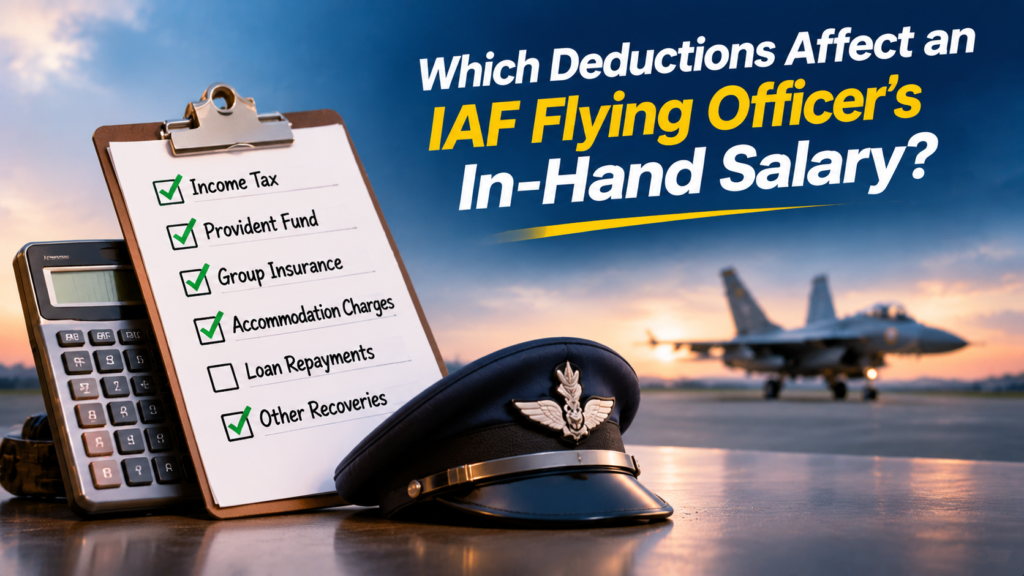
An Indian Air Force Flying Officer’s take-home salary may be reduced by several deductions, depending on individual circumstances. These can include:
- Income tax: Tax deducted according to applicable income-tax rules.
- Provident fund contributions: Where applicable under the officer’s service arrangements.
- Group insurance: Contributions towards applicable service insurance schemes.
- Accommodation charges: Recoveries where applicable.
- Loan repayments: Instalments deducted from salary, where authorised.
- Other recoveries: Additional deductions permitted under service rules.
The Pension Fund Regulatory and Development Authority identifies Armed Forces personnel as an exception to the mandatory central-government National Pension System (NPS) framework. Automatically inserting a civilian NPS deduction into an IAF salary estimate can produce an incorrect result.
What is the Annual Salary of a Flying Officer?
The annual salary of an Indian Air Force Flying Officer depends on basic pay, Military Service Pay (MSP), Dearness Allowance (DA), and other eligible allowances.
At unchanged entry-level pay rates, the annual calculations are:
- Annual Basic Pay + MSP: ₹71,600 × 12 = ₹8,59,200.
- Annual Gross Salary (without flying allowance): ₹1,14,560 × 12 = ₹13,74,720.
- Annual Gross Salary (with eligible flying allowance): ₹1,45,810 × 12 = ₹17,49,720.
The gross salary examples use the assumed 60% DA rate and the illustrative flying allowance of ₹31,250 per month. They exclude HRA, transport, and other additional payments, as well as deductions.
Actual annual earnings may vary because of joining dates, salary increments, DA revisions, promotions, postings and changes in allowance eligibility. Annual allowances, reimbursements and arrears should also be calculated separately.
These figures represent illustrative annual gross earnings and not guaranteed annual take-home salaries or official IAF salary packages.
Has the 8th Pay Commission Changed Flying Officer Salary?
No confirmed 8th Pay Commission salary revision for Indian Air Force Flying Officers has been established. The available 2026 IAF recruitment notifications continue to specify salary under the 7th Central Pay Commission (7th CPC) structure.
The 8th Central Pay Commission’s official updates describe its ongoing work. However, a revised Flying Officer pay matrix and its implementation details have not been officially confirmed.
Salary figures circulating online based on estimated fitment factors or projected pay increases should therefore be treated as forecasts and not confirmed salaries.
Any change to Flying Officer pay will need to be supported by official government notifications specifying the revised pay structure, applicable allowances, and implementation date. Until then, the existing 7th CPC pay structure remains the reference for the salary calculations.
How Does Salary Differ Between Flying Branch and Ground Duty Flying Officers?
The starting basic pay of Indian Air Force officers is determined by their rank and pay level, not simply by whether they belong to the Flying Branch or Ground Duty. However, additional allowances can create differences in total monthly earnings.
- Flying Branch: Eligible pilots may receive additional flying allowances.
- Ground Duty Technical: Eligible officers may receive technical allowances.
- Ground Duty Non-Technical: Additional earnings depend on the officer’s appointment, duties and posting.
The IAF’s official pay and allowance information explains the different allowances available to officers. Holding the rank of Flying Officer does not automatically make every allowance payable.
HRA, Transport and Other Allowances for IAF Officers
In addition to basic pay, MSP and eligible branch-specific allowances, Indian Air Force officers may receive other payments depending on their accommodation, location, duties and service entitlements.
House Rent Allowance (HRA) and Government Accommodation
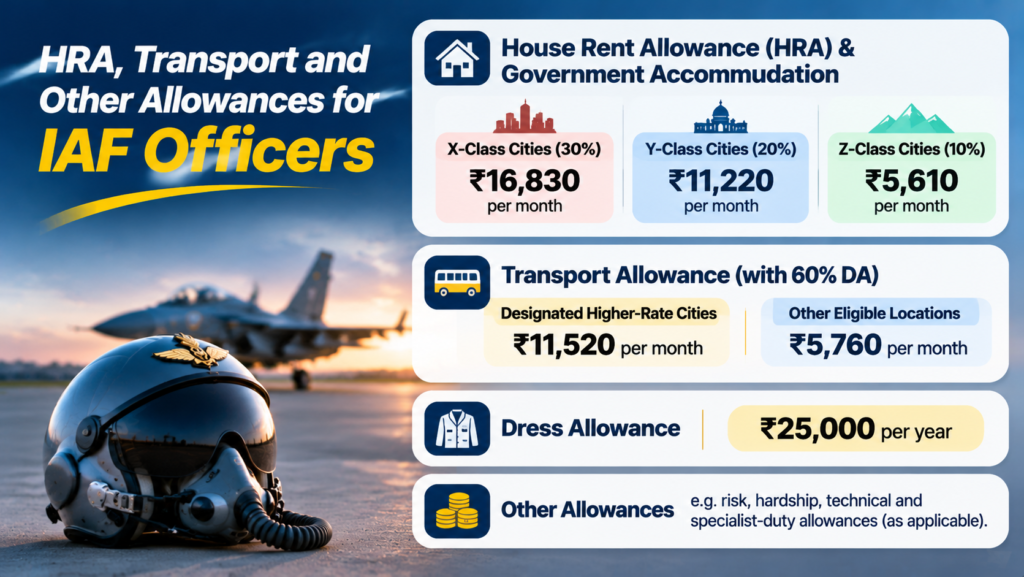
The Defence Ministry’s HRA order specifies different HRA rates for X, Y and Z-classified cities, subject to the applicable eligibility conditions.
At a monthly basic pay of ₹56,100, the illustrative HRA amounts are:
- X-class cities (30%): ₹16,830 per month, including Delhi, Mumbai, Kolkata, Chennai, Bengaluru, Hyderabad, Pune and Ahmedabad (Gujarat).
- Y-class cities (20%): ₹11,220 per month, including Jaipur, Lucknow, Bhopal, Chandigarh, Srinagar, Surat and Vadodara.
- Z-class cities (10%): ₹5,610 per month, including Udaipur, Jaisalmer, Baramulla, Anantnag, Kargil and other eligible smaller cities and towns
These calculations are based on basic pay.
HRA is not automatically payable to every officer. Government accommodation and the applicable service entitlement rules must be considered before including it in a salary calculation.
Transport, Dress and Posting-Related Allowances
The published service conditions in the September 2026 Gazette specify the following transport allowance rates for eligible officers:
- Designated higher-rate cities: ₹7,200 plus DA.
- Other eligible locations: ₹3,600 plus DA.
Using a 60% DA calculation, these amounts become ₹11,520 and ₹5,760 per month, respectively.
Dress allowance is paid annually rather than monthly. The notified base amount of ₹20,000, after a 25% enhancement, becomes ₹25,000 per year.
Other payments may include risk and hardship allowances, technical allowances, and specialist-duty allowances. These depend on the officer’s actual duties, appointment, and eligibility.
Not every officer receives all these allowances simultaneously.
How does Flying Officer Salary Increase with Promotion?
Salary progression involves movement through pay-matrix cells, promotion to higher ranks, and changes in eligible allowances.
The IAF’s published rank-wise pay table gives the following basic-pay ranges:
| Rank | Pay level | Monthly basic-pay range |
| Flying Officer | 10 | ₹56,100–₹1,77,500 |
| Flight Lieutenant | 10B | ₹61,300–₹1,93,900 |
| Squadron Leader | 11 | ₹69,400–₹2,07,200 |
| Wing Commander | 12A | ₹1,21,200–₹2,12,400 |
| Group Captain | 13 | ₹1,30,600–₹2,15,900 |
| Air Commodore | 13A | ₹1,39,600–₹2,17,600 |
| Air Vice Marshal | 14 | ₹1,44,200–₹2,18,200 |
| Air Vice Marshal (HAG Scale) | 15 | ₹1,82,200–₹2,24,100 |
| HAG+Scale | 16 | ₹2,05,400–₹2,24,400 |
| VCAS / AOC-in-C / Air Marshal | 17 | ₹2,25,000 |
| Chief of the Air Staff (CAS) | 18 | ₹2,25,000 |
These are monthly basic-pay ranges, excluding MSP, DA, and other allowances.
The Indian Air Force specifies the following minimum service periods before a flying officer can be considered for promotion:
- Flight Lieutenant: After completing 2 years of service.
- Squadron Leader: After completing 6 years of service.
- Wing Commander: After completing 13 years of service.
Officers must also meet the applicable promotion and selection requirements. Completing these years of service does not guarantee automatic promotion.
This is why a search such as “Flying Officer salary after five years” does not have one fixed answer. An officer’s earnings depend on their current rank, basic-pay level, and eligible allowances, rather than simply the number of years served.
Civilian airline pilots follow a different salary progression based on their rank, aircraft type and flying experience. The pilot salary structure in India across CPL and ATPL qualifications and different airline positions provides a useful comparison with military officer pay.
Do Flying Officers receive a Pension after Retirement?
Whether a Flying Officer receives a pension after leaving the Indian Air Force depends on the type of commission and the applicable service rules. Not every IAF officer is eligible for a regular service pension.
According to the AFCAT 02/2026 notification, Short Service Commission (SSC) officers are not entitled to a regular service pension. The service period is:
- Flying Branch SSC: 14 years from the date of commissioning.
- Ground Duty SSC: 10 years initially, with a possible four-year extension subject to applicable conditions.
Permanent Commission (PC) officers follow different retirement rules. According to the Ministry of Defence’s pension guidance, a commissioned officer generally requires at least 20 years of qualifying service to become eligible for a service pension, subject to applicable rules and exceptions.
An SSC officer may be considered for Permanent Commission under specified conditions, but this change is not automatic or guaranteed.
Before joining the IAF, candidates should check:
- Commission type: Whether the entry offers SSC or PC.
- Service commitment: The required period of service.
- Retirement benefits: Whether the commission provides pension eligibility.
- Future opportunities: Whether a change from SSC to PC is possible and what conditions apply.
The distinction matters: Completing the 14-year Flying Branch SSC engagement does not automatically make an officer eligible for a regular service pension. Understanding the commission terms is essential when comparing long-term career benefits.
What Benefits and Perks do Indian Air Force Flying Officers receive?
An Indian Air Force career offers several benefits beyond monthly salary. These include accommodation, medical facilities, leave entitlements, travel concessions, educational opportunities, and insurance coverage. The actual benefits depend on eligibility, service conditions and applicable schemes.
Accommodation, Medical Facilities and Family Benefits
Eligible IAF officers receive access to service accommodation and medical facilities for themselves and their eligible family members or dependants. These facilities can help reduce household expenses, although availability and entitlement depend on service conditions.
The IAF also provides access to school facilities, Canteen Stores Department (CSD) facilities, sporting amenities and educational opportunities under its official service benefits.
These benefits should be considered separately from monthly salary rather than treated as additional cash payments.
Annual Leave and Travel Benefits
Indian Air Force officers are entitled to 60 days of annual leave and 20 days of casual leave, along with applicable leave travel concessions.
However, leave is subject to approval and operational requirements. Officers cannot assume unrestricted flexibility when choosing their leave dates.
Educational support and study leave may also be available under specific schemes, depending on the officer’s career stage and eligibility.
Life Insurance and Financial Protection
The AFCAT 02/2026 notification specifies ₹1.25 crore of contributory insurance cover for death while in service through the Air Force Group Insurance Society (AFGIS).
This insurance provides financial protection to eligible beneficiaries. However, it is not part of an officer’s annual salary or monthly earnings. Insurance contributions and policy conditions should be considered separately from the stated coverage amount.
Indian Air Force vs Commercial Airline Pilot: Which Career Should You Choose?
Choosing between an Indian Air Force career and a commercial airline career involves more than comparing salaries. Both offer different professional opportunities, responsibilities, working environments, and long-term commitments.
Retired Group Captain P. S. Arora discussed the differences between military and commercial aviation in a 2011 interview.
An Indian Air Force career involves military service, operational duties, postings and service commitments. Commercial airline pilots, on the other hand, work under airline-specific recruitment processes, employment contracts, aircraft qualifications and career progression structures.
The training pathways also differ. VFTI’s comparison of flight school vs Air Force pilot training explains the differences in eligibility, selection and training requirements.
A civilian aviation career can begin with professional pilot qualifications through Commercial Pilot Licence training course, followed by the applicable licensing, training and airline recruitment requirements.
The civilian route involves several stages of professional preparation, including ground school, practical flying and licensing requirements. These stages are covered in VFTI’s guide to commercial pilot training programmes in India.
Check your academic and medical eligibility, understand the training requirements, and request a current, itemised fee breakdown before enrolling.