
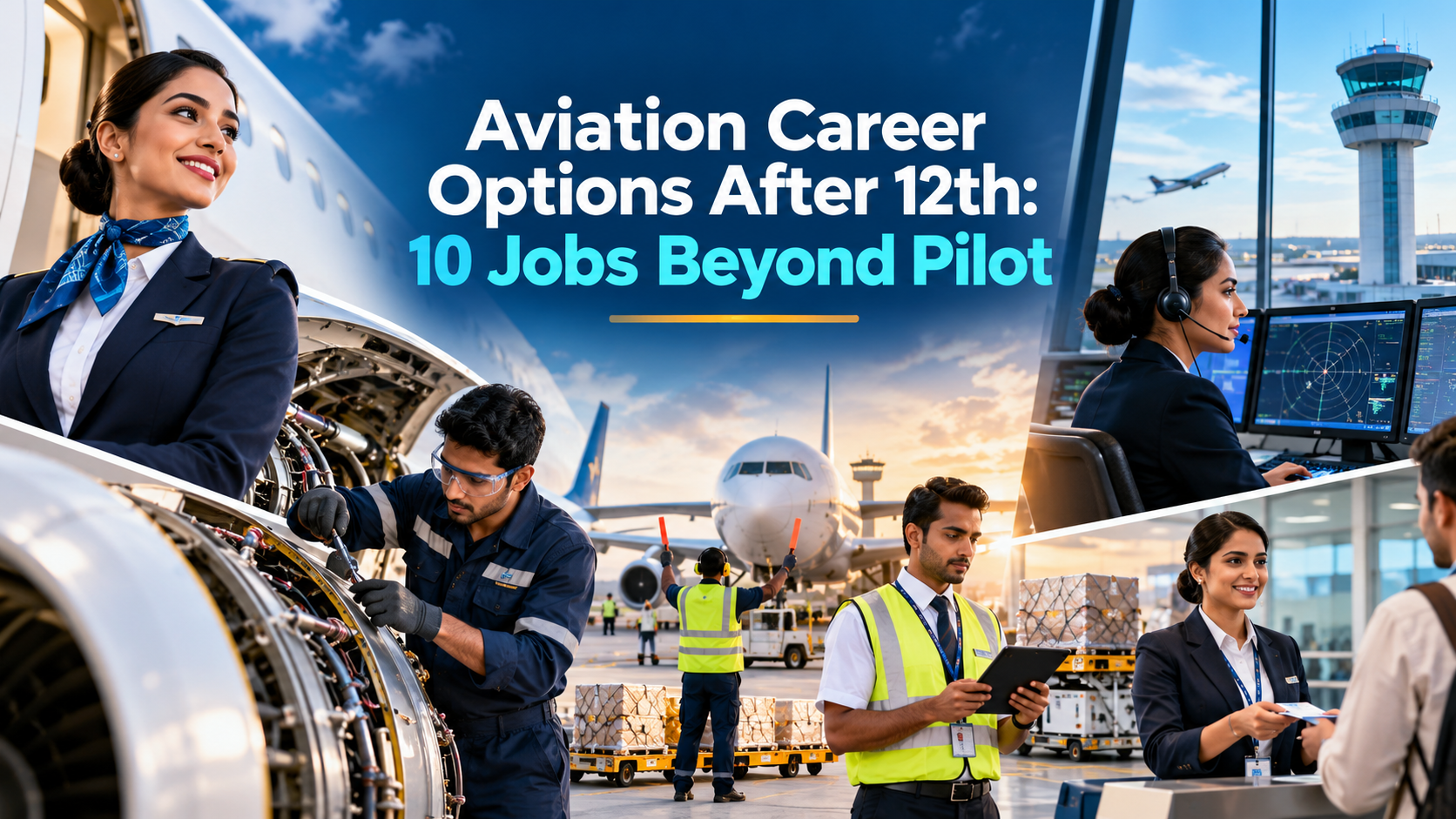
Aviation Career Options After 12th: 10 Jobs Beyond Pilot
pgvisav@gmail.com
October 31, 2026
•15 min read
Aviation career options after Class 12 in India include cabin crew, passenger services, ticketing, cargo operations, ramp operations, aircraft maintenance, air traffic control and aviation engineering. While some airlines and employers recruit Class 12 graduates for entry-level positions, other careers require a university degree, specialised training, practical experience or regulatory approval.
This distinction is important when choosing an aviation course. Getting admission to an aviation training programme does not automatically qualify you for a job after completing it.
Start by identifying the type of work you want to pursue, then check the qualifications, training, and experience required to enter that profession.
Which Aviation Careers Can You Explore After Class 12th?
The following table compares popular aviation career paths, highlighting which roles may offer entry-level opportunities after Class 12 and which require additional qualifications, specialised training or professional licensing. Actual eligibility depends on the employer, institution and applicable recruitment requirements.
| Career option | Route to investigate after Class 12 |
| Cabin crew | Airline recruitment followed by required training |
| Airport passenger service agent | Eligible junior vacancies or further study where required |
| Airline reservation and ticketing agent | Reservation-system skills and employer-specific selection |
| Air cargo operations assistant | Cargo or logistics training and suitable entry-level vacancies |
| Ramp operations staff | Role-specific training; technical or driving qualifications where required |
| Airport operations executive | Relevant further study and operational experience |
| Flight dispatcher | Specialised training, supervised experience and applicable approval |
| Aircraft maintenance engineer | Relevant training, examinations, experience and DGCA licensing |
| Air traffic controller | Eligible science or engineering degree, recruitment and subsequent training |
| Aerospace or aeronautical engineer | Relevant engineering degree and technical specialisation |
Airport jobs are offered by different organisations, including airlines, airport operators, ground-handling companies and independent service providers. Before applying, check who the actual employer is and which organisation will issue your employment contract.
1. Cabin Crew

Cabin crew looks after passenger safety, onboard service, and assistance throughout a flight. Their responsibilities include conducting safety checks, following emergency procedures, assisting passengers, and responding calmly when something goes wrong.
Class 12 can meet the educational requirement for entry-level cabin crew recruitment. Air India’s cabin crew criteria, for example, specify Class 12 with at least 50% marks, alongside age, communication, physical, and medical conditions.
A private cabin crew diploma is not listed as a mandatory qualification. Candidates who successfully clear the airline’s selection process must complete the required airline training before beginning operational duties.
This role suits people who enjoy helping others and can remain composed during irregular hours, difficult conversations, and demanding situations.
2. Airport Passenger Service Agent
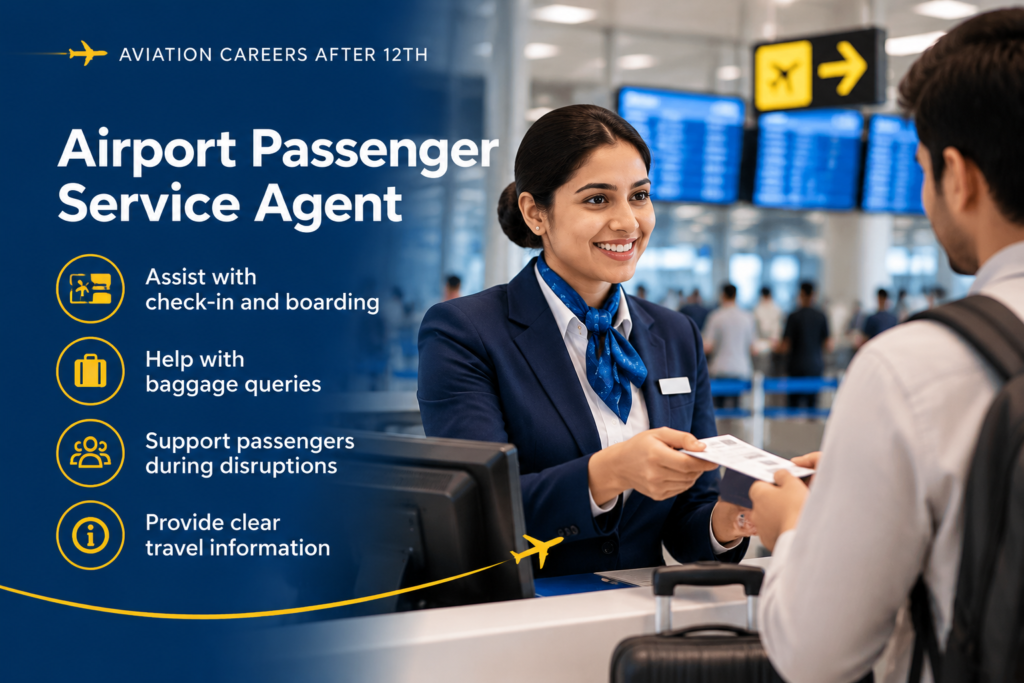
Airport passenger service agents assist travellers with check-in, boarding, baggage-related queries, and flight disruptions. Their responsibilities involve communicating travel information, coordinating with airline teams and helping passengers navigate airport procedures.
Some entry-level passenger service positions accept Class 12 graduates, while other customer service vacancies require a university degree. The Ministry of Civil Aviation’s career guidance provides information about different aviation roles and their entry requirements.
Check the exact job title instead of assuming every “ground staff” vacancy has the same eligibility.
You may enjoy this work if you communicate clearly, use computers confidently, and can handle queues without losing patience.
3. Airline Reservation and Ticketing Agent

Airline reservation and ticketing agents help customers book flights, understand fare conditions, and manage changes or cancellations. They may work in airline offices, contact centres, travel agencies or other booking-related businesses.
Accuracy is essential. A booking error can affect a passenger’s journey and create additional costs.
The Aviation and Aerospace Skill Development Council’s job-role list includes airline reservation agent among its Class 12 entry pathways. Individual employers may specify additional qualifications or experience.
A useful reservation and ticketing course should include practical training with reservation systems and cover fare rules, booking records, ticket modifications, and cancellation procedures. Before enrolling, ask which systems and software you will actually use during training.
4. Air Cargo Operations Assistant
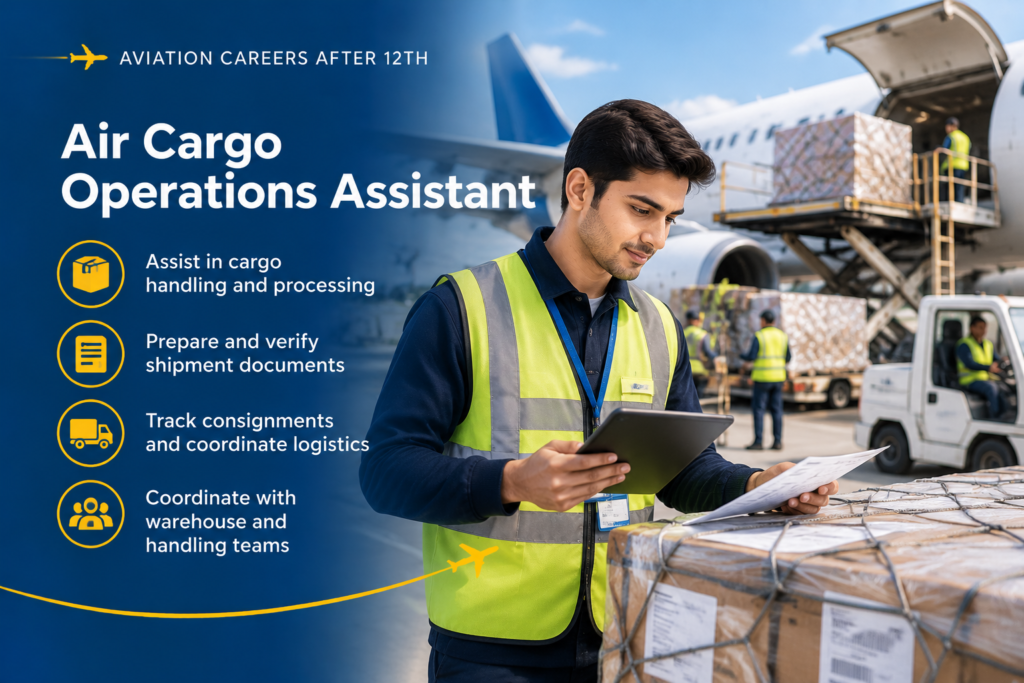
Air cargo operations assistants support the movement of goods through air transport networks. Depending on their position, responsibilities may include preparing shipment documentation, tracking consignments, coordinating warehouse activities, and communicating with customers and handling teams.
This career involves organised logistical work, accurate documentation, and attention to shipment deadlines. It may suit candidates who prefer operational coordination over continuous passenger interaction.
Entry requirements vary between cargo support, documentation, warehouse and supervisory positions. Review actual recruitment notices before choosing a logistics or cargo-handling course.
Ask training providers whether their programmes cover shipment documentation, cargo handling procedures, warehouse operations and any function-specific training required for assigned duties, including dangerous goods training where applicable.
5. Airport Ramp Operations Staff
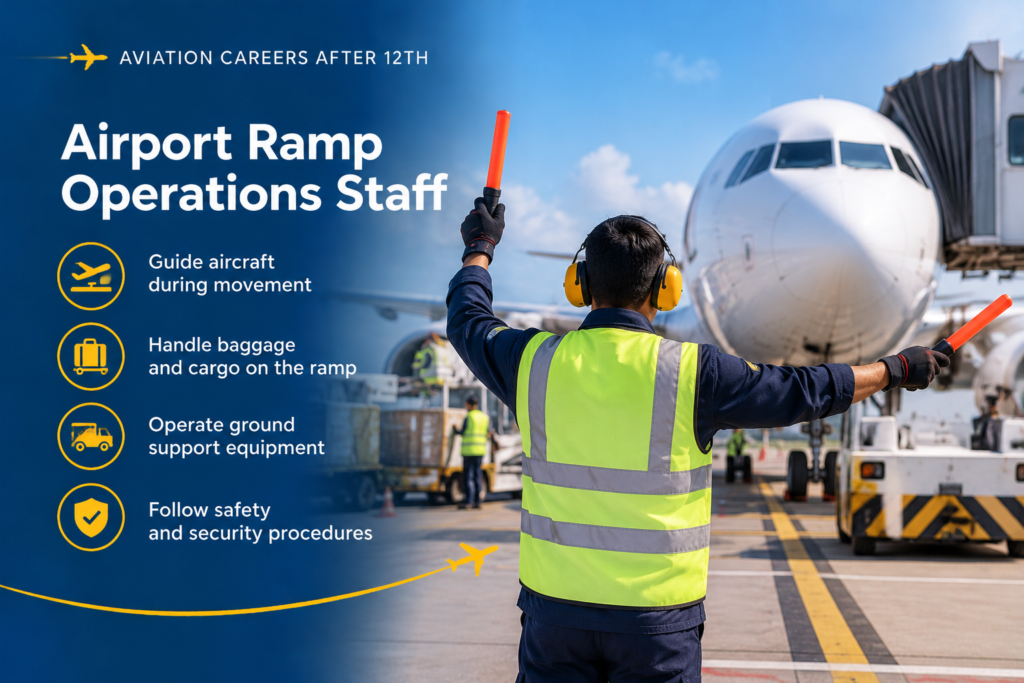
The ramp is the area where aircraft are parked and serviced between flights. Ramp teams support activities such as baggage movement, loading and coordination around the aircraft.
This is a safety-sensitive operational environment that requires employees to follow airport procedures. Equipment operation requires appropriate training and authorisation.
The term ‘ramp staff’ covers several different positions. An AI Airport Services Limited recruitment advertisement, for example, distinguishes technical ramp-service posts from other handling positions and specifies trade and driving requirements. That historical notice illustrates the differences.
Read duties and qualifications together before applying.
6. Airport Operations Executive
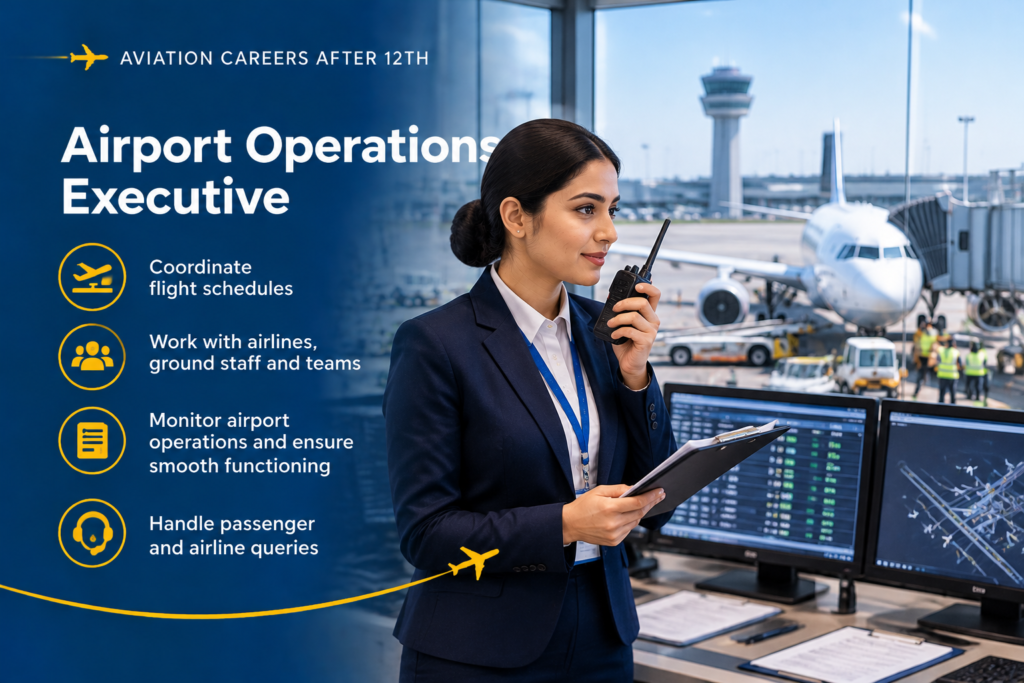
Airport operations executives support the coordination of activities across airport terminals, facilities and operational departments. Depending on the department, work may involve monitoring airport facilities, coordinating resources, communicating operational disruptions and following up with different service teams.
A relevant degree can help you pursue this pathway, but an “airport management” course does not automatically make you an airport manager.
Senior operational positions generally require relevant industry experience. A GMR Airport Operations Control Centre duty-manager advertisement illustrates this by requiring graduation and substantial relevant aviation experience.
Candidates should identify realistic entry-level positions and understand how responsibilities and qualifications develop with experience.
7. Flight Dispatcher
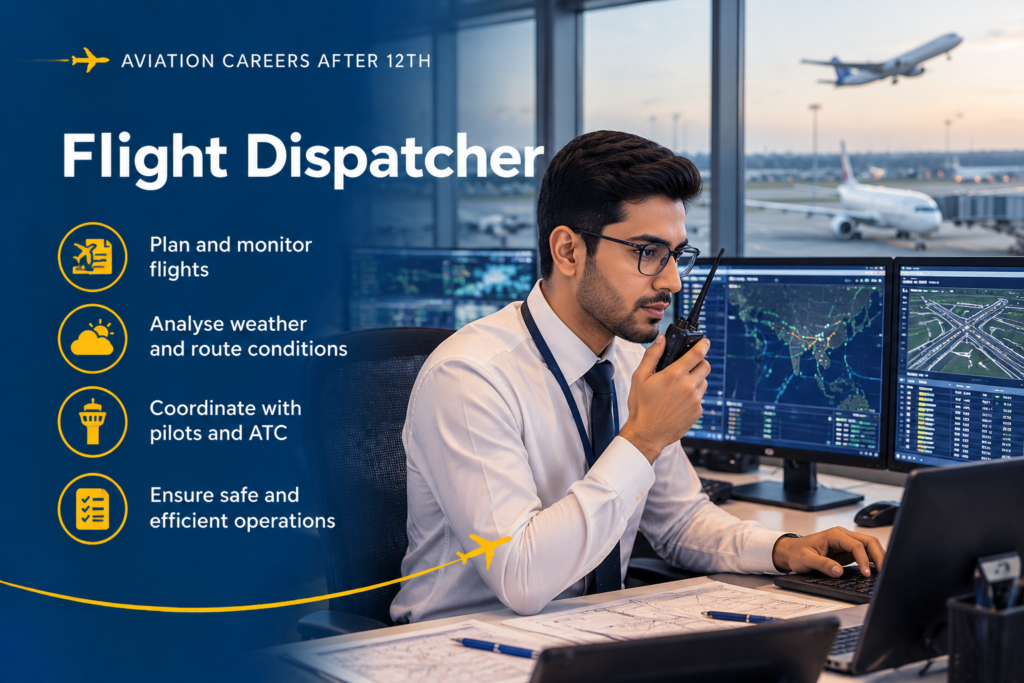
Flight dispatchers support airline flight planning and operational monitoring. Their responsibilities involve working with information such as weather conditions, flight routes, aircraft operating requirements, and other factors relevant to safe flight operations.
However, becoming a qualified flight dispatcher involves prescribed knowledge, training, supervised experience, and the applicable Directorate General of Civil Aviation (DGCA) requirements. A general airport management certificate does not automatically establish dispatcher qualification.
The pathway includes prescribed knowledge, training, supervised experience, and applicable Directorate General of Civil Aviation (DGCA) approvals. A general airport-management certificate does not establish dispatcher qualification.
Before enrolling in a programme, ask the training provider to explain the complete route from course admission to operational approval, including who provides practical experience. The Ministry’s flight-dispatch career guidance provides further information about flight dispatch and its professional requirements.
8. Aircraft Maintenance Engineer
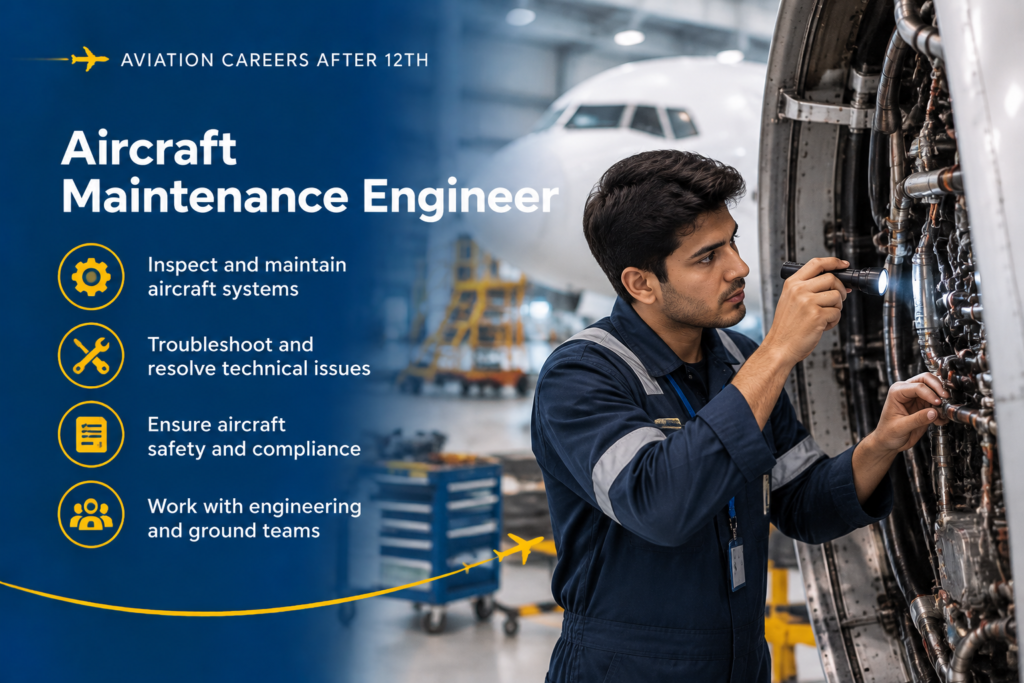
Aircraft maintenance engineers work with aircraft systems, inspections, defects and maintenance records. The career suits students who enjoy technical problem-solving and careful practical work.
However, completing an AME course does not automatically grant a DGCA AME licence. Under DGCA CAR-66, applicants must meet the applicable knowledge, examination, practical experience and other licensing requirements.
An engineering degree alone also does not provide the authority to certify aircraft maintenance. The relevant licence privileges, aircraft ratings and maintenance organisation authorisations determine the scope of certification.
VFTI’s guide to aircraft maintenance, repair and overhaul introduces the maintenance organisations, workplaces and technical activities associated with this career.
9. Air Traffic Controller (ATC)
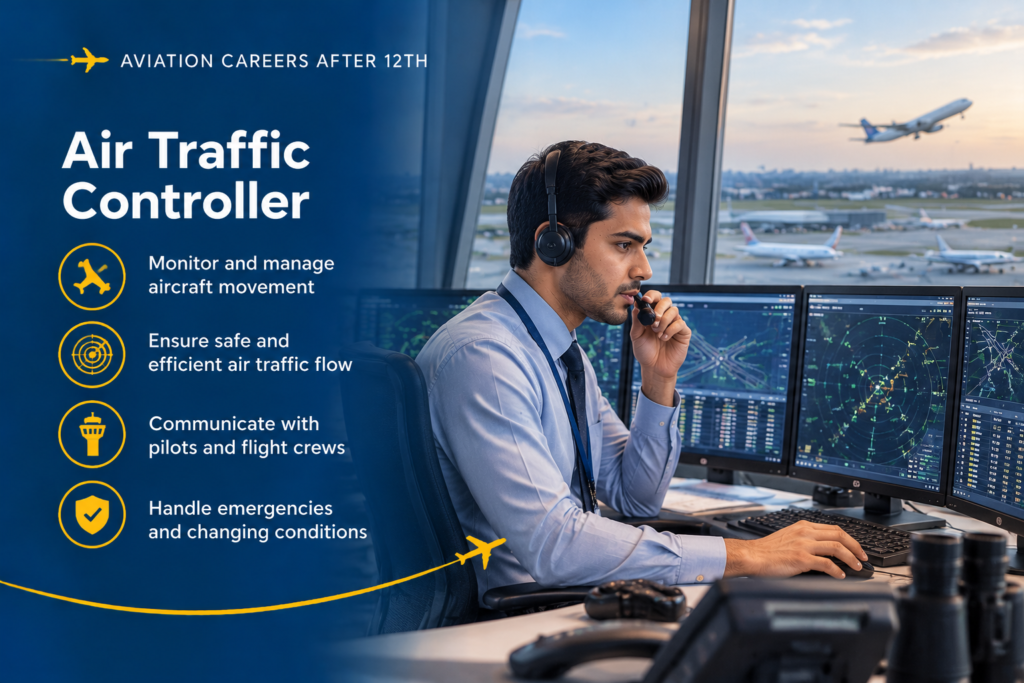
Air Traffic Controllers coordinate aircraft movements, issue clearances and maintain the required separation between aircraft. They work with pilots and other aviation professionals to manage air traffic safely and efficiently.
This is a career that students can prepare for after Class 12, but a Class 12 qualification alone is not sufficient for the usual Airports Authority of India (AAI) Junior Executive (Air Traffic Control) recruitment route.
AAI recruitment specifies relevant science or engineering degree qualifications, followed by the applicable selection and training process.
Check the educational requirements and subject combinations in the latest recruitment notification before selecting an undergraduate programme. The AAI recruitment dashboard provides official recruitment information.
The work demands sustained concentration, clear communication, disciplined decision-making and the ability to manage demanding operational situations.
10. Aerospace or Aeronautical Engineer
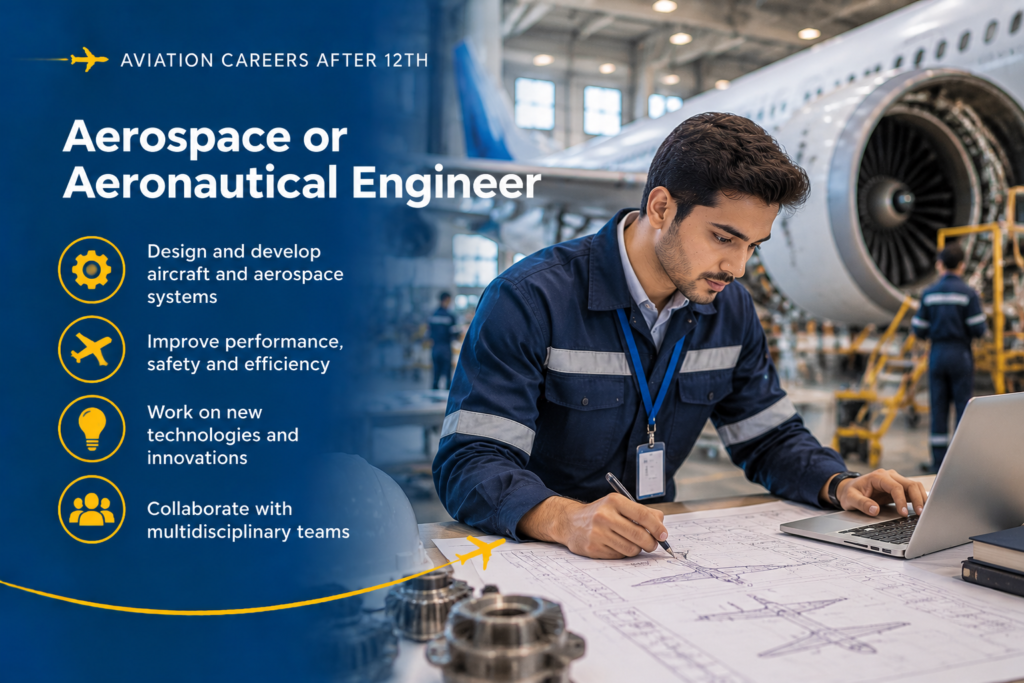
Aerospace and aeronautical engineers work on the design, development, analysis, testing and improvement of aircraft and related systems. Depending on their specialisation, they may work with aircraft structures, propulsion systems, aerodynamics, materials or manufacturing processes.
A relevant engineering degree is the usual academic pathway into this profession. Opportunities can also involve mechanical, electrical or electronics engineering, depending on the position.
This career is different from licensed aircraft maintenance. Designing or analysing an aircraft component and certifying completed aircraft maintenance involve separate responsibilities and qualification pathways.
Before choosing an engineering degree, review its curriculum, laboratory facilities, technical projects, and industry connections. An aviation-related course title alone does not establish whether a programme is suitable for your intended engineering role.
Which Aviation Career is Best for Girls After Class 12 in India?
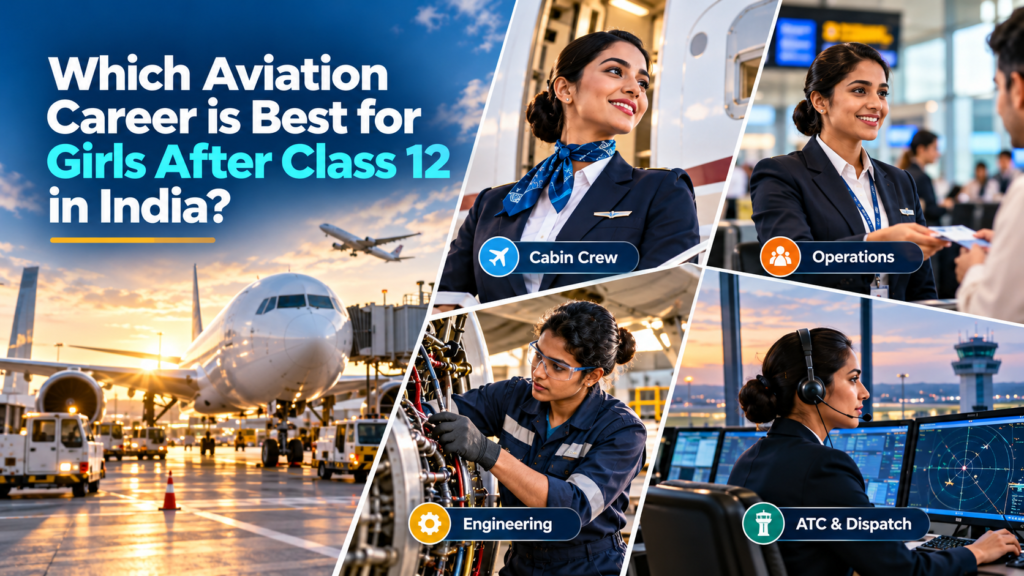
There is no single aviation career that is best for every girl. Women can pursue opportunities across the aviation industry, including cabin crew, airport operations, aircraft maintenance, aerospace engineering, air traffic control, flight dispatch, and cargo management.
The right career depends on your interests, qualifications, and the kind of work environment you prefer.
- Enjoy communication and customer service? Cabin crew and airport passenger service roles may suit you.
- Interested in technology and aircraft systems? Consider aircraft maintenance and aerospace engineering.
- Good at planning and decision-making? Air traffic control and flight dispatch may be worth considering.
- Prefer coordination and logistics? Look into cargo operations, reservation services, and airport management.
What Should Girls Consider Before Choosing an Aviation Career?
Beyond salary and job title, consider the practical aspects of working in aviation:
- Working hours: Check shift patterns, night duties, and weekly schedules.
- Safety and transport: Ask about staff transport for early morning or late-night shifts.
- Location and accommodation: Consider relocation, hostel availability and living expenses.
- Workplace support: Understand employee facilities, reporting channels and policies for addressing workplace concerns.
- Career progression: Ask about opportunities for promotions, specialisation and further qualifications.
Medical, physical and educational requirements vary between aviation careers. Always check the relevant recruitment notice rather than assuming cabin crew eligibility conditions apply to technical or operational positions.
The best aviation career is one that matches your abilities, interests, and long-term professional goals.
Which Aviation Courses Can You Pursue After Class 12 Without Maths?
Not studying Mathematics in Class 12 does not mean you have to give up on an aviation career. Several pathways may be available, including cabin crew, airline reservation and ticketing, passenger services, and certain cargo-support positions. Some airport operations roles may also become accessible through further education or specialised training.
For example, Air India’s cabin crew eligibility criteria specify Class 12 with at least 50% marks without listing Mathematics as a compulsory subject. Candidates must still meet the airline’s age, communication, physical, medical, and other selection requirements.
However, academic requirements differ across aviation professions. Students without Class 12 Mathematics should not assume they qualify for every technical or operational programme. Air traffic control recruitment, for example, specifies particular science or engineering qualifications, while aircraft maintenance and engineering pathways have their own subject and admission requirements.
Before enrolling, check the eligibility criteria of the actual course and the recruitment requirements of your intended employer. A general aviation diploma cannot replace compulsory Physics, Mathematics or engineering qualifications where these are specified.
Even when Mathematics is not a formal entry requirement, basic numeracy remains useful. Practise percentages, time calculations, spreadsheet operations, and checking figures accurately. These skills can help with flight reservations, fare calculations, shipment records, and everyday airport operations.
How Should You Choose an Aviation Career After 12th?
Choosing an aviation career after Class 12 involves more than selecting a popular job title. Consider the nature of the work, qualifications required, working environment, and training investment before deciding which pathway suits you.
Match the aviation work to your strengths
Different aviation careers require different strengths. Cabin crew and passenger service roles involve communication, customer assistance, and teamwork. Cargo and reservation positions require organisation, accuracy and attention to detail. Aircraft maintenance and engineering involve technical knowledge, while flight dispatch and air traffic control demand concentration and operational decision-making.
Consider the working environment as well. Shift duties, relocation, outdoor assignments, irregular schedules, and time away from home can influence whether a particular role suits your expectations.
Check the aviation job eligibility before paying for the course
Collect three official advertisements for the role you want. Compare their educational requirements, experience conditions, and selection stages.
Then ask the training provider:
- Which specific recruitment or qualification requirement does this course help me meet?
- Will I receive a certificate, university degree, or preparation for a regulated professional qualification?
- What practical training and industry exposure are included?
- Which examinations, approvals, or experience requirements will remain after completing the programme?
- What is the complete course fee, and what are the withdrawal and refund conditions?
VFTI’s questions to ask before paying flight-school fees focus on pilot training, but its advice on written course inclusions, refund policies and career-support claims is also useful when evaluating other aviation training investments.
Build skills required for aviation jobs
Build skills that employers can assess during recruitment and on the job. Practise clear English, professional email writing, basic spreadsheets and accurate record-keeping. Prepare examples that demonstrate how you handled responsibility, resolved a problem, supported a team or communicated during a difficult situation. These examples can help you respond more confidently during interviews and practical assessments.
VFTI’s article on skills assessed during pilot recruitment also explains communication and professional conduct, although technical selection requirements differ across careers.
Choose the Job Before Choosing the Course
Shortlist two careers, read their recruitment requirements and calculate the cost of becoming eligible. That gives your course search a clear purpose.
VFTI specialises in pilot training and ground classes. If flying remains on your shortlist alongside these alternatives, ask VFTI about the CPL training pathway so you can compare its requirements and financial commitment before making your decision.
Frequently Asked Questions
- Can Arts and Commerce students work in aviation?
Yes. Cabin crew, reservations, and some passenger-service or cargo roles offer routes that do not universally require a science background.
- Is an aviation diploma compulsory for every airport job?
No. Requirements depend on the role. Some employers recruit eligible candidates directly and provide job-specific training; others require a degree, technical qualification or experience.
- Which non-pilot aviation job pays the most?
There is no reliable single answer across these careers. Experience, employer, location, allowances, and responsibility affect earnings. Compare equivalent career stages and written salary components rather than a senior specialist’s package with a trainee’s pay.